
Building AI as the Next Digital Public Infrastructure (DPI) | Current Affairs | Vision IAS

Upgrade to Premium Today

Start Now
MENU
Home
Quick Links

High-quality MCQs and Mains Answer Writing to sharpen skills and reinforce learning every day.

Watch explainer and thematic concept-building videos under initiatives like Deep Dive, Master Classes, etc., on important UPSC topics.

A short, intensive, and exam-focused programme, insights from the Economic Survey, Union Budget, and UPSC current affairs.

ESC

In Summary

  • Digital Public Infrastructure (DPI) approach democratizes AI by building shared, standards-based layers for enhanced access, interoperability, and trust.
  • Challenges include capacity gaps in data centers and compute, energy constraints, high entry barriers, uneven AI adoption, and data governance under the DPDP Act, 2023.
  • Recommendations involve AI-DPI enablers (people, infrastructure, governance), treating AI assets as Digital Public Goods (DPGs), expanding compute access, building shared data repositories, and supporting indigenous AI development.

In Summary

DPI approach offers one way to democratise access to AI infrastructure by building shared, standards-based layers that enhance access, interoperability, accountability, and trust.
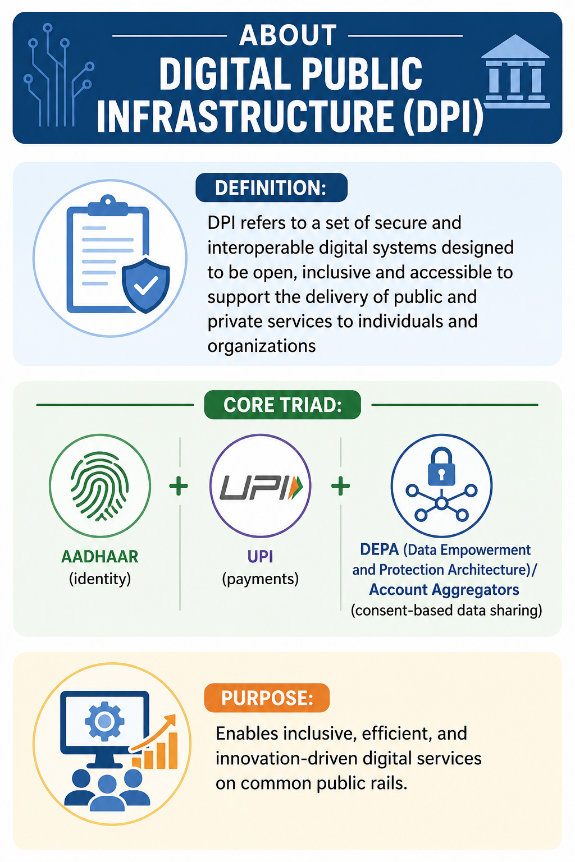
Need for DPI Approach for AI Development 

  • Reduce AI Dependence and enhance Digital Sovereignty: Build domestic AI capabilities to reduce reliance on costly foreign AI services.
  • Democratise AI: Open compute, datasets, and models enable startups, MSMEs, and researchers.
  • Smarter Governance: Enables predictive public services, fraud detection, and better policy delivery.
    • E.g. multilingual, voice-based AI for last-mile governance.

Challenges

  • Capacity Gaps: India generates ~20% of global data but has only ~3% of data centre capacity and <5% of AI compute; infrastructure concentrated in Tier-1 cities.
  • Energy Constraints: AI infrastructure requires expansion of electricity and cooling systems.
  • High Entry Barriers: Expensive GPUs, TPUs, and HPC limit access for startups and research institutions.
  • Uneven AI Adoption: Slow in agriculture, public services etc.
  • Data Governance: Ensuring privacy, interoperability, and security under the DPDP Act, 2023.

Recommendations

AI-DPI Enablers: People (AI skilling), Infrastructure (cloud, GPUs), and Governance (Responsible AI & DEPA).

  • Adopt DPI & DPG Approach: Treat AI datasets, compute, and model hubs as Digital Public Goods (DPGs).
  • Expand Compute Access: Under IndiaAI Mission, National Supercomputing Mission and India Semiconductor Mission.
  • Build Shared Data Repositories: Expand platforms like AIKosh, Bhashini, TGDeX with federated data sharing.
  • Regional and Green Infrastructure: Develop Tier-2/3 edge data centres through PPPs and state incentives; Promote renewable-powered, energy-efficient data centres.
  • Support Indigenous AI: Provide compute credits and funding for sovereign AI models and local-language applications.

Watch Video News Today

Explore Related Content

Discover more articles, videos, and terms related to this topic

RELATED VIDEOS

3
Simplified | Seeing is not Believing: The DeepFake Dilemma

Simplified | Seeing is not Believing: The DeepFake Dilemma

YouTube HD
Simplified: Virtual influencers revolutionizing creator marketing

Simplified: Virtual influencers revolutionizing creator marketing

YouTube HD
Success of India's Digital Public Infrastructure

Success of India's Digital Public Infrastructure

YouTube HD

RELATED TERMS

3

Sovereign AI

A concept referring to a nation's ability to develop, deploy, and control its AI capabilities independently, free from reliance on foreign powers or technologies. This is highly relevant for UPSC in the context of national security, technological self-reliance, and geopolitical strategy.

PPPs

Public-Private Partnerships. These are collaborative arrangements between a public sector entity and a private sector entity for the provision of public infrastructure or services, aiming to leverage private sector expertise and capital for public benefit.

TGDeX

TGDeX (Technologies and Government Data Exchange) is likely a platform facilitating data sharing and exchange, potentially for government services or research purposes, with a focus on data security and interoperability.

Title is required. Maximum 500 characters.

Search Notes

Filter Notes

Loading your notes...
Searching your notes...
Loading more notes...
You've reached the end of your notes

No notes yet

Create your first note to get started.

No notes found

Try adjusting your search criteria or clear the search.

Saving...
Saved

Please select a subject.

Referenced Articles

linked

No references added yet