


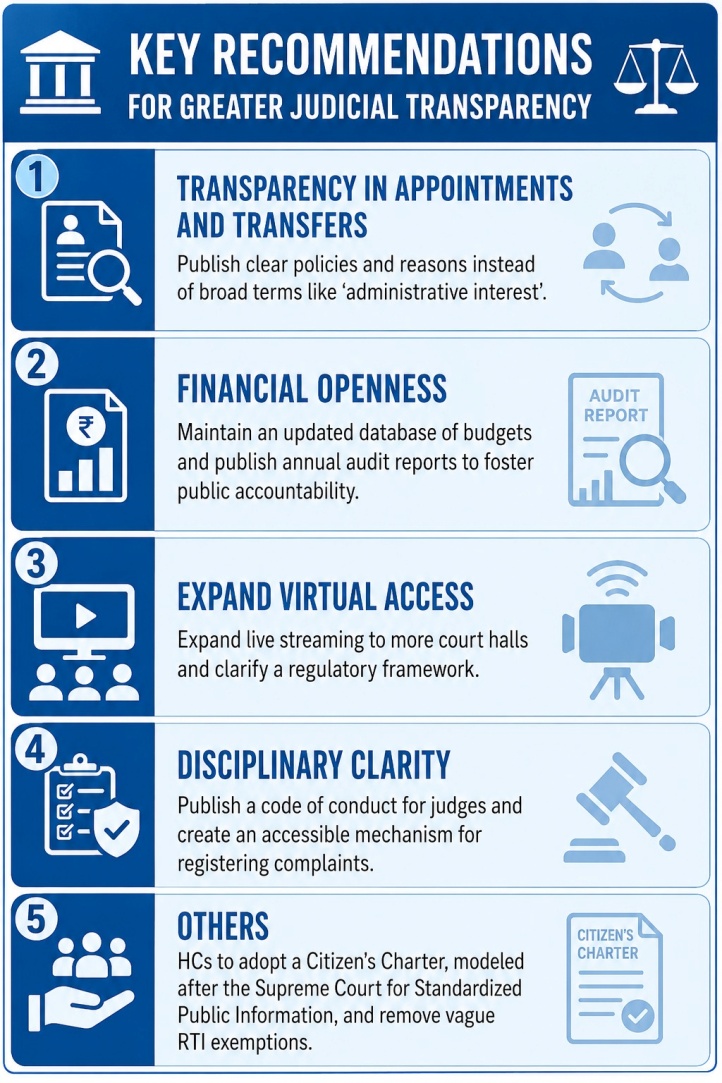
Report assesses disclosure of information by Supreme Court and High Courts on their official websites.
About Judicial Transparency Index
- Developed by Justice, Access and Lowering Delays in India (JALDI) Initiative in 2025.
- JALDI’s Vision: Zero Delay judiciary; Inclusive & Accessible courts; Effective & Quality Justice.
- It provides baseline standards against which transparency in Indian courts may be assessed.
- It examines judicial transparency in three categories — judicial processes, institutional governance and administration, and judicial and administrative personnel.
- Judicial transparency is proactive disclosure of information on court websites that enables public to assess courts’ functioning.
Issues in Judicial Transparency
- Non-Disclosure of Judicial Processes: No HC publishes criteria governing judicial recusals on their websites.
- Only Delhi HC indicates process for requesting recusals.
- Absence of SC Live-Streaming Rules: Despite landmark Swapnil Tripathi v. UoI judgment mandating amendments to Supreme Court Rules, 2013, formal guidelines governing live proceedings remain unimplemented and unavailable on court website.
- Budgetary Opacity: 8 HCs publish zero budget details, and 15 fail to disclose any expenditure data for current or past years.
- Asset disclosure: No HC has published complete asset disclosures by all its judges.
- Only 7 HCs have any judges who publicly declare their assets.
- Judicial appointments: Limited disclosure of reasons for recommending judges to SC and transferring HC judges.



