
Himalayas approaching tipping point, millions of livelihoods at stake: Report | Current Affairs | Vision IAS

Upgrade to Premium Today

Start Now
MENU
Home
Quick Links

High-quality MCQs and Mains Answer Writing to sharpen skills and reinforce learning every day.

Watch explainer and thematic concept-building videos under initiatives like Deep Dive, Master Classes, etc., on important UPSC topics.

A short, intensive, and exam-focused programme, insights from the Economic Survey, Union Budget, and UPSC current affairs.

ESC

In Summary

  • The Prosperous and Resilient Himalayas Report by NIHE highlights rapid glacier retreat, with Himalayas losing over 40% of glacial area since the Little Ice Age.
  • Himalayas, comprising 18% of India's land, are prone to ~35% of national disasters, with only 0.1% of glaciers monitored despite 56 high-risk glacial lakes.
  • The report proposes 10 critical transitions, empowering the Himalayan Council, activating dual government and market engines, fostering regional cooperation, and building a Himalayan Intelligence System.

In Summary

Prosperous and Resilient Himalayas Report by G.B. Pant National Institute of Himalayan Environment (NIHE) highlights eroding Himalayas amid recent floods near the Nepal-Tibet border, which claimed 1,300 lives and more than 5,300 are still missing.

Key Highlights of Report

  • Rapid glacier retreat: Glacial area lost since Little Ice Age is more than 40% in Himalayas which is around 10% in the Arctic region. 
  • Disaster prone: Himalayas are 18% of India's land but ~35% of India's disasters.
  • Lack of monitoring: 56 glacial lakes in India rated "very high risk" however only ~0.1% of Himalaya's ~40,000 glaciers are currently monitored.
  • Three Reinforcing "Cascading Tipping Point" Loops
  • Nature loop: Glacial retreat → lower albedo → more heat absorption → faster melt.
  • Hazard loop: One hazard cascades rapidly into multiple (glacier collapse → landslide → dam → flood).
  • Economic vulnerability loop: Post-disaster recovery spending crowds out resilience investment, deepening vulnerability to the next shock.


Way forward

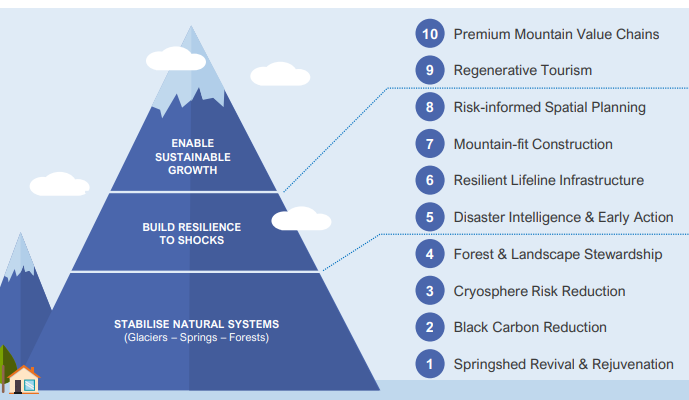
  • 10 Critical transitions: for sustainable Himalayas. (See angiographic)
  • Revive and empower NITI Aayog's Himalayan Council: Make it the senior coordinating body, backed by PMO
  • Two engines, one mission: Activate a Government Engine (Centre-State-transboundary coordination) alongside a Market & Civil Society Engine ("Himalayan Catalyst") working in tandem.
  • Go regional, not just national: Deepen India-Nepal-Bhutan cooperation, the Alpine Convention offers a template for formal transboundary governance. 
  • Build a "Himalayan Intelligence System": Integrating ISRO, IMD, NDMA, ICIMOD to convert scattered data into decision-grade risk intelligence.
Watch Video News Today

Explore Related Content

Discover more articles, videos, and terms related to this topic

RELATED VIDEOS

2
Carbon Markets

Carbon Markets

YouTube HD
What is Artificial Rain? | Deep Dive With VisionIAS

What is Artificial Rain? | Deep Dive With VisionIAS

YouTube HD

RELATED TERMS

3

ICIMOD

The International Centre for Integrated Mountain Development (ICIMOD) is an intergovernmental knowledge and learning centre dedicated to protecting the Hindu Kush Himalaya (HKH) region. India is a regional member country.

NDMA

राष्ट्रीय आपदा प्रबंधन प्राधिकरण (National Disaster Management Authority)। यह भारत में आपदा प्रबंधन के लिए एक शीर्ष निकाय है, जो नीति, योजना और समन्वय के लिए जिम्मेदार है।

IMD

India Meteorological Department, the principal agency responsible for meteorological observations, weather forecasting, and seismology in India.

Title is required. Maximum 500 characters.

Search Notes

Filter Notes

Loading your notes...
Searching your notes...
Loading more notes...
You've reached the end of your notes

No notes yet

Create your first note to get started.

No notes found

Try adjusting your search criteria or clear the search.

Saving...
Saved

Please select a subject.

Referenced Articles

linked

No references added yet