
Meta to share child safety information directly with Indian law enforcement agencies | Current Affairs | Vision IAS

Upgrade to Premium Today

Start Now
MENU
Home
Quick Links

High-quality MCQs and Mains Answer Writing to sharpen skills and reinforce learning every day.

Watch explainer and thematic concept-building videos under initiatives like Deep Dive, Master Classes, etc., on important UPSC topics.

A short, intensive, and exam-focused programme, insights from the Economic Survey, Union Budget, and UPSC current affairs.

ESC

In Summary

  • Meta will report child safety matters to India's Cybercrime Coordination Centre (I4C) and NCMEC.
  • Online child sexual abuse includes CSAM, grooming, sextortion, live-streaming of abuse, and online trafficking facilitation.
  • India's initiatives include the POCSO Act, 2012, and IT Act, 2000, while global efforts involve the UNCRC and INTERPOL's ICSE Database.

In Summary

Meta the parent firm of Instagram and Facebook, will report child safety matters directly to cybercrime portal of India's Cybercrime Coordination Centre (I4C) in addition to U.S. based National Center for Missing & Exploited Children (NCMEC).

  • Meta is the first major tech intermediary to commit to establishing a direct reporting pipeline to Indian law enforcement. 


Online child sexual abuse 
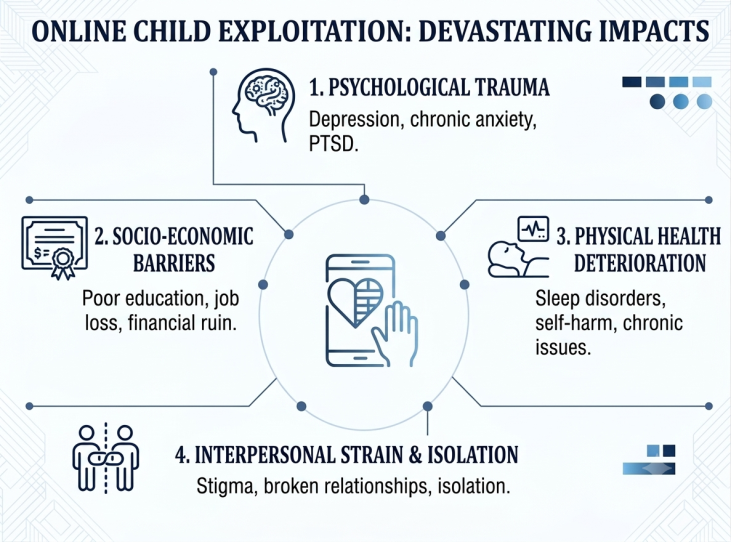
  • Definition: Online child sexual abuse and online child sexual exploitation involve the use of information and communication technology as a means to sexually abuse and/or sexually exploit children. (UN Interagency Working Group on sexual exploitation of children) 
  • Types of online child sexual abuse
  • Child Sexual Abuse Material (CSAM): Production, distribution, and circulation of sexually exploitative content involving minors online.
  • Online Grooming: Adults building trust with minors on digital platforms with intent to sexually exploit or abuse them.
  • Sextortion: Coercing minors into providing sexual content or acts by threatening to expose earlier obtained images/videos.
  • Live-streaming of Abuse: Real-time online broadcast of child sexual abuse.
  • Online Trafficking Facilitation: Use of digital platforms (social media, dark web).


Initiatives  

  • India
  • POCSO Act, 2012: Section 15 criminalizes the storage and possession of CSEAM.
  • Information Technology Act, 2000 (Amended 2008): Section 67B criminalizes publishing, browsing etcof child sexual abuse content.
  • Other: IT Rules, 2021, Juvenile Justice Act, 2015, NCRB's CSAM tracking etc.
  • Global
  • UN Convention on the Rights of the Child (1989): India's ratification reinforces commitments to protect children.
  • Budapest Convention on Cybercrime: Addresses online CSAM (India not a signatory).
  • Other: INTERPOL's International Child Sexual Exploitation (ICSE) Database, etc.
Watch Video News Today

Explore Related Content

Discover more articles, videos, and terms related to this topic

RELATED VIDEOS

1
Transformation of Family Structures in India

Transformation of Family Structures in India

YouTube HD

RELATED TERMS

3

INTERPOL's International Child Sexual Exploitation (ICSE) Database

A global database maintained by INTERPOL to store and analyze information related to child sexual exploitation cases, aiding international law enforcement efforts in identifying and apprehending offenders.

Budapest Convention on Cybercrime

The first international treaty on cybercrime, adopted by the Council of Europe. It aims to harmonize national laws, improve investigative techniques, and increase cooperation among nations in fighting cybercrime, including online CSAM. India is not a signatory.

Information Technology Act, 2000 (Amended 2008)

An Indian law that governs electronic commerce and communication. Section 67B specifically addresses the publication, browsing, transmission, or collection of child sexual abuse content electronically.

Title is required. Maximum 500 characters.

Search Notes

Filter Notes

Loading your notes...
Searching your notes...
Loading more notes...
You've reached the end of your notes

No notes yet

Create your first note to get started.

No notes found

Try adjusting your search criteria or clear the search.

Saving...
Saved

Please select a subject.

Referenced Articles

linked

No references added yet
