


The External Affairs Minister (EAM) said that the Global South may be in the front row of global crises, but it is in the “back row” of decision-making.
What is the Global South?
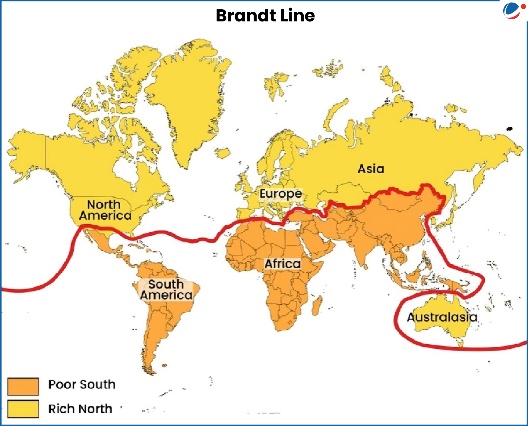
- Concept: Refers broadly to developing, emerging and underdeveloped nations across Latin America, Africa, Asia and Oceania, sharing experiences of colonisation, economic exploitation and structural marginalisation.
- Origin: Coined by Carl Oglesby in the late 1960s and popularised by the Brandt Line.
- Key Concerns of the Global South: Marginalisation in global decision-making, food and energy insecurity, climate finance and technology gaps, trade barriers etc.
Significance of the Global South for India
- Trade & Investment: Expands economic ties especially trade with Africa and Latin American countries.
- Resource Security: Ensures access to critical minerals and petroleum needed for industry and technology.
- Global Governance: Builds coalitions to push for reforms in the United Nations, International Monetary Fund and World Bank.
- India as ‘Voice of Global South’: Through platforms like the Voice of Global South Summit (VOGSS), International Solar Alliance (ISA) etc.
Way Forward
- Multilateral Reform: Ensure fair representation and voting rights for developing nations in global institutions like IMF, UNSC etc.
- Global Development Compact: Promote trade, capacity building, technology sharing and concessional finance.
- South-South Integration: Boost intra-regional trade, economic cooperation and industrial value chains.
- Climate Finance & Technology: Link climate finance with green technology transfer and scale Southern-led initiatives.
- Digital Public Infrastructure & Artificial Intelligence: Share digital infrastructure and human-centric artificial intelligence to bridge technology gaps.



