


Why in the News?
Pradhan Mantri Matsya Sampada Yojana (PMMSY) completed 5 years of its launch.
About PMMSY
- Genesis: Launched in 2020 by Department of Fisheries, under the Union Ministry of Fisheries, Animal Husbandry and Dairying.
- Objective: To address the critical gaps in fish production and productivity, quality, technology, post-harvest infrastructure and marketing.
- Duration: It is implemented in all States and UTs for a period of five years from FY 2020-21 to FY 2024-25 (extended up to FY 2025-26).
- Nodal Agency: National Fisheries Development Board (NFDB) for implementing the training, awareness and capacity-building programmes.
- Structure and Components: It is an umbrella scheme with two separate components as below:
- Central Sector Scheme (CS): Fully funded and implemented by Central Government.
- Centrally Sponsored Scheme (CSS): Partially supported by the Central Government and implemented by the states.
- Enhancement of Production and Productivity.
- Infrastructure and Post-harvest Management.
- Fisheries Management and Regulatory Framework.
Targets and Achievements:
Area | Targets | Achievements |
Fish Production and Fish Productivity |
|
|
Economic Value Addition | Reduction of post-harvest losses from the reported 20-25% to about 10%. | Post-harvest losses reduced to 10-15% (As of Dec 2024). |
Enhancing Income and Employment Generation | Generating 55 lakh direct and indirect employment opportunities. | 58 lakh employment opportunities created in fishing and aquaculture related activities (As of Dec 2024). |
Important Key Initiatives under PMMSY
- Empowering Women in Fisheries: By providing up to 60% of total project cost as financial assistance (up to ₹1.5 crore/project) under beneficiary-oriented activities and the Entrepreneur Model.
- Building Climate Resilience: Department of Fisheries has identified 100 coastal fishermen villages as Climate Resilient Coastal Fishermen Villages (CRCFV).
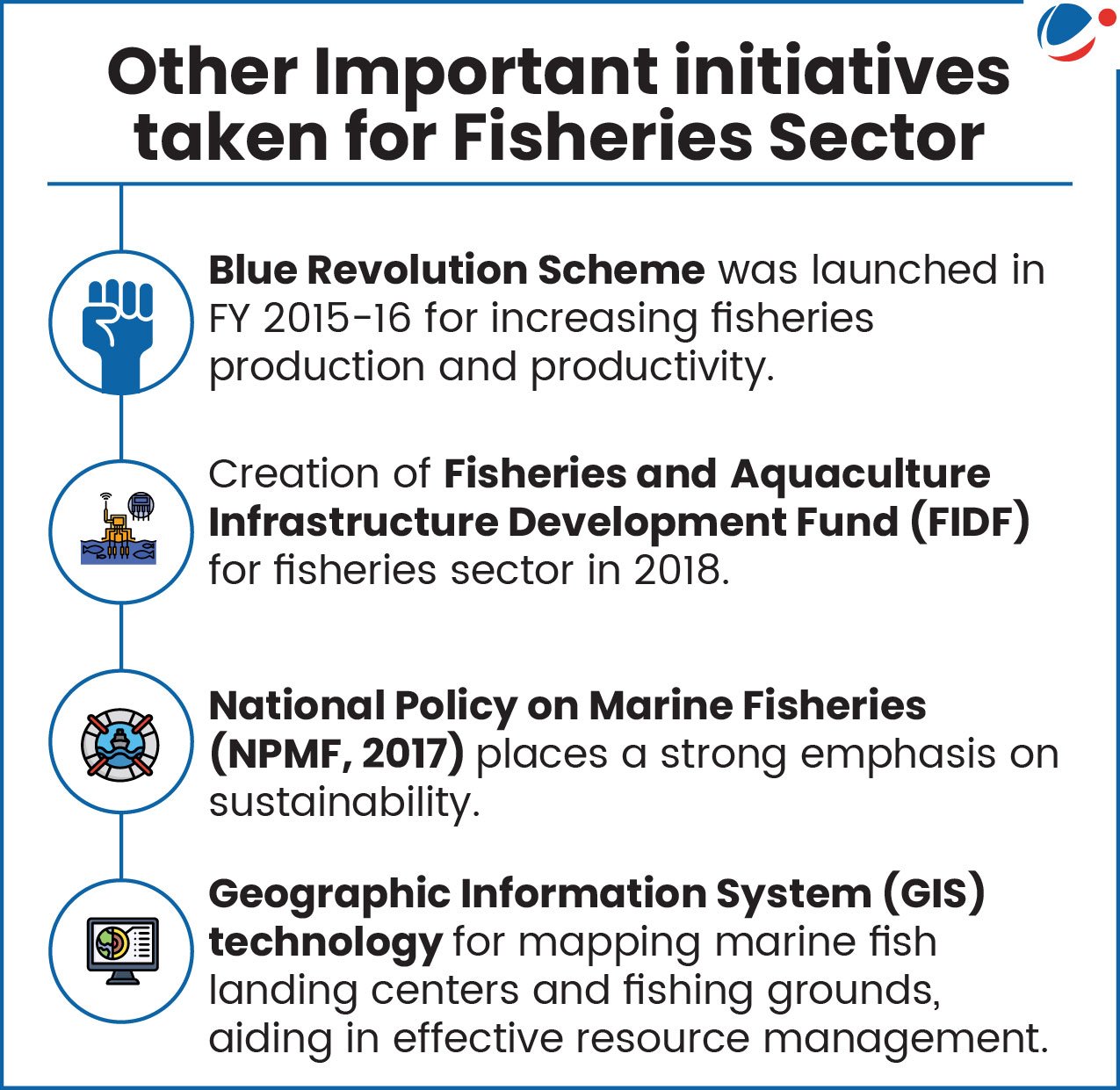
- Boosting Productivity through Biofloc Technology: It is a sustainable aquaculture method that recycles nutrients in water using beneficial microbes.
- Strengthening Post-Harvest and Marketing Ecosystems: 2,195 fisheries cooperatives as Fish Farmers Producer Organizations (FFPOs) have been supported with a project outlay of ₹544.85 crore.
- Strengthening Value Chains and Resilience: Pradhan Mantri Matsya Kisan Samridhi Sah-Yojana (PMMKSSY), a Central Sector Sub-scheme under PMMSY launched in 2024 for four years.
Challenges persist in Fisheries Sector
- Governance issues: Unlike Marine fisheries (fisheries beyond territorial waters), inland fisheries are a State subject resulting in variations in legislations and policies across States and gets neglected, despite their key contributions in livelihoods and nutritional security.
- Global challenges: Transport disruptions and shipping route instability due to global conflicts are pressuring Indian seafood exporters to maintain competitiveness against China, Vietnam, Indonesia and Ecuador.
- Disease management: e.g., shrimp farming industry in Andhra Pradesh is facing a serious threat from Enterocytozoon hepatopenaei (EHP), a microsporidian parasite.
- During FY 2024-25, frozen shrimp remained the major export item accounting for a share of 40.19% in quantity and 66.12% in value of total seafood export basket.
- Environmental damage from disasters / accidents: e.g., MSC Elsa-3 shipwreck off Kochi coast contaminated water & sediments, affecting plankton, benthos, fish eggs and larvae, and higher marine life.
Way Forward
- Promote Research-farmer partnership: E.g., ICAR-CIBA organized a training programme on effective management of shrimp diseases such as Hepatopancreatic Microsporidiosis (HPM).
- Promote sustainability in global market: Centre has initiated steps to secure global eco-labelling tag for Lakshadweep tuna fisheries using traditional fishing methods. Lakshadweep tuna can fetch premium prices, benefiting artisanal fishers.
- Parliamentary Standing Committee on Agriculture recommended to:
- Establish the Indian Council for Fishery and Aquaculture Research (ICFAR) to facilitate focussed and in-depth research, but also address the challenges faced by the fishery sector.
- Enforce Minimum Legal Mesh Size (MLS) regulations uniformly and ban destructive fishing methods.
Conclusion
To ensure the sustainable use and conservation of fisheries while balancing economic, social, and environmental priorities, it is recommended to focus on capacity building and adopt a participatory management approach supported by interdisciplinary and inter-institutional cooperation and collaboration.


