


Why in the News?
The Madhya Pradesh High Court has declared Bhojshala-Kamal Maula Mosque complex in Dhar as a protected monument under Ancient Monuments and Archaeological Sites and Remains (AMASR) Act, 1958 with character of a Hindu temple.
More about the News
- The Court quashed Archaeological Survey of India (ASI) order of 2003 that had restricted Hindu worship to specific days and permitted namaz for Muslim community on Friday.
- The ASI will continue to exercise overall supervisory administration, conservation, and management of the property.
- The Court held, based on ASI findings of 94 sculptures and 150+ Sanskrit inscriptions, that site was built by Raja Bhoj in 1034 AD and later converted into mosque.
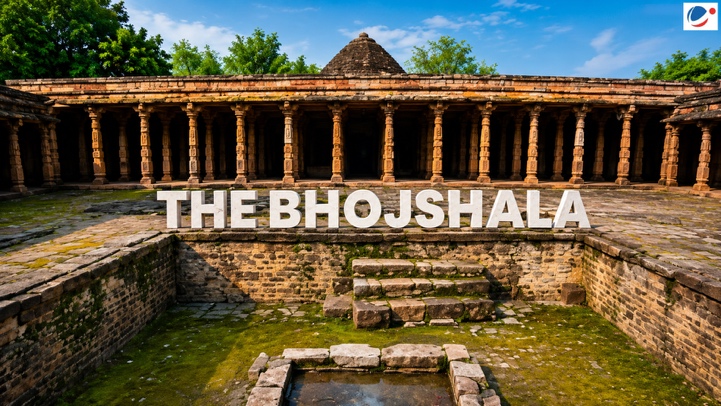
- The high court ruled that the Bhojshala case was a matter of protecting the fundamental "right of worship" guaranteed under Articles 25 and 26 of the Constitution.
About Bhojshala Temple
- Origins: Established by Parmara King Bhoja in 11th-century Dhar, Madhya Pradesh.
- It was turned into the Kamal Maula Mosque by the subsequent Muslim rulers of Dhar.
- Deity: Goddess Vagdevi Saraswati or Ambika
- The court has directed the government to make formal efforts to repatriate the ancient idol of Goddess Saraswati currently housed in the British Museum in London.
- Key Features:
- Served as a premier college and centre of Sanskrit learning (Sarasvatisadana or Bharatibhavana).
- Engraved slabs contain two odes to the Kurmavtara or crocodile incarnation of Vishnu written in Prakrit, classical poetry etc.
- Inscription of Karpuramanjari Drama composed in poetry by Royal Tutor Madana, disciple of the famous Jain scholar Ashadhara.
- The play refers to the wars between the Paramaras and the Chalukyas which were ended by matrimonial alliance.
- Two sarpabandha pillar inscriptions detailing Sanskrit grammar.
- Two Sanskrit stanzas in Anustubh metre were engraved, one praising Paramara king Udayaditya and Naravarman, successors of Raja Bhoja, and the other that inscription was installed by Udayaditya.
About King Bhoja (1000 to 1055 AD)
- Contemporary of: Rajendra I, Chola Dynasty, who built Brihadisvara Temple in Gangaikonda Cholapuram.
- Conquests: He defeated the Chalukyas of Lata (present-day Gujarat), Shilahara of Konkan, and Chahamanas of Shakambhari. He increased his power among the Dubkund Kachchhapaghatas and the Chandela feudatories. He adopted the title of Parameshvara-Parama Bhattaraka.
- Contribution to Literature:
- Samarängana Sutradhara, an encyclopedic work on architecture. It deals with the planning of towns and villages, building of houses, halls and palaces as well as temples.
- Sarasvatīkaṇṭhabharaṇa, a treatise on Sanskrit grammar for poetic compositions; Vyavaharamanjari, a text on Dharmashastras or Hindu law and Charucharya a text on personal hygiene.
- Contribution to Architecture:
- He founded the city of Bhojpur on the banks of the Betwa river, constructed the Bhojeshwar Temple, built three dams in the area, constructed Upper Lake in Bhopal by constructing an earthen dam across the Kolans River.
- The lake was renamed Bhojtaal in 2011.
- He founded the city of Bhojpur on the banks of the Betwa river, constructed the Bhojeshwar Temple, built three dams in the area, constructed Upper Lake in Bhopal by constructing an earthen dam across the Kolans River.
About Parmara Dynasty
Bhumija Temple Architecture
Panchayatana Type
|
- Origin: Believed to have originated from the Agnivanshi Rajputs, a warrior class claiming divine ancestry.
- Founder: It was founded in the early ninth century by Upendra (Krishanaraja). Siyaka II made it an independent kingdom. After defeating Rashtrakuta King Khotigga, Siyaka II succeeded the Rashtrakutas of Manykheta.
- Extent of Kingdom: The Paramara Kingdom had its main capitals at Ujjain and Dhara (Dharanagari). At its peak, it extended from Kota-Bundi (north) to the Godavari region and Khandesh (south), from Bhilsa-Hoshangabad-Sagar (east) to the Mahi River (west), covering much of present-day Malwa and adjoining regions.
- Temple Architecture: Bhumija style of temple-architecture. Most of the Paramara temples are of the Panchayatana type.

