


It also marks 1000 years since the first attack on the temple in 1026 A.D by Mahmud Ghazni.
About Somnath Temple
- One of twelve Aadi Jyotirlingas.
- Jyotirlinga means ‘column or pillar of light’.
- Location: Prabhas Patan along the Saurashtra coast in Gujarat.
- Literary Sources: Dwadasha Jyotirlinga Stotram (Places Somnath first among the twelve Jyotirlingas), Skanda Purana, Prabhasa Khanda, Rig Veda and Bhagavat.
- Mythology Associated: Built by Chandra Dev, the Moon God, who worshipped Lord Shiva here to free himself from a curse. Som means Moon. Nath means Lord.
- Religious Sects Associated: Shaivism, Vaishnavism, Shaktism.
- Foreign Travellers Associated: Mentioned by the Arab traveler Al-Biruni.
- Architecture: Chalukya style also called Kailash Mahameru Prasad Style.
- Features:
- Vesara Style: Blends Nagara-style with Dravidian-style.
- Constituents: Shikhara, Garbhagriha, Sabha Mandap, Nritya Mandap, traditional carvings, a spacious clean courtyard, and Baan Stambh pointing toward the South Pole.
- Material: Built of sandstone.
- Features:
- Restoration:
- 12th century: Kumarapala
- 13th century: King of Junagadh
- 18th century: Ahilyabai Holkar
- 1951: Pran Pratishtha (consecration) done by Dr. Rajendra Prasad.
- It was initiated by Sardar Patel in 1947.
Article Sources
1 sourceNetherlands returned 11th-Century Chola Copper Plates to India during Prime Minister’s State Visit to Netherlands.
- The artefacts have been in possession of Leiden University and are popularly known as Leiden copper plates.
- During the visit, two countries also elevated their relations to Strategic Partnership.
About Leiden Copper Plates
- Consists of 21 large and 3 small copper plates fastened with a bronze ring bearing the seal of Chola king Rajendra Chola I and another set carrying the seal of Kulottunga Chola I.
- Language: Tamil and Sanskrit.
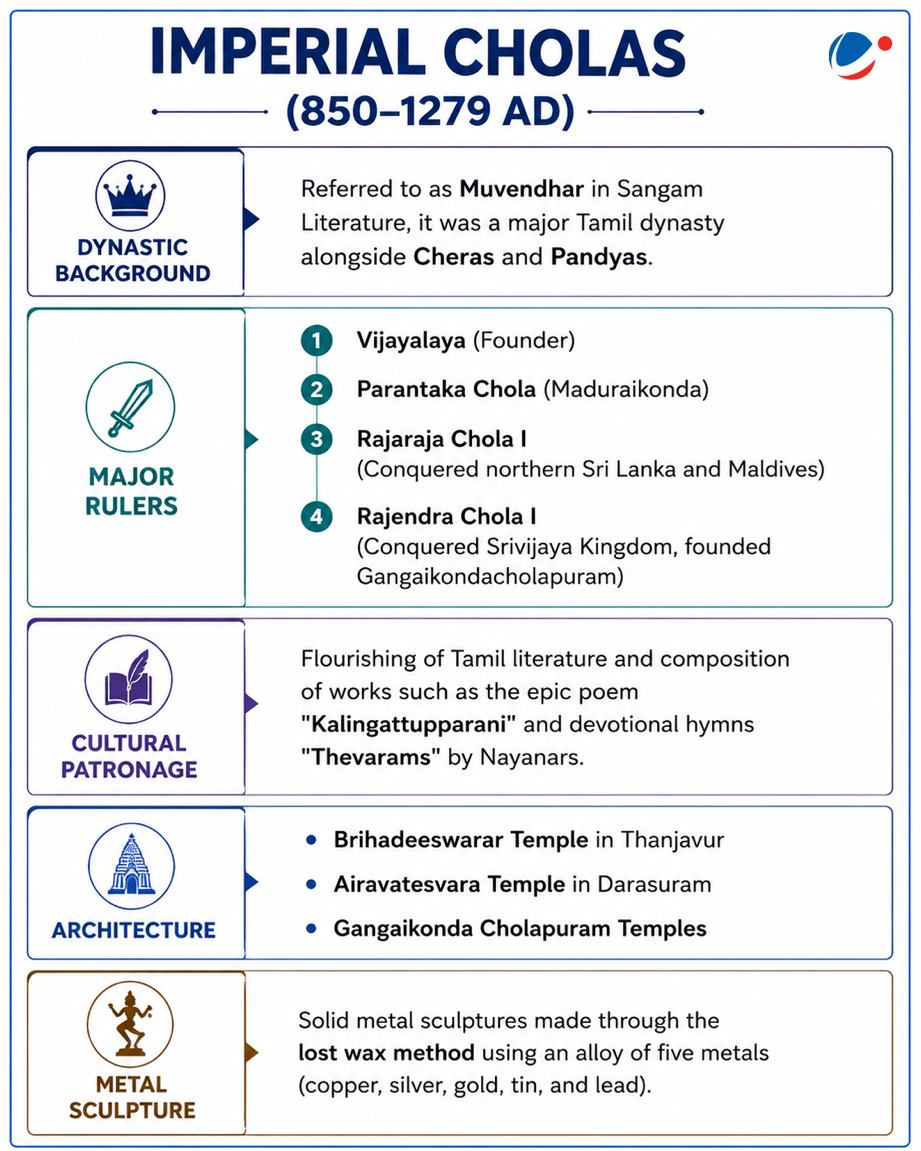
- These plates were brought to Netherlands in 1712 from Nagapattinam by Florentius Camper, a Dutch missionary, associated with Dutch East Indies Company.
- Significance: Provide insights into Chola Empire’s administration, taxation, land reforms, irrigation systems, and trade practices.
- Records grant of Anaimangalam village to Buddhist vihara built by Srivijaya rulers of Southeast Asia, signifying religious harmony and links with Southeast Asia.
About Copper Plate Inscriptions
- Official records engraved on copper sheets and usually tied together with a ring bearing the royal seal.
- They usually recorded grants of land, lists of royal lineages carrying royal seal, religious grants, donations etc.
- Earliest known copperplate inscription is Sogaura Copperplate of Mauryan Era mentioning hunger relief efforts (praktrit language and Brahmi script).
- Majority of the copper plate inscriptions are concentrated in the southern states.
Indian War Memorial inaugurated at Imjingak Park, Seoul (South Korea), in the backdrop of the 75th anniversary of the Korean War.
- It honours the sacrifice and service of the 60 Para Field Ambulance and Custodian Force of India.
About the Korean War
- After World War II, Korea was divided along the 38th Parallel:
- North Korea (backed by Soviet Union and China)
- South Korea (supported by USA)
- North Korea invaded the South in 1950, igniting a Cold War proxy conflict.
- A 1953 armistice divided the peninsula at the 38th parallel, roughly aligning with the Demilitarised Zone.
Article Sources
1 sourceYang Shuang-zi, Taiwanese writer and author of 'Taiwan Travelogue' and translator Lin King win International Booker Prize 2026.
About International Booker Prize
- It is awarded annually for a single book, translated into English and published in the UK or Ireland.
- It was established in 2005 as the Man Booker International Prize.
- Indian Winners of International Booker Prize:
- Geetanjali Shree-Tomb of Sand (2022), translated by Daisy Rockwell. It was the first Hindi work to win this prize.
- Banu Mushtaq- Heart Lamp (2025), translated by Deepa Bhasthi which was the first Kannada work to win this prize.
Note: International Booker Prize is different from Booker Prize which rewards work written in English.
Tags:


