Rashtriya Bal Swasthya Karyakram (RBSK) | Current Affairs | Vision IAS

Upgrade to Premium Today

Start Now
MENU
Home
Quick Links

High-quality MCQs and Mains Answer Writing to sharpen skills and reinforce learning every day.

Watch explainer and thematic concept-building videos under initiatives like Deep Dive, Master Classes, etc., on important UPSC topics.

A short, intensive, and exam-focused programme, insights from the Economic Survey, Union Budget, and UPSC current affairs.

ESC

Rashtriya Bal Swasthya Karyakram (RBSK)

30 Jun 2026
2 min

In Summary

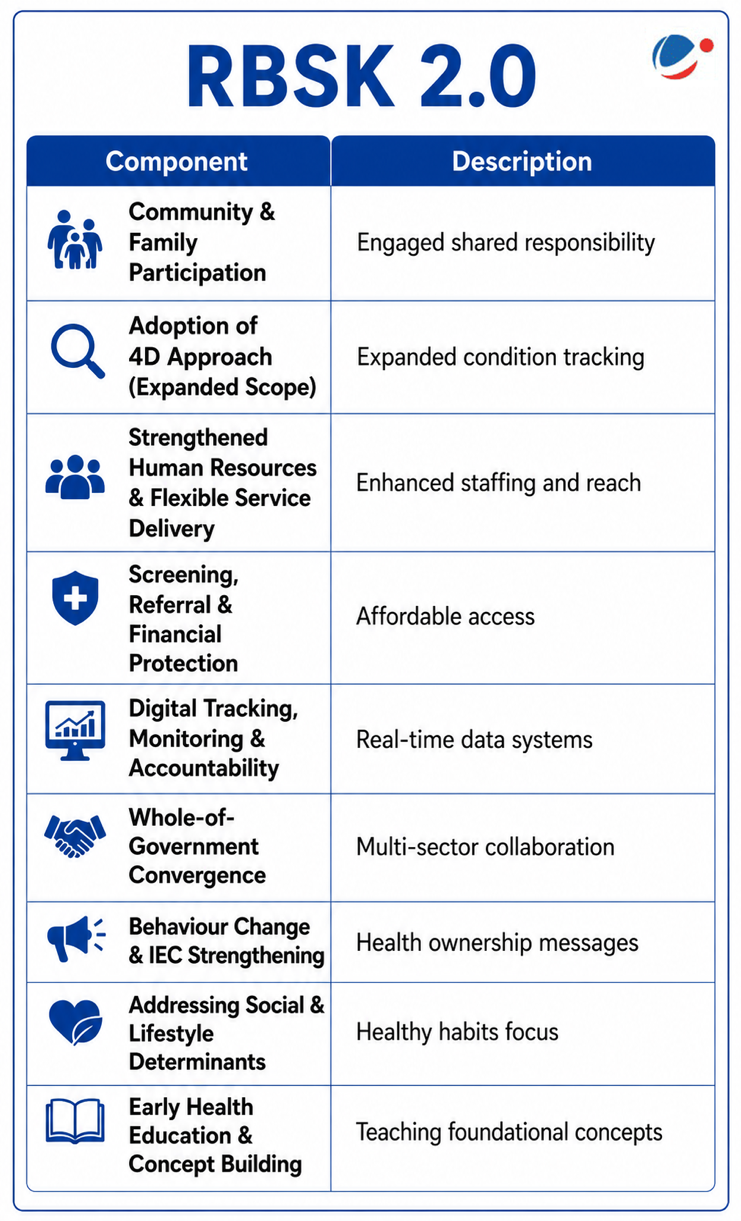
  • Rashtriya Bal Swasthya Karyakram (RBSK) 2.0 Guidelines released by MoHFW for early identification and comprehensive care of children up to 18 years.
  • The program targets 38 conditions, including the original 4Ds (Defects, Diseases, Deficiencies, Delays) and new-age challenges like mental health and NCD risk factors.
  • RBSK 2.0 emphasizes strengthened referral linkages, digitalization with health cards, and multi-sectoral convergence with education and WCD systems.

In Summary

Why in the News? 

The Ministry of Health and Family Welfare recently released the Rashtriya Bal Swasthya Karyakram (RBSK) 2.0 Guidelines.

Objectives of the Scheme

Salient Features of the Scheme

  • Early Identification & Intervention: Early detection and treatment of the 4Ds—Defects at birth, Diseases, Deficiencies, and Developmental Delays (including disabilities)
  • Comprehensive Care: Provides preventive, promotive, and curative healthcare for children
  • Holistic Development: Ensures child survival, growth, development, and improved quality of life
  • Economic Relief: Reduces out-of-pocket expenditure through timely intervention and disease prevention.
  • Origin: Launched in February 2013
  • Ministry: Ministry of Health and Family Welfare (MoHFW)
  • Rashtriya Bal Swasthya Karyakram (RBSK) is a program for early identification of selected health conditions and linking them for medical and surgical management, thereby providing comprehensive care for children in the community.
    • RBSK 2.0 covers 38 common health conditions for early detection, free treatment, and necessary interventions, including surgeries at tertiary levels.
  • Implementing Agency: National Health Mission (NHM) 
  • Target group: Children from birth to 18 years of age
  • Key Highlights of RBSK 2.0 Guidelines
    • Delivery Points: Newborns from birth to 6 weeks.
    • Anganwadi Centres: Preschool children from 6 weeks to 6 years.
    • Government & Government-Aided Schools: Students from 6 to 18 years.
    • District Early Intervention Centers (DEIC): Comprehensive management under one roof
  • Tertiary Care: Including surgical management, Cochlear implants provided under RBSK by NHM.
  • Social and Behaviour Change Communication (SBCC) with Participatory Care
  • Early education and concept building among children regarding healthy and unhealthy practices.
  • Promotes active involvement of children, families, schools, and communities in the continuum of care and adoption of healthy practices at home. 
  • Expanded Scope Beyond 4Ds:  Incorporating new-age health challenges, including mental health conditions, behavioural concerns, and risk factors for non-communicable diseases (NCDs) like diabetes and hypertension alongside the traditional 4Ds. 
  • Screening Platforms Screening is conducted continuously across a child's development at specific locations:
  • Strengthened referral linkages: Emphasize strengthened referral linkages and continuity of care, with clearly defined pathways from community-level screening to facility-based diagnosis and treatment.
  • Expanded Scope of Secondary & Tertiary Care: It is envisioned with a structured hub-and-spoke model to enable specialist services reach children at all levels.
  • Digitalization & Tracking:  Introduces digital health cards, real-time monitoring, and referral tracking systems. 
  • Health card concept: Introduction of longitudinal "Health Card" linked with child tracking (report card concept)
  • Multi-Sectoral Convergence: Integrates health, education, and women & child development systems through schools and Anganwadi Centres.
  • Others

Explore Related Content

Discover more articles, videos, and terms related to this topic

RELATED TERMS

3

Health Card (Longitudinal Health Card)

A digital or physical record that tracks a child's health status, screenings, interventions, and progress over time. The introduction of a longitudinal health card linked with child tracking aims for better monitoring and continuity of care in RBSK 2.0.

Hub-and-Spoke Model

A logistical or organizational model where a central entity (hub) serves multiple peripheral entities (spokes). In the context of PM-SETU, ITIs are modernized into central 'hubs' that support and guide smaller, specialized training centers or 'spokes' to offer industry-specific skills.

Non-communicable diseases (NCDs)

Chronic diseases that are not passed from person to person. They are often of long duration and generally progress slowly. Major NCDs include cardiovascular diseases, cancers, chronic respiratory diseases, and diabetes, often linked to lifestyle factors and environmental conditions.

Title is required. Maximum 500 characters.

Search Notes

Filter Notes

Loading your notes...
Searching your notes...
Loading more notes...
You've reached the end of your notes

No notes yet

Create your first note to get started.

No notes found

Try adjusting your search criteria or clear the search.

Saving...
Saved

Please select a subject.

Referenced Articles

linked

No references added yet