
NBFCs show resilience under Scale-based Regulation: RBI | Current Affairs | Vision IAS
MENU
Home

Periodically curated articles and updates on national and international developments relevant for UPSC Civil Services Examination.

Quick Links

High-quality MCQs and Mains Answer Writing to sharpen skills and reinforce learning every day.

Watch explainer and thematic concept-building videos under initiatives like Deep Dive, Master Classes, etc., on important UPSC topics.

ESC

A recent article by the RBI titled ‘Peeling the Layers: A Review of the NBFC Sector in Recent Times’ highlighted that the Non-Banking Financial Companies (NBFCs) remain resilient post introduction of Scale-based Regulation (SBR) in 2022.

  • NBFCs are companies registered under the Companies Act, 1956/ 2013 engaged in business of loans and advances, acquisition of marketable securities of a like nature, leasing, hire-purchase, insurance business, chit business, etc.

What is SBR for NBFCs?
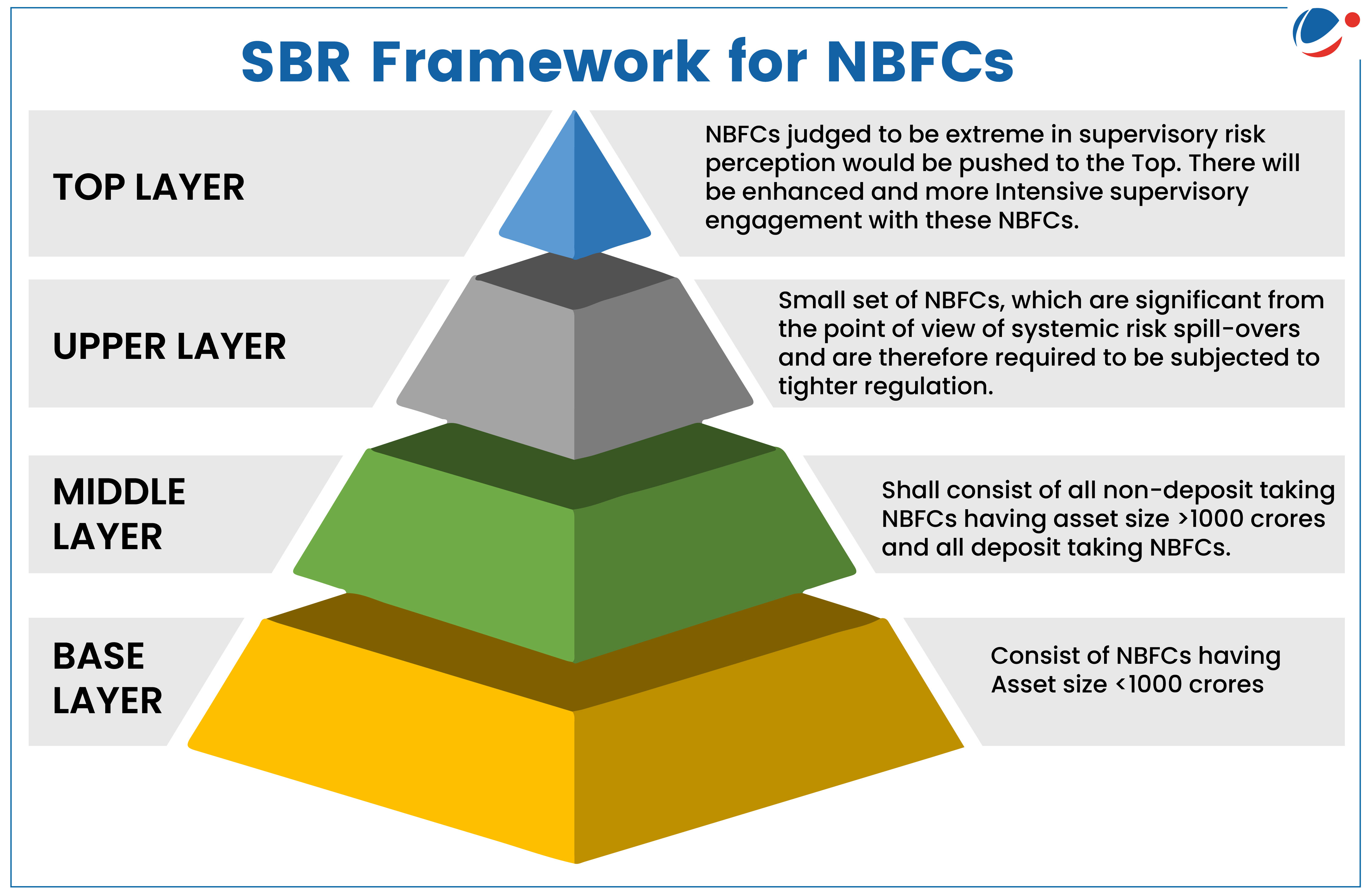
An infographic image describing SBR (Scale-Based Regulation) framework for NBFCs which classifies them into four layers based on asset size and risk perception. The Base Layer includes NBFCs with an asset size below ₹1000 crores, while the Middle Layer consists of all deposit-taking NBFCs and non-deposit taking NBFCs with assets above ₹1000 crores. The Upper Layer features NBFCs that are systemically significant and pose a higher risk, requiring stricter regulation. The Top Layer consists of those NBFCs with extreme supervisory risk, warranting intensive regulatory oversight.
  • Segregation of NBFCs: NBFCs are segregated into four layers based on their size, activity, and perceived level of riskiness. (Refer to Infographic). 
  • Differential regulations: Each tier is subject to different regulatory requirements, tailored to its size and risk profile. 

Key Highlights of the RBI Article

  • Resilient Financial Landscape: The sector maintained double-digit credit growth, adequate capital levels, a low delinquency ratio, and registered a consistent rise in profitability.
  • Improved Asset Quality: Gross Non-performing Asset (GNPA) ratio has decreased, from 4.4% & 10.6% in December 2021 to 2.4% & 6.3% in December 2023 for government NBFCs & nongovernment NBFCs respectively. 
  • Concerns: Emerging risks and challenges, especially from cyber-security and climate risks. 

Watch Video News Today

Explore Related Content

Discover more articles, videos, and terms related to this topic

RELATED VIDEOS

3
News Today (Oct 18, 2024)

News Today (Oct 18, 2024)

YouTube HD
Circularity in Textile Structure

Circularity in Textile Structure

YouTube HD
Weekly Focus | India's Natural Wealth

Weekly Focus | India's Natural Wealth

YouTube HD
Title is required. Maximum 500 characters.

Search Notes

Filter Notes

Loading your notes...
Searching your notes...
Loading more notes...
You've reached the end of your notes

No notes yet

Create your first note to get started.

No notes found

Try adjusting your search criteria or clear the search.

Saving...
Saved

Please select a subject.

Referenced Articles

linked

No references added yet

Subscribe for Premium Features