
‘Sustainable Food Systems and India’s Trade Agreement’ Policy Brief released by ICRIER | Current Affairs | Vision IAS
MENU
Home

Periodically curated articles and updates on national and international developments relevant for UPSC Civil Services Examination.

Quick Links

High-quality MCQs and Mains Answer Writing to sharpen skills and reinforce learning every day.

Watch explainer and thematic concept-building videos under initiatives like Deep Dive, Master Classes, etc., on important UPSC topics.

ESC

Policy Brief identifies regulatory and other issues and makes policy recommendations to help develop a sustainable food system and take the country from food security to nutrition security, and help enhance quality production, exports and earnings of farmers.

What is Sustainable Food System (SFS)?
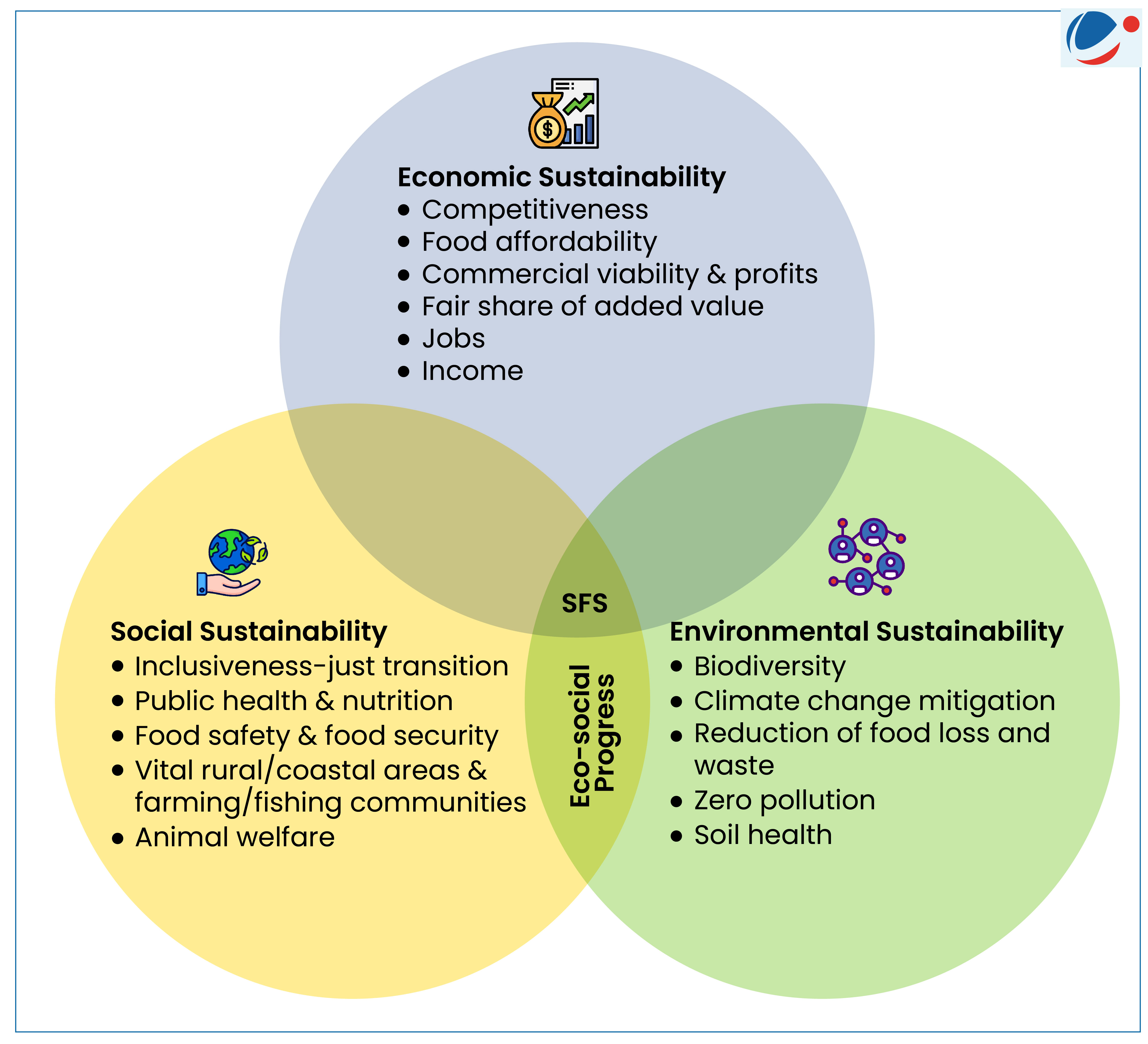
An infographic Venn diagram depicting the intersection of three dimensions of sustainability—Economic, Social, and Environmental—relevant to sustainable food systems (SFS). Economic Sustainability focuses on competitiveness, food affordability, profitability, jobs, and income. Social Sustainability emphasizes inclusiveness, public health, food security, rural development, and animal welfare. Environmental Sustainability highlights biodiversity, climate change mitigation, zero pollution, and soil health. At the center, these aspects combine to support eco-social progress and sustainable food systems (SFS).
  • It is a system that delivers food security, safety, and nutrition for all which is economically, socially and environmentally sustainable. (refer infographic). 

Issues in India’s SFS

  • Gaps in coordination across multiple government agencies:  e.g., divided responsibilities among APEDA, Spices Board and the Export Inspection Council in case of spices.
  • Lack of data and information on policies/schemes: e.g., Lack of impact assessment.
  • Difficulties in supply chain traceability and gaps in use of technology: e.g., fragmented supply chain, lack of robust public-private partnerships on farm for technology transfer, etc.
  • Trade-related issues: e.g., sporadic bans or export duties, rejection of exports due to non-adherence of SPS standards, etc.

Key Recommendations

  • Comprehensive vision document with specific goals of reducing food waste, use of harmful pesticides etc.
  • Streamline coordination across multiple regulators. e.g., single nodal agency for exports.
  • Implement farm-to-fork product traceability. e.g., ‘GrapeNet’ monitoring fresh grapes exported from India to EU.
  • Reduce trade barriers by strengthening quality testing and certification.
  • Implementation of good agricultural practices. e.g., International Year of Millets 2023.

Article Sources

1 source
Watch Video News Today

Explore Related Content

Discover more articles, videos, and terms related to this topic

RELATED VIDEOS

3
Circularity in Textile Structure

Circularity in Textile Structure

YouTube HD
The Contribution of Indian Cinema to the Creative Economy

The Contribution of Indian Cinema to the Creative Economy

YouTube HD
Impact Investments

Impact Investments

YouTube HD
Title is required. Maximum 500 characters.

Search Notes

Filter Notes

Loading your notes...
Searching your notes...
Loading more notes...
You've reached the end of your notes

No notes yet

Create your first note to get started.

No notes found

Try adjusting your search criteria or clear the search.

Saving...
Saved

Please select a subject.

Referenced Articles

linked

No references added yet

Subscribe for Premium Features