
Indian Scientists develop Model to understand the Equatorial ElectroJet (EEJ) | Current Affairs | Vision IAS
MENU
Home

Periodically curated articles and updates on national and international developments relevant for UPSC Civil Services Examination.

Quick Links

High-quality MCQs and Mains Answer Writing to sharpen skills and reinforce learning every day.

Watch explainer and thematic concept-building videos under initiatives like Deep Dive, Master Classes, etc., on important UPSC topics.

ESC

EEJ model will help to understand the EEJ’s impact on orbiting satellite, Global Navigation Satellite System (GNSS)-based navigation/positioning and other satellite communication links as well as electrical power grids.

About the Equatorial ElectroJet (EEJ)

  • EEJ: It’s a ribbon of intense 100 kA (kiloamperes) current flowing in Earth's ionosphere (Earth’s Upper atmosphere) at 100km altitude.
    • EEJ’s (North‐South) width: It’s of a few hundred kilometres (∼600 km).
  • Genesis: It is formed in Earth's magnetic equator, where magnetic field lines run parallel to Earth's surface, leading to an intense current density in the ionosphere.
  • Path of travelling: EEJ travels along magnetic equator(See image).
    • Typically, the EEJ current flows eastward during the day, and reverses direction in the night-time & produce a characteristic magnetic signature both on ground and in space (measured by magnetometers).

 Effects of EEJ 

  • EEJ intensifies Earth's geomagnetic field near equator. 
  • EEJ disruptions impact power infrastructure and electricity monitoring systems across equatorial regions.     

About Magnetic equator
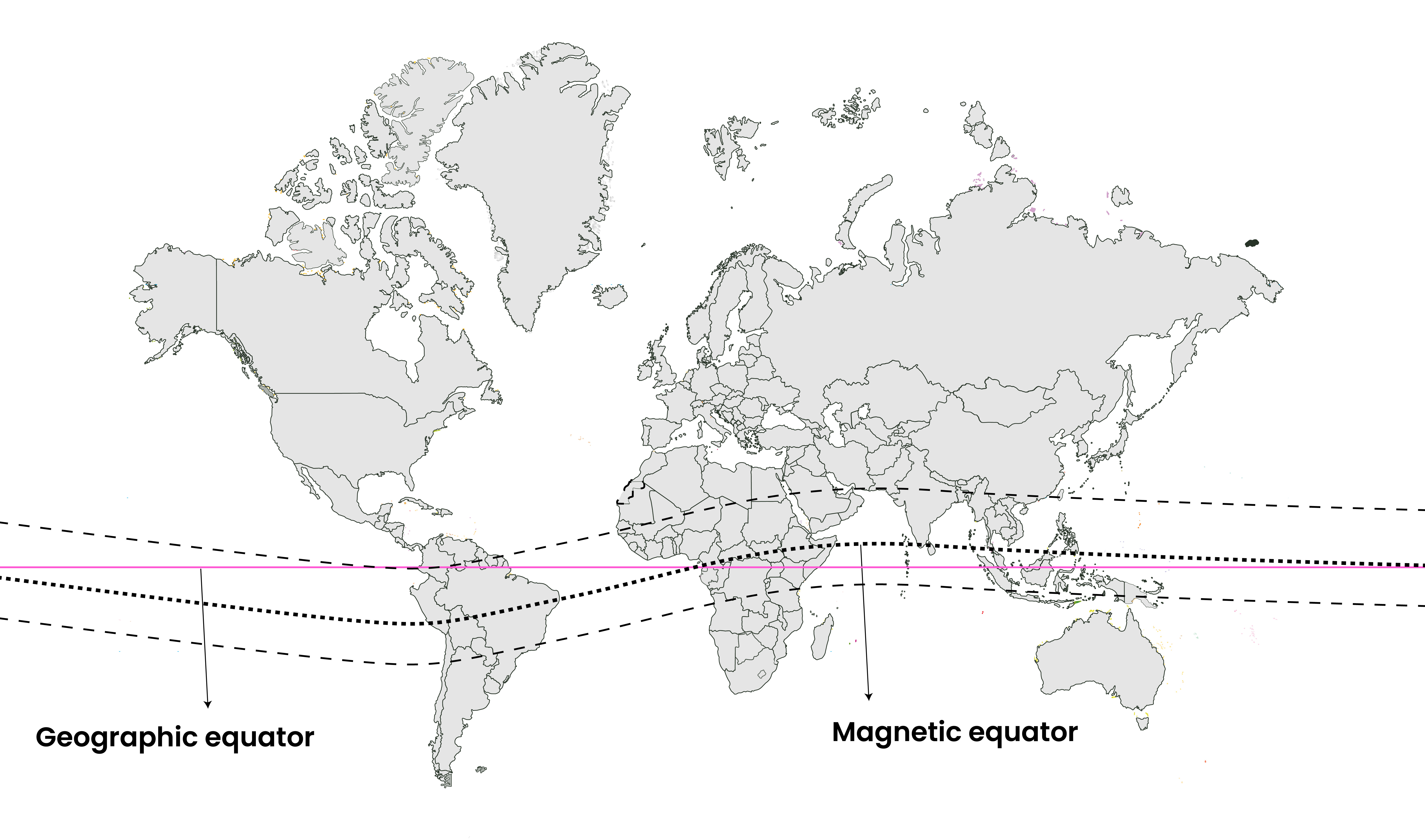
The image shows a world map with two lines labeled as the "Geographic equator" and the "Magnetic equator." The geographic equator, shown as a straight pink line, runs horizontally across the middle of the map, representing 0° latitude. The magnetic equator, depicted as a dashed line, deviates slightly north and south of the geographic equator, indicating the varying path of the Earth's magnetic field's midpoint.
  • It is a line of zero magnetic dip, meaning that a magnetic needle has no dip at these points. 
  • Unlike Earth's geographic equator, the magnetic equator is not fixed, but slowly changes.
  • The geographic equator is a great circle around the Earth and it remains fixed at Zero-degree latitude.
Watch Video News Today

Explore Related Content

Discover more articles, videos, and terms related to this topic

RELATED VIDEOS

1
News Today (Oct 31, Nov 01-02-03-04, 2024)

News Today (Oct 31, Nov 01-02-03-04, 2024)

YouTube HD
Title is required. Maximum 500 characters.

Search Notes

Filter Notes

Loading your notes...
Searching your notes...
Loading more notes...
You've reached the end of your notes

No notes yet

Create your first note to get started.

No notes found

Try adjusting your search criteria or clear the search.

Saving...
Saved

Please select a subject.

Referenced Articles

linked

No references added yet

Subscribe for Premium Features