
Small Language Models (SLMs) as future of Artificial Intelligence | Current Affairs | Vision IAS
MENU
Home
Quick Links

High-quality MCQs and Mains Answer Writing to sharpen skills and reinforce learning every day.

Watch explainer and thematic concept-building videos under initiatives like Deep Dive, Master Classes, etc., on important UPSC topics.

ESC

In Summary

  • Smaller Language Models (SLMs) are compact AI systems with millions to 30 billion parameters, contrasting with LLMs' hundreds of billions or trillions.
  • SLMs offer advantages like lower cost, on-device deployment, and AI democratization, though they have limitations in accuracy and scope compared to LLMs.
  • Currently, SLMs handle approximately 95% of global AI work, with examples including Llama, Mistral, Gemma, and Granite.

In Summary

The Union Minister for Electronics and IT stated that the future of AI will be shaped by SLMs rather than extremely Large Language Models (LLMs).

What are SLMs?
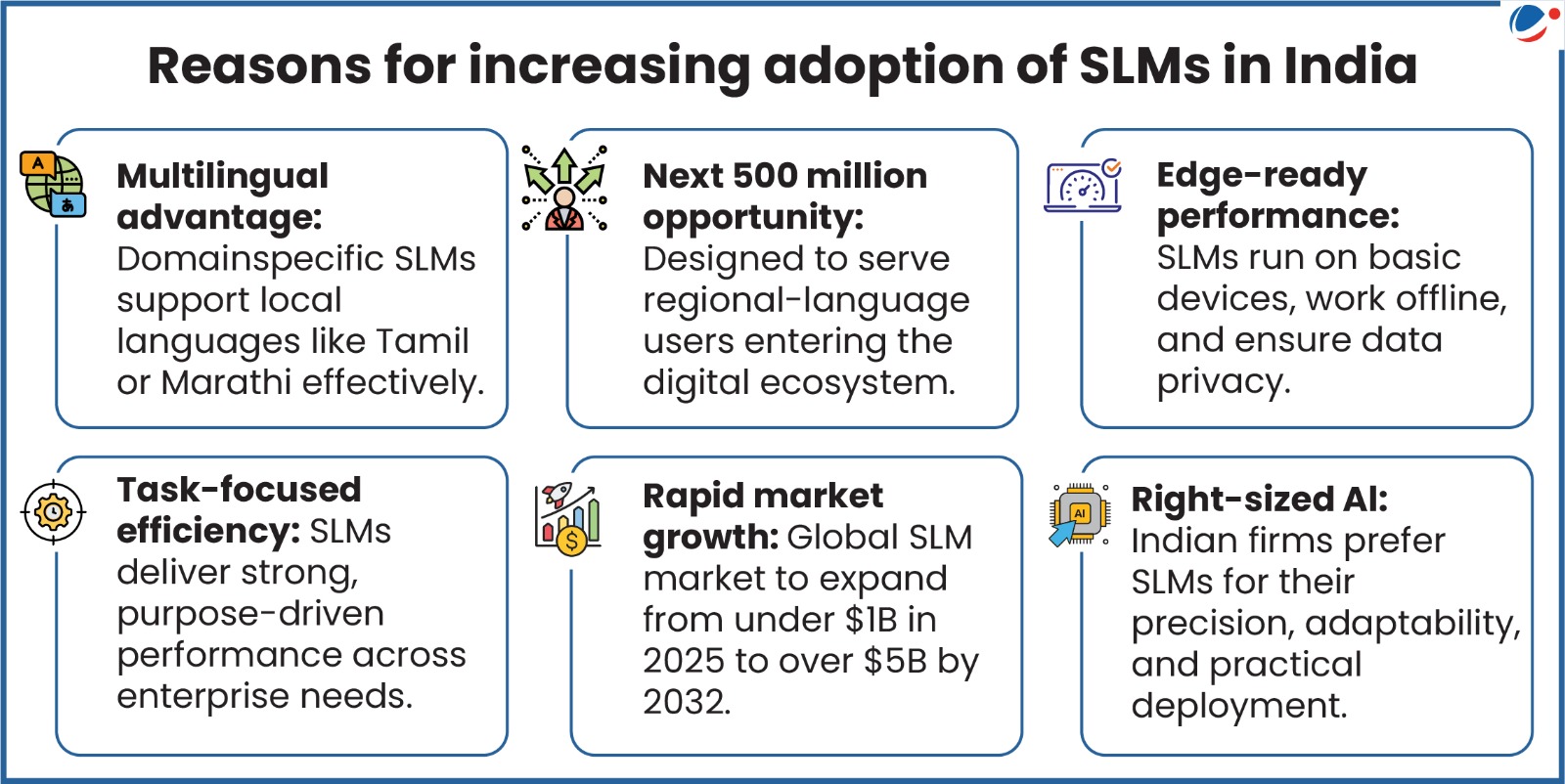
  • SLMs are compact AI systems built on simpler neural network architectures, designed to generate and understand natural language, as LLMs do.
  • Parameters used by SLMs: several million to 30 billion parameters, whereas LLMs often possess hundreds of billions or even trillions parameters.
  • At present, nearly 95% of AI work globally is currently handled by SLMsE.g.  Llama, Mistral, Gemma and Granite etc.

Advantages of SLMs over LLMs

  • Cheaper: Smaller models typically require less computational power, reducing costs. 
  • Ideal for on-device deployment: As they are optimized for efficiency and performance on resource-constrained devices with limited connectivity, memory, and electricity.
  • Democratization of AI: More organizations can participate in developing models with a more diverse range of perspectives and societal needs.
  • Other: Streamlined monitoring and maintenance, Improved data privacy and security, Lower infrastructure, deeper expertise for domain-specific tasks, lower latency etc.

Limitations of SLMs

  • Less accuracy: Larger models offer superior accuracy and versatility and are well-suited for more complex tasks.
  • Narrow scope: SLMs are typically trained on smaller, specialized datasets, limiting their flexibility and general knowledge compared to larger models.
  • Other: Less Creativity, Lesser data analysis etc.
Watch Video News Today

Explore Related Content

Discover more articles, videos, and terms related to this topic

RELATED VIDEOS

3
Simplified | Seeing is not Believing: The DeepFake Dilemma

Simplified | Seeing is not Believing: The DeepFake Dilemma

YouTube HD
Simplified: Virtual influencers revolutionizing creator marketing

Simplified: Virtual influencers revolutionizing creator marketing

YouTube HD
Sovereign AI | Paritosh Parmar Sir

Sovereign AI | Paritosh Parmar Sir

YouTube HD

RELATED TERMS

3

Democratization of AI

The concept of making AI technology and its development more accessible to a wider range of individuals, organizations, and communities. This is facilitated by tools and models like SLMs that require fewer resources, enabling broader participation and diverse perspectives in AI creation.

On-device deployment

The process of running AI models directly on end-user devices (like smartphones or IoT devices) rather than relying on cloud servers. SLMs are particularly suited for this due to their efficiency, which reduces reliance on strong connectivity, substantial memory, and high power consumption.

Parameters (in AI)

In the context of AI models like SLMs and LLMs, parameters are the internal variables that the model learns from data during training. The number of parameters is a key indicator of a model's size, complexity, and potential capabilities. A higher number of parameters generally implies a more powerful but resource-intensive model.

Title is required. Maximum 500 characters.

Search Notes

Filter Notes

Loading your notes...
Searching your notes...
Loading more notes...
You've reached the end of your notes

No notes yet

Create your first note to get started.

No notes found

Try adjusting your search criteria or clear the search.

Saving...
Saved

Please select a subject.

Referenced Articles

linked

No references added yet
