
UN University Institute for Water, Environment and Health releases report on Global Water Bankruptcy | Current Affairs | Vision IAS
MENU
Home
Quick Links

High-quality MCQs and Mains Answer Writing to sharpen skills and reinforce learning every day.

Watch explainer and thematic concept-building videos under initiatives like Deep Dive, Master Classes, etc., on important UPSC topics.

ESC

In Summary

  • The planet has entered the Global Water Bankruptcy era, characterized by persistent degradation of human-water systems beyond realistic recovery prospects.
  • Water Bankruptcy results from slow-onset depletion, infrastructure-driven overshoot, ecological liquidation, and climate-amplified stress on water resources.

In Summary

The report highlighted that the planet has entered the Global Water Bankruptcy era.

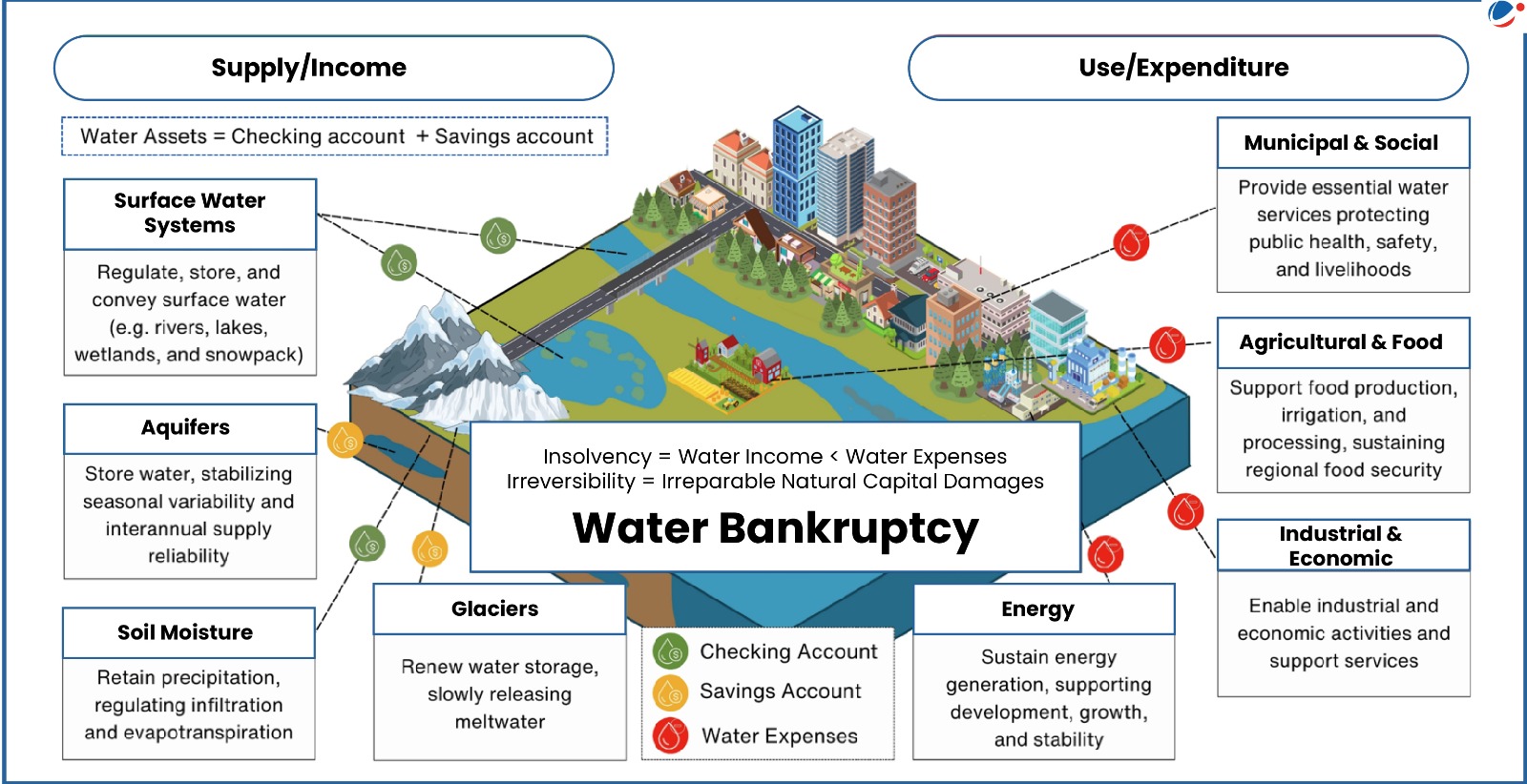
  • Water Bankruptcy is a persistent post-crisis condition of human-water system in which long-term water use has exceeded renewable inflows and safe depletion limits, causing irreversible or effectively irreversible degradation.
    • Report highlights that parts of the water and natural capital—rivers, lakes, aquifers, wetlands, soils, and glaciers—have been damaged beyond realistic prospects of full recovery.
  • In contrast, water stress is a condition of high-water demand relative to supply but impacts are largely reversible and water crisis is where shock-driven disruptions temporarily push water systems beyond capacity but which can be restored through emergency and restoration measures. 

Factors leading to Water Bankruptcy 

  • Slow-onset depletion: Chronic overuse of surface and groundwater slowly degrades storage and quality, with early warning signs ignored until irreversible thresholds are crossed.
  • Infrastructure-driven overshoot: Large dams and transfers enable expansion beyond sustainable limits.
  • Ecological liquidation: Wetlands, floodplains, forests, and soils are converted or degraded in ways that increase short-term productive capacity while eroding long-term water storage, filtration, and buffering.
  • Climate-amplified overshoot: Climate change accelerates existing stress by reducing reliable supply and increasing variability in already overexploited systems.
Watch Video News Today

Explore Related Content

Discover more articles, videos, and terms related to this topic

RELATED VIDEOS

1
Role of Indian Diaspora in Making India Self-Reliant

Role of Indian Diaspora in Making India Self-Reliant

YouTube HD

RELATED TERMS

3

Climate-amplified overshoot

The exacerbation of existing water stress and overuse by climate change. This occurs as climate change reduces reliable water supply and increases variability in already overexploited water systems.

Ecological liquidation

The conversion or degradation of natural water-regulating ecosystems like wetlands, floodplains, forests, and soils. This practice prioritizes short-term productive capacity at the expense of long-term water storage, filtration, and buffering capabilities.

Infrastructure-driven overshoot

A situation where the development and utilization of large-scale water infrastructure, such as dams and water transfer projects, enable water use to expand beyond sustainable ecological and resource limits.

Title is required. Maximum 500 characters.

Search Notes

Filter Notes

Loading your notes...
Searching your notes...
Loading more notes...
You've reached the end of your notes

No notes yet

Create your first note to get started.

No notes found

Try adjusting your search criteria or clear the search.

Saving...
Saved

Please select a subject.

Referenced Articles

linked

No references added yet
