


The Compact, supported by Unified Coalition for AMR Response aims to unlock sustainable financing from both public and private sources to reduce the global AMR deaths, saving more than 100 million lives by 2050.
About AMR
- It occurs when bacteria, viruses, fungi and parasites no longer respond to antimicrobial medicines (antibiotics, antivirals, antifungals, etc.) making them ineffective.
- It is a natural process that happens over time through genetic changes in pathogens.
- However, its spread is accelerated by human activity, mainly the misuse and overuse of antimicrobials.
- Status in India: Around 6 lakh lives are lost each year due to resistant infections.
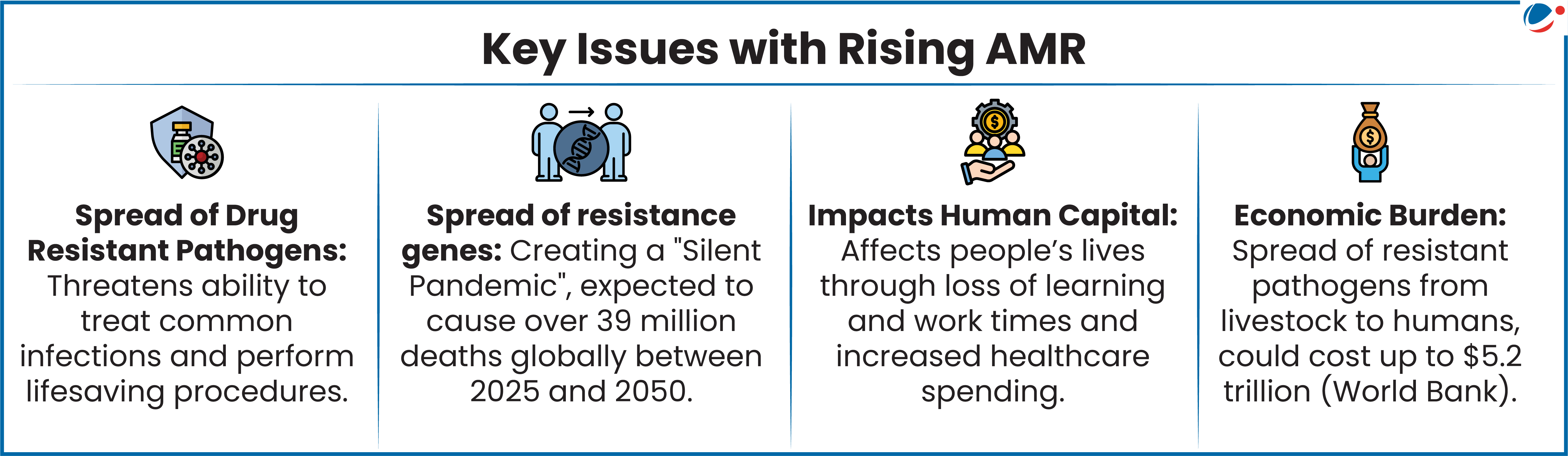
Key Initiatives taken to address AMR
- National Action Plan on AMR 2.0 (2025-2029): Unified and coordinated effort across the human, animal, agriculture and environmental sectors.
- First Indigenous Antibiotic, Nafithromycin: Launched in 2024 ,it is designed to treat both typical and atypical drug-resistant bacteria.
- National surveillance networks: Generate annual AMR surveillance reports, with data submitted to the Global AMR Surveillance System (GLASS).
- Global Initiatives Efforts:
- Global Action Plan (GAP) on AMR during 2015 World Health Assembly.
- United Nations General Assembly High-Level Meeting on AMR, 2024, to reduce global deaths associated with bacterial AMRs by 10% by 2030 against the 2019 baseline, etc.



