Government Notifies Referral Centre “Bhavasagara” and Agharkar Research Institute as National Repository for Deep-Sea Fauna under Biological Diversity Act 2002 | Current Affairs | Vision IAS

Upgrade to Premium Today

Start Now
MENU
Home
Quick Links

High-quality MCQs and Mains Answer Writing to sharpen skills and reinforce learning every day.

Watch explainer and thematic concept-building videos under initiatives like Deep Dive, Master Classes, etc., on important UPSC topics.

A short, intensive, and exam-focused programme, insights from the Economic Survey, Union Budget, and UPSC current affairs.

ESC

In Summary

  • The CMLRE in Kochi houses over 3,500 identified voucher specimens, with Agharkar Research Institute preserving microorganisms and fungi.
  • Under the Biological Diversity Act, the repository will preserve deep-sea species and build taxonomy expertise, aligning with the UN Decade of Ocean Science.
  • Global frameworks like UNCLOS, CBD, SDG 14, and the High Seas Treaty protect marine environments and resources.

In Summary

“Bhavasagara” Referral Centre at the Centre for Marine Living Resources and Ecology (CMLRE) in Kochi, houses over 3,500 taxonomically identified and geo-referenced voucher specimens

  • Agharkar Research Institute Pune, for its collection of Microorganisms and National Fungal Culture Collection.
    • Under the Biological Diversity Act, the repository will securely preserve biological samples, act as custodian of newly discovered deep-sea species, and build expertise in deep-sea taxonomy aligned with the UN Decade of Ocean Science (2021–2030).

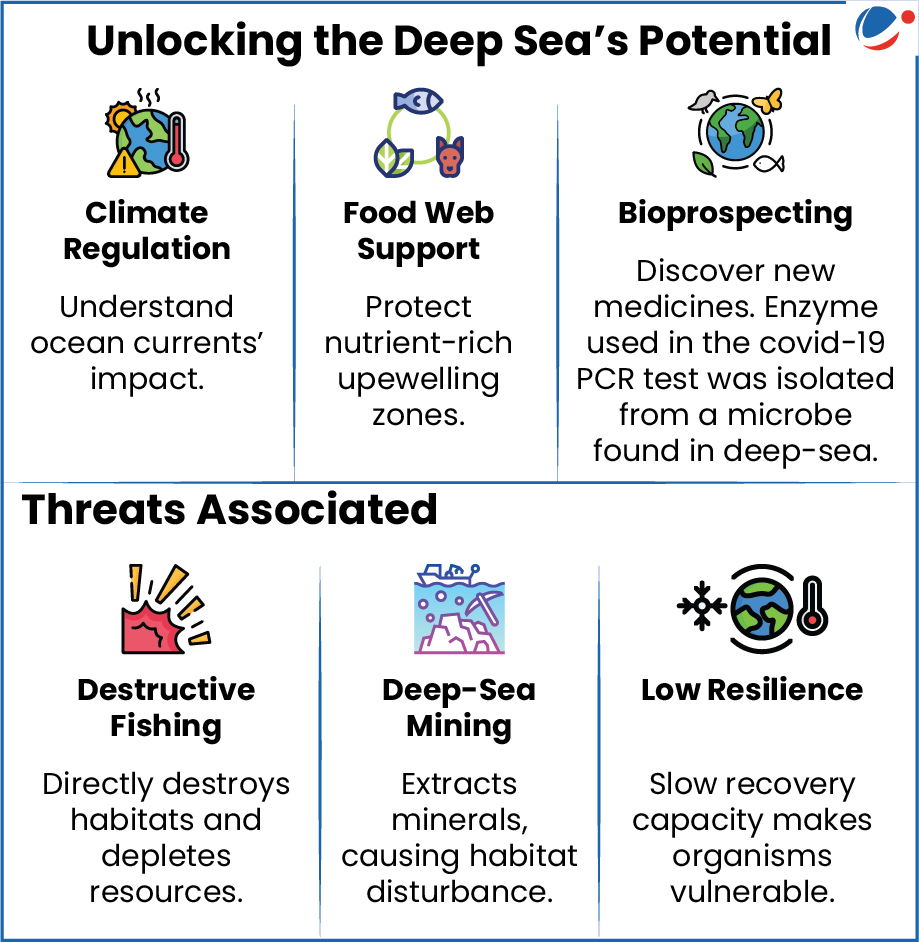
About the Deep Sea

  • Definition: Refers to ocean regions below 200 meters, extending from the twilight zone to the abyssal plains and deep seabed.
    • It is the oldest and largest biome on Earth, constituting nearly 90–95% of Earth’s habitable space.

Global Frameworks Protecting the Marine Environment

  • UNCLOS: Global legal order to protect the marine environment and manage the equitable utilization of ocean resources.
  • Convention on Biological Diversity: Promotes the conservation of biodiversity, sustainable use of its components, and equitable sharing of genetic resource benefits.
  • SDG 14: Focuses on conserving "Life Below Water”.
  • High Seas Treaty (BBNJ Agreement):Legally binding, it protects waters outside national jurisdictions. 
Watch Video News Today

Explore Related Content

Discover more articles, videos, and terms related to this topic

RELATED VIDEOS

3
News Today (Sep 27, 2024)

News Today (Sep 27, 2024)

YouTube HD
Carbon Markets

Carbon Markets

YouTube HD
What is Artificial Rain? | Deep Dive With VisionIAS

What is Artificial Rain? | Deep Dive With VisionIAS

YouTube HD

RELATED TERMS

3

High Seas Treaty (BBNJ Agreement)

A legally binding international agreement that aims to protect marine biodiversity in areas beyond national jurisdiction (the high seas), addressing issues like marine genetic resources, area-based management tools, and environmental impact assessments.

SDG 14 (Life Below Water)

One of the 17 Sustainable Development Goals adopted by the United Nations, specifically focusing on the conservation and sustainable use of oceans, seas, and marine resources for sustainable development.

Convention on Biological Diversity (CBD)

An international treaty adopted at the Earth Summit in Rio de Janeiro in 1992. It aims to conserve biological diversity, promote the sustainable use of its components, and ensure the fair and equitable sharing of benefits arising from the use of genetic resources.

Title is required. Maximum 500 characters.

Search Notes

Filter Notes

Loading your notes...
Searching your notes...
Loading more notes...
You've reached the end of your notes

No notes yet

Create your first note to get started.

No notes found

Try adjusting your search criteria or clear the search.

Saving...
Saved

Please select a subject.

Referenced Articles

linked

No references added yet