
India has food grain stock three times the existing buffer norms: Government | Current Affairs | Vision IAS

Upgrade to Premium Today

Start Now
MENU
Home
Quick Links

High-quality MCQs and Mains Answer Writing to sharpen skills and reinforce learning every day.

Watch explainer and thematic concept-building videos under initiatives like Deep Dive, Master Classes, etc., on important UPSC topics.

A short, intensive, and exam-focused programme, insights from the Economic Survey, Union Budget, and UPSC current affairs.

ESC

In Summary

  • India holds 602 LMT food stock (222 LMT wheat, 380 LMT rice) and ranks high globally in pulses, millets, rice, wheat, fruits, vegetables, spices, and coconut.
  • Agricultural exports grew to USD 51.1 billion (FY25), with processed food share at 20.4%, and horticulture production reached 362.08 MT, exceeding foodgrain output.
  • Buffer stocks, managed by CCEA, ensure food security, price stabilization, PDS supply, and emergency reserves.

In Summary

India currently has around 222 Lakh Metric Tonnes (LMT) of wheat and approximately 380 LMT of rice, taking the total food stock to about 602 LMT.

India’s Foodgrain Production

  • Agricultural exports rose from USD 34.5 billion (FY20) to USD 51.1 billion (FY25), with processed food share increasing to 20.4%, signalling value-added growth.
  • Horticulture production reached 362.08 million tonnes, surpassing foodgrain output and indicating a structural shift towards high-value crops.
  • India ranks among the top producers globally, being largest producer of pulses (25.68 MT) and millets, 2nd largest producer of rice, wheat and fruits and vegetables.
  • Leadership in High-Value Crops with 1st in spices and coconut production and 2nd in sugarcane, cotton, and tea production.

About Buffer Stock

  • It is the quantity of foodgrains procured, stored, and maintained by the government to meet emergency requirements, stabilize prices, and ensure supply through welfare schemes.
  • These norms are fixed by the Cabinet Committee on Economic Affairs (CCEA) on a quarterly basis.
  • Purpose of Buffer Stock
    • Food Security: Ensures availability of food during droughts, floods, or crop failure.
    • Price Stabilisation: Prevents sharp rise or fall in food prices.
    • Public Distribution System (PDS): Supplies subsidised foodgrains to the poor.
    • Emergency Reserve: Acts as a cushion during crises.
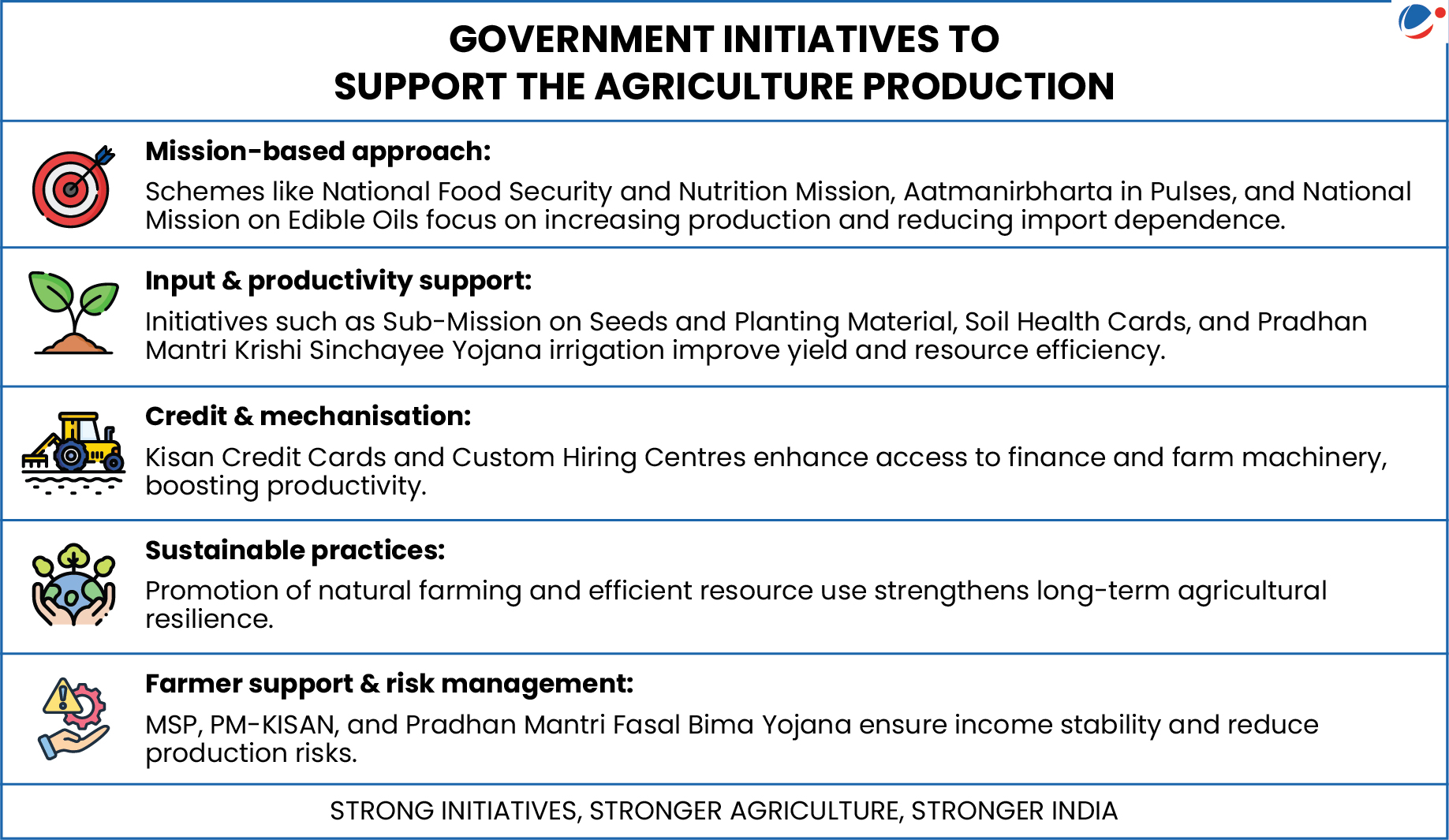
Watch Video News Today

Explore Related Content

Discover more articles, videos, and terms related to this topic

RELATED VIDEOS

3
The Contribution of Indian Cinema to the Creative Economy

The Contribution of Indian Cinema to the Creative Economy

YouTube HD
Impact Investments

Impact Investments

YouTube HD
Universal and Meaningful Connectivity

Universal and Meaningful Connectivity

YouTube HD

RELATED TERMS

3

Horticulture production

The cultivation of fruits, vegetables, flowers, medicinal plants, and plantation crops. Surpassing foodgrain output signifies a shift towards these higher-value agricultural segments.

Value-added growth

Economic growth achieved through processing raw materials or agricultural produce into higher-value finished goods, as indicated by the increasing share of processed food in agricultural exports.

Horticulture

The art and science of cultivating fruits, vegetables, ornamental plants, and medicinal herbs. It is a key component of diversifying agriculture and increasing farm incomes.

Title is required. Maximum 500 characters.

Search Notes

Filter Notes

Loading your notes...
Searching your notes...
Loading more notes...
You've reached the end of your notes

No notes yet

Create your first note to get started.

No notes found

Try adjusting your search criteria or clear the search.

Saving...
Saved

Please select a subject.

Referenced Articles

linked

No references added yet
