
Need for Multilateralism in Outer Space Governance | Current Affairs | Vision IAS

Upgrade to Premium Today

Start Now
MENU
Home
Quick Links

High-quality MCQs and Mains Answer Writing to sharpen skills and reinforce learning every day.

Watch explainer and thematic concept-building videos under initiatives like Deep Dive, Master Classes, etc., on important UPSC topics.

A short, intensive, and exam-focused programme, insights from the Economic Survey, Union Budget, and UPSC current affairs.

ESC

In Summary

  • Existing Outer Space Treaty (OST) has weak enforcement and lacks detailed private sector regulations, hindering effective governance.
  • The Artemis Accords' 'safety zones' and geopolitical fragmentation, like US-led Artemis vs. China-led ILRS, risk resource control and conflict.
  • Transitioning to sustained space presence requires a multilateral, rules-based order to prevent de facto sovereignty and militarization.

In Summary

Recently launched Artemis II Mission to Moon and related ‘Space Race’ have reignited the debate around the Outer Space Governance.

Challenges in Outer Space Governance and Need for Multilateralism

  • Limitations of Existing Frameworks: OST lacks detailed regulatory code for private sector (although they are responsibility of States); potentially weak enforcement mechanism.
  • Space Resource Exploitation: E.g. The Artemis Accords propose "safety zones" to avoid "harmful interference" which may act as exclusion zones, letting early nations control lunar resources. 
  • Threat of Militarization: Use of dual-use technologies heightens strategic distrust.
  • Geopolitical Fragmentation: Outer Space is seeing a transition from space exploration to sustained presence, which necessitates a rules-based order to prevent de facto sovereignty and conflict.
    • E.g. US-led Artemis and China-led International Lunar Research Station (ILRS)

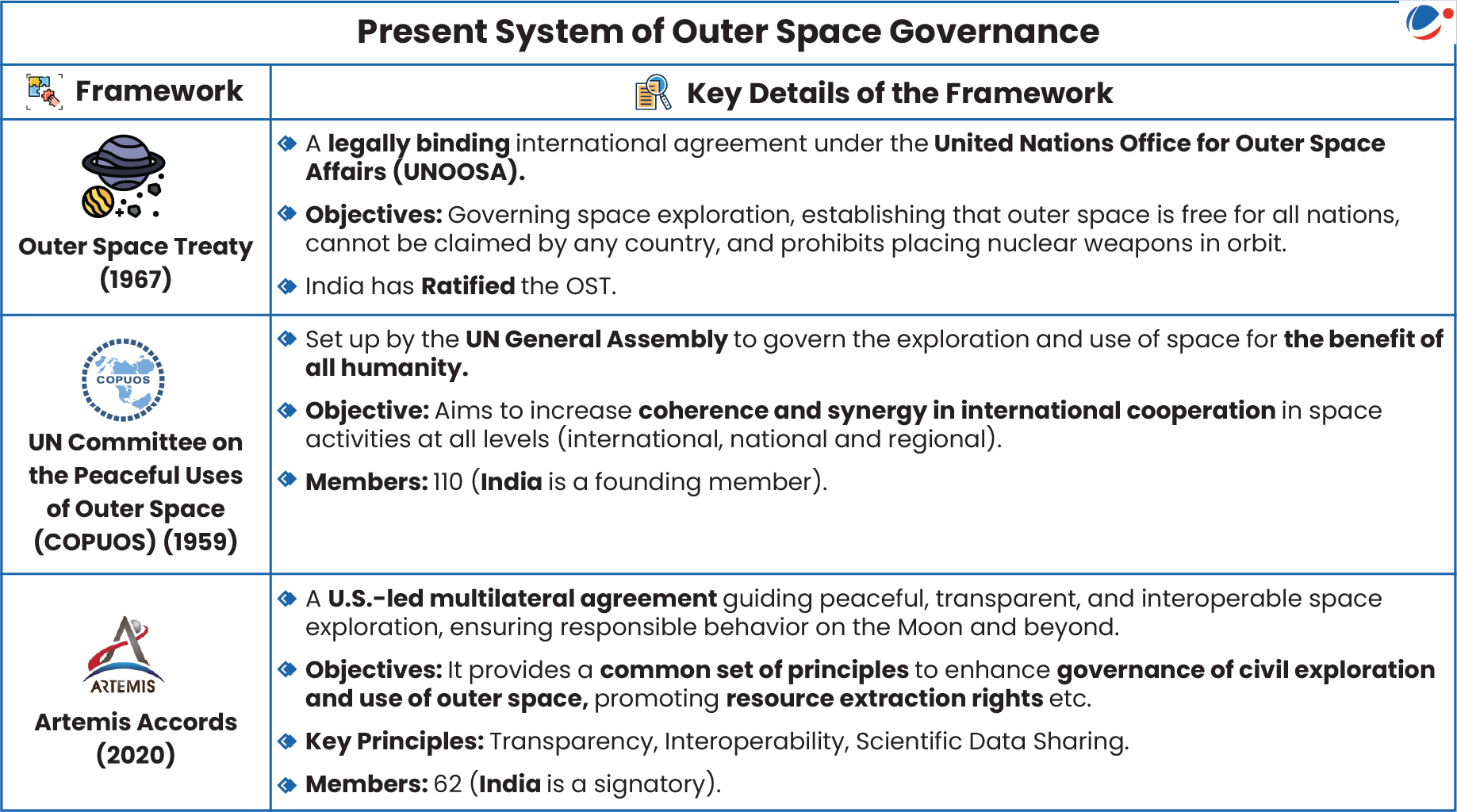
Present System of Outer Space Governance
Watch Video News Today

Explore Related Content

Discover more articles, videos, and terms related to this topic

RELATED TERMS

3

De Facto Sovereignty

The assertion of control or jurisdiction over a territory or domain, such as outer space, through actual occupation and use, rather than through formal international recognition or legal establishment. In space, this could arise from a nation or entity establishing a sustained presence and claiming control over resources or areas.

International Lunar Research Station (ILRS)

A proposed lunar base project led by China and Russia, aiming to establish a scientific research station on the Moon. It is seen as a rival to the US-led Artemis program's objectives for lunar presence.

Militarization of Space

The development and deployment of weapons or military capabilities in outer space, or the use of space assets for military purposes. This is a significant concern in outer space governance due to the potential for escalating conflicts and strategic instability.

Title is required. Maximum 500 characters.

Search Notes

Filter Notes

Loading your notes...
Searching your notes...
Loading more notes...
You've reached the end of your notes

No notes yet

Create your first note to get started.

No notes found

Try adjusting your search criteria or clear the search.

Saving...
Saved

Please select a subject.

Referenced Articles

linked

No references added yet