
Supreme Court Judges expressed concern about misuse of Public Interest Litigation (PIL) | Current Affairs | Vision IAS

Upgrade to Premium Today

Start Now
MENU
Home
Quick Links

High-quality MCQs and Mains Answer Writing to sharpen skills and reinforce learning every day.

Watch explainer and thematic concept-building videos under initiatives like Deep Dive, Master Classes, etc., on important UPSC topics.

A short, intensive, and exam-focused programme, insights from the Economic Survey, Union Budget, and UPSC current affairs.

ESC

In Summary

  • PILs, intended for social justice, are increasingly misused for personal, publicity, or political gain, eroding public trust.
  • Originating in the US, PILs were pioneered in India by Justices Bhagwati and Iyer, with the first case being Hussainara Khatoon (1979).
  • Challenges include judicial burden, potential overreach, and abuse of liberal locus standi, despite SC/HC powers under Articles 32/226.

In Summary

The judge observed that PILs, originally meant to advance social justice and improve access to justice, are increasingly being misused as private, publicity, political and even paisa interest litigations.
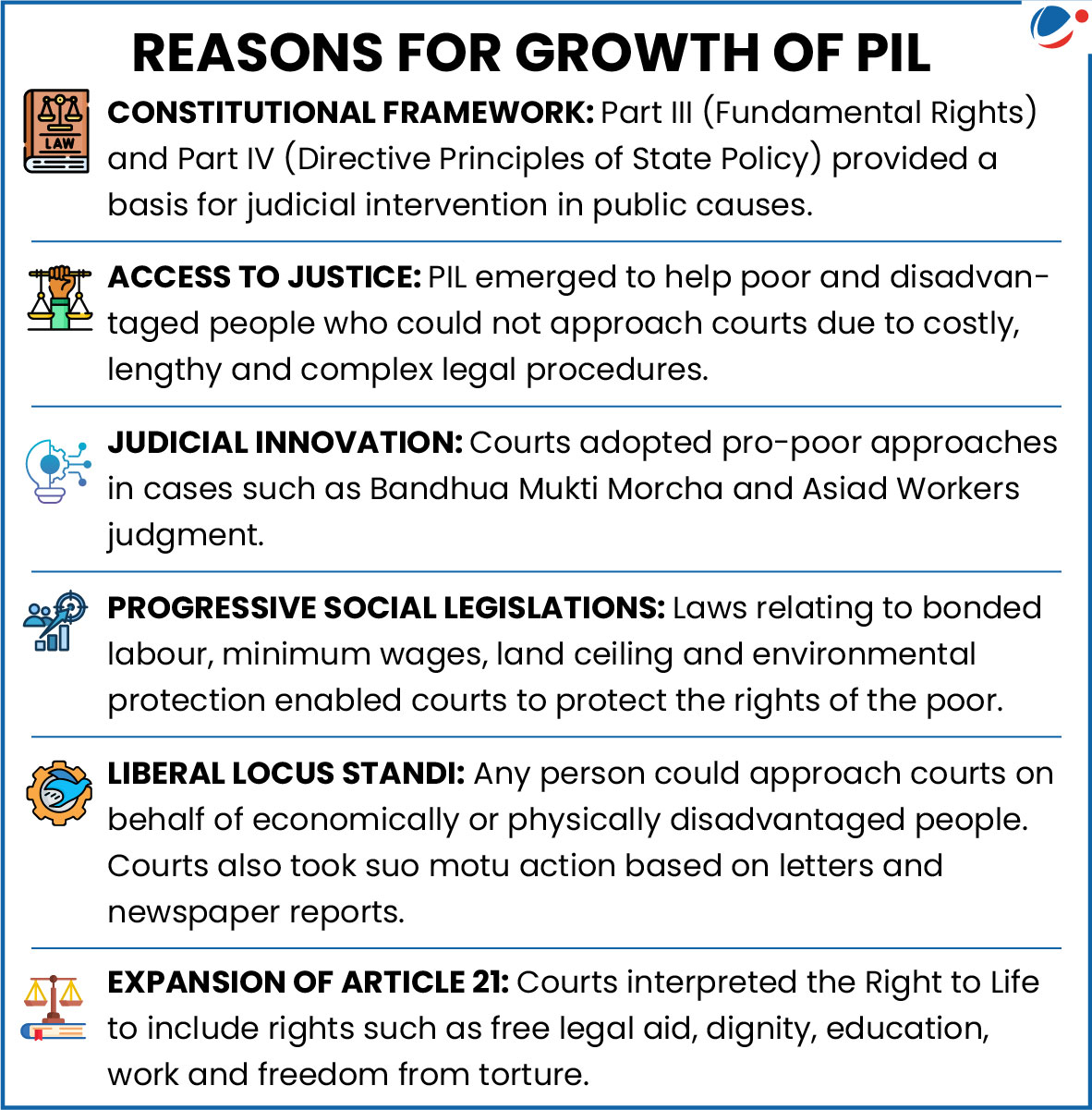
About Public Interest Litigation

  • Definition: It refers to the litigations, filed by a party without any locus standi (i.e., the party who is not aggrieved), to protect the general public interest.
  • Origin: PIL concept began in the late Nineteenth Century in the United States, with the landmark Gideon's case forming its foundation.
    • Efforts of Justice P N Bhagwati and Justice V R Krishna Iyer were instrumental in initialization of PILs in India. 
    • In India, first reported instance of PIL is when Justice Bhagwati ordered release of 70 undertrial prisoners in Hussainara Khatoon Case, 1979.
  • The Supreme Court and the High Courts have the right to admit PILs under Articles 32 and 226, respectively.

Challenges

  • Misuse of PIL: PIL has often been used for publicity purposes, personal gains, vendetta politics, thus weakening public trust.
  • Burden on Judiciary: PIL cases are often prioritised over ordinary pending cases, increasing pressure on courts and delaying other matters.
  • Judicial Overreach Concerns: PIL has faced criticism for the judiciary overstepping its jurisdiction and facing difficulties in ensuring implementation of its orders.
  • Others: Frivolous Litigation, Abuse of liberal locus standi etc. 

Watch Video News Today

Explore Related Content

Discover more articles, videos, and terms related to this topic

RELATED VIDEOS

2
News Today (Apr 12-13, 2026)

News Today (Apr 12-13, 2026)

YouTube HD
Lateral Entry

Lateral Entry

YouTube HD

RELATED TERMS

3

Frivolous Litigation

Legal actions that are considered trivial, baseless, or brought without any legitimate legal grounds, often intended to harass or delay. This is a challenge associated with the misuse of liberal locus standi in PILs.

Judicial Overreach

A situation where the judiciary is perceived to exceed its constitutional mandate and intrude upon the functions of the executive or legislative branches. The concept of 'constitutional morality' has been criticized for potentially contributing to judicial overreach.

Article 226

Empowers High Courts to issue writs for the enforcement of fundamental rights and for any other purpose. High Courts in India can admit PILs under this article.

Title is required. Maximum 500 characters.

Search Notes

Filter Notes

Loading your notes...
Searching your notes...
Loading more notes...
You've reached the end of your notes

No notes yet

Create your first note to get started.

No notes found

Try adjusting your search criteria or clear the search.

Saving...
Saved

Please select a subject.

Referenced Articles

linked

No references added yet