
ILO adopts First Global Treaty to set Binding Labor Standards for Gig Work | Current Affairs | Vision IAS

Upgrade to Premium Today

Start Now
MENU
Home
Quick Links

High-quality MCQs and Mains Answer Writing to sharpen skills and reinforce learning every day.

Watch explainer and thematic concept-building videos under initiatives like Deep Dive, Master Classes, etc., on important UPSC topics.

A short, intensive, and exam-focused programme, insights from the Economic Survey, Union Budget, and UPSC current affairs.

ESC

In Summary

  • ILO Convention 193 promotes decent work for platform workers, ensuring fair pay, safety, and rights.
  • It mandates algorithmic transparency, data privacy, and protection for vulnerable groups like migrant workers.
  • The ILO, established in 1919, promotes social justice and decent work, with India as a founding member.

In Summary

The ILO Convention No. 193Concerning Decent Work in the Platform Economy’ was adopted at the 114th session of International Labour Organization (ILO) in Geneva. 
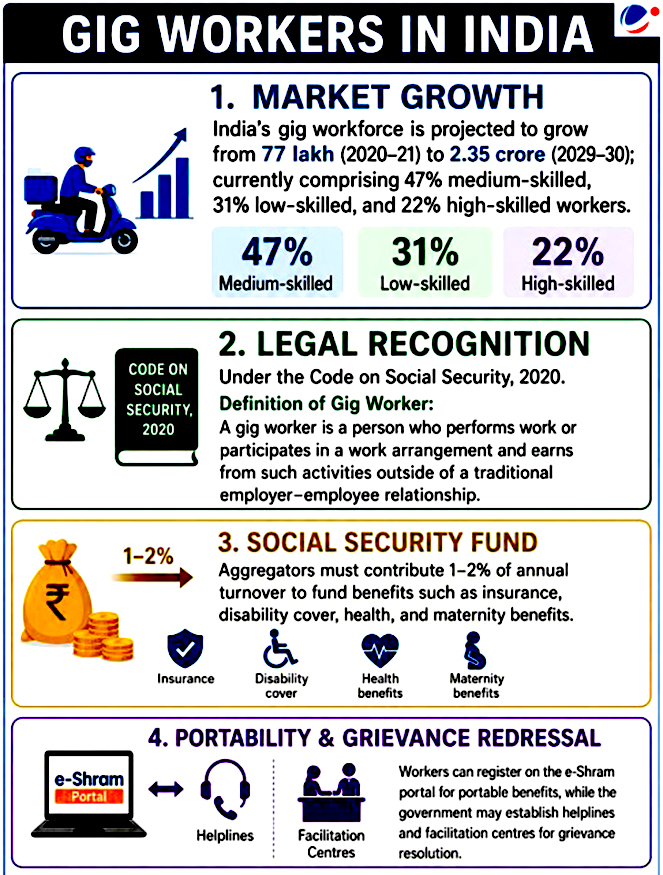
  • Enforcement: The convention will take effect 12 months after at least two member states ratify it, requiring governments to establish effective dispute resolution and enforcement mechanisms.

Key Features of the Convention

  • Comprehensive Coverage: The protections apply to all formal and informal platform workers (both online or location-based such as delivery, taxi).
  • Worker Classification & Fair Pay: Governments must ensure gig workers are correctly classifiedbased on how their work is performed, preventing misclassification. 
    • Workers must receive timely pay and, if considered employees, at least theminimum wage.
  • Fundamental Rights & Safety: Guarantees core rights such as freedom of association, non-discrimination, and access to social security. It also ensures a safe working environment, allowing workers to refuse dangerous tasks without penalty.
  • Algorithmic Transparency: Platforms must be transparent about automated systems used to monitor workers. 
    • Workers have the right to request a human review of significant automated decisions, such as account deactivations or withheld pay.
  • Data & Vulnerable Groups: The treaty mandates strict safeguards for personal data privacy and includes specific measures to protect migrant and refugee platform workers from recruitment and employment abuses.

About ILO

  • Establishment: In 1919 under Treaty of Versailles; became the first specialized agency of the UN in 1946.
  • Members: 187; India is a founding Member and has been a permanent member of the ILO Governing Body since 1922.
  • Mandate: Promotes social justice, decent work, and internationally recognized labour rights, based on the principle that lasting peace rests on social justice.
  • Global Recognition: Awarded the 1969 Nobel Peace Prize for advancing workers' rights, social justice, and international cooperation.
  • Key Reports: World Employment and Social Outlook (WESO), Global Wage Report, World Social Protection Report, etc.
  • ILO Conventions: India has ratified six out of the eight core/fundamental ILO Conventions, except -
    • Freedom of Association and Protection of the Right to Organise Convention, 1948 (No. 87).
    • Right to Organise and Collective Bargaining Convention, 1949 (No. 98).
Watch Video News Today

Explore Related Content

Discover more articles, videos, and terms related to this topic

RELATED VIDEOS

3
The Contribution of Indian Cinema to the Creative Economy

The Contribution of Indian Cinema to the Creative Economy

YouTube HD
Impact Investments

Impact Investments

YouTube HD
Universal and Meaningful Connectivity

Universal and Meaningful Connectivity

YouTube HD

RELATED TERMS

3

Right to Organise and Collective Bargaining Convention, 1949 (No. 98)

An ILO convention that aims to protect workers' rights to organize and engage in collective bargaining, ensuring that employers negotiate with workers' representatives and do not discriminate against union members.

Freedom of Association and Protection of the Right to Organise Convention, 1948 (No. 87)

An ILO convention that guarantees workers and employers the right to form and join organizations of their own choosing, and for these organizations to function freely, without interference from the state or each other.

Core/Fundamental ILO Conventions

A set of eight internationally agreed-upon conventions that represent the core principles of labor rights, including freedom of association, abolition of forced labor, elimination of child labor, and non-discrimination. Ratification of these is considered a mark of a country's commitment to labor standards.

Title is required. Maximum 500 characters.

Search Notes

Filter Notes

Loading your notes...
Searching your notes...
Loading more notes...
You've reached the end of your notes

No notes yet

Create your first note to get started.

No notes found

Try adjusting your search criteria or clear the search.

Saving...
Saved

Please select a subject.

Referenced Articles

linked

No references added yet
