
Madhya Pradesh plans to restart excavation of the Vaishya Tekri site in Ujjain | Current Affairs | Vision IAS

Upgrade to Premium Today

Start Now
MENU
Home
Quick Links

High-quality MCQs and Mains Answer Writing to sharpen skills and reinforce learning every day.

Watch explainer and thematic concept-building videos under initiatives like Deep Dive, Master Classes, etc., on important UPSC topics.

A short, intensive, and exam-focused programme, insights from the Economic Survey, Union Budget, and UPSC current affairs.

ESC

In Summary

  • The Maurya-era Buddhist stupa, a centrally protected site, may be larger than the Great Stupa at Sanchi.
  • Key stupa components include the Anda (mound), Harmika (abode of gods), Yashti (pole), Chhatri (umbrella), Vedika (railing), Torana (gateway), and Pradakshinapatha (path).

In Summary

The huge Maurya-era Buddhist stupa was partially excavated in 1938–39 and the structure could be larger than the Great Stupa at Sanchi. 

  • It is a centrally protected archaeological site under Archaeological Survey of India (ASI).

About Stupa

  • A stupa was originally a mound containing relics of Buddha, his bodily remains or objects associated with him.
    • The tradition of building stupas may have been pre-Buddhist.
  • According to the Ashokavadana, Ashoka distributed portions of Buddha's relics to important towns and ordered stupas to be constructed over them.

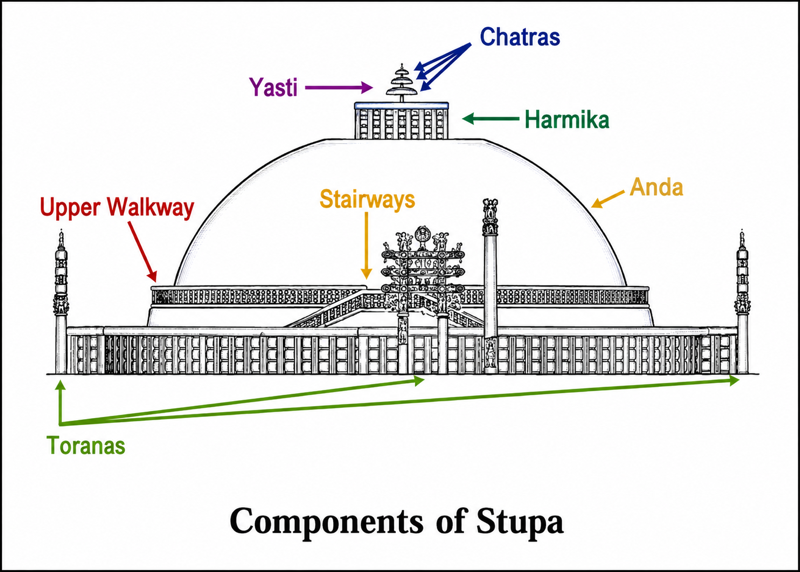
Components of Stupa 

  • Anda: Hemispherical mound; evolved from the original earth mound.
  • Harmika: Balcony-like structure above the anda; represented abode of gods.
  • Yashti: Pole rising from the harmika.
  • Chhatri: Umbrella over the yashti.
  • Vedika/Railing: Separated sacred space from secular world.
  • Torana: Gateway, often richly carved.
  • Pradakshinapatha: Circumambulatory path around the stupa.

Types of Stupas

  • Relic Stupa: Contains relics/remains of Buddha, Buddhas, disciples or saints.
    • Ex: Piprahwa Stupa, UP
  • Object Stupa: Preserves sacred objects associated with Buddha/Buddhist teachers.
    • Ex: Kesariya Stupa, Bihar
  • Commemorative Stupa: : Commemorates important events/places in Buddha’s life.
    • Ex: Dharmarajika Stupa at Sarnath, Ashokan Stupa at Bodh Gaya.
  • Symbolic Stupa: Symbolises Buddha and his Dhamma, with or without relics.
  • Votive Stupa: Small stupas built by pilgrims/devotees at important Buddhist centres.
Tags:
Watch Video News Today

Explore Related Content

Discover more articles, videos, and terms related to this topic

RELATED VIDEOS

1
In conversation:  Meaning of Living Heritage

In conversation: Meaning of Living Heritage

YouTube HD

RELATED TERMS

3

Archaeological Survey of India (ASI)

A premier organisation of the Government of India, responsible for archaeological research and the conservation and preservation of cultural monuments in the country. It falls under the Ministry of Culture.

Pradakshinapatha

A circumambulatory path around the base of a stupa, used by devotees for ritualistic walking (pradakshina) in a clockwise direction.

Torana

A gateway, typically found in Buddhist stupas, which is often elaborately carved and marks an entrance to the sacred precinct.

Title is required. Maximum 500 characters.

Search Notes

Filter Notes

Loading your notes...
Searching your notes...
Loading more notes...
You've reached the end of your notes

No notes yet

Create your first note to get started.

No notes found

Try adjusting your search criteria or clear the search.

Saving...
Saved

Please select a subject.

Referenced Articles

linked

No references added yet