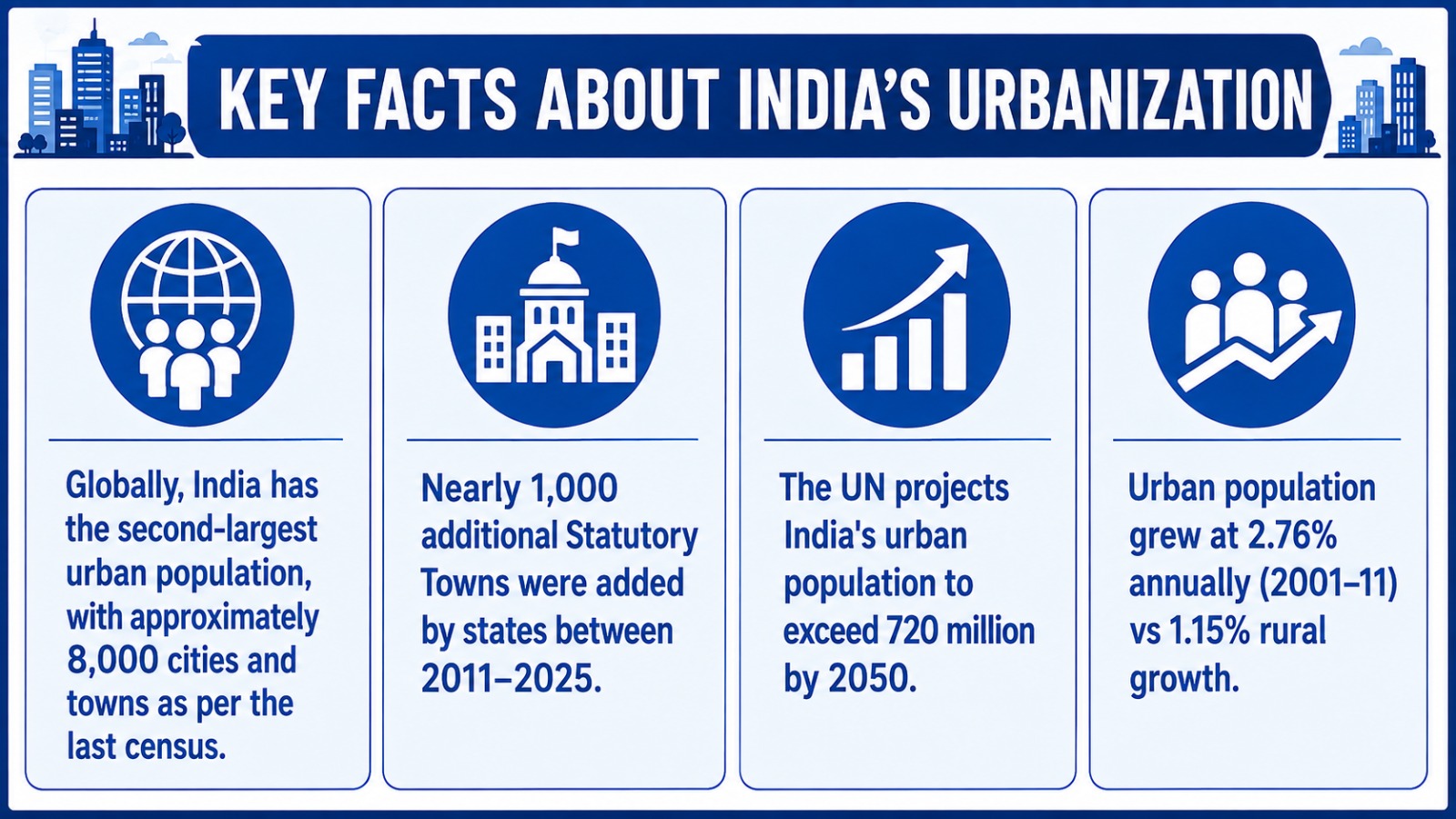
Prepared by World Resources Institute (WRI) India at the request of the Economic Advisory Council to the Prime Minister (EAC-PM), the report provides evidence-based recommendations for a National Urbanization Policy (NUP).
Key Highlights of the Report
| Issues In Urbanization | Recommendations |
Hidden Urbanization: 7,428 small towns; many Census Towns remain under rural governance. | Standardize urban classification and municipalisation criteria. |
Peri-urban sprawl: Growth beyond municipal boundaries, e.g. Bengaluru Electronic City. | Adopt city-region planning for peri-urban areas. |
Fragmented planning: Housing, transport and industry planned separately. | Make statutory regional plans the common framework for land use, housing, transport and infrastructure. |
Infrastructure gaps: 17% waste remains uncollected; only 26% treated. | Prioritize integrated infrastructure, especially in small towns. |
Housing shortage: Urban housing shortage increased from 18.78 million units (2012) to ~29 million (2018). | Promote affordable, serviced and climate-resilient housing. |
Climate vulnerability: At 3°C warming, 103 Indian cities could experience ≥150 days/year above 35°C. | Integrate climate resilience and multi-hazard planning. |
Governance silos: Multiple ministries and agencies work separately. | Establish a National Urbanization Council and State Urbanization Councils to coordinate ministries. |
Weak municipal finance (Incomplete Devolution under 74th Amendment): Property tax contributes only ~0.15% of GDP, leaving them short on finances. | Strengthen the 3Fs Functions, Funds and Functionaries. |
Weak urban data: Peri-urban growth is poorly captured. | Develop a national urban data ecosystem and knowledge-sharing network. |