
Prime Minister highlighted India’s Elephant conservation efforts on World Elephant Day (August 12) | Current Affairs | Vision IAS

Upgrade to Premium Today

Start Now
MENU
Home
Quick Links

High-quality MCQs and Mains Answer Writing to sharpen skills and reinforce learning every day.

Watch explainer and thematic concept-building videos under initiatives like Deep Dive, Master Classes, etc., on important UPSC topics.

A short, intensive, and exam-focused programme, insights from the Economic Survey, Union Budget, and UPSC current affairs.

ESC

In Summary

  • Elephants, divided into African and Asian groups, are keystone species vital for ecosystem health through seed dispersal and habitat creation.
  • Asian elephants, with India hosting 60% of the global population, are classified as Endangered under IUCN Red List and Schedule I of the Wildlife Protection Act, 1972.
  • India's conservation efforts include Project Elephant (1992), 33 Elephant Reserves, 150 Corridors, genetic databases, and measures to mitigate human-elephant conflict and train collisions.

In Summary

Elephants are divided into two distinct geographical and genetic groups: African elephants (Loxodonta africana) and Asian elephants (Elephas maximus). 

About Elephants
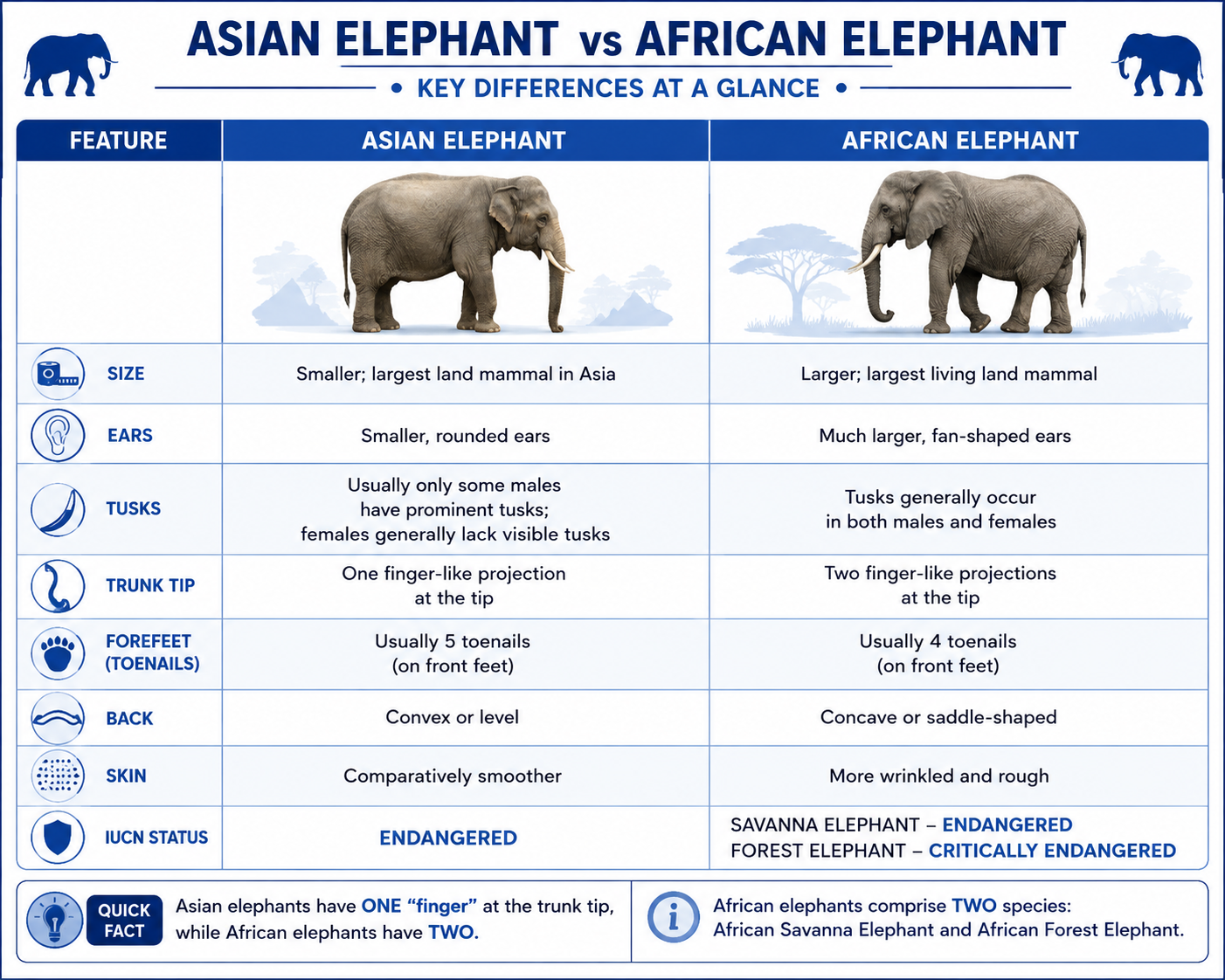
  • Characteristics:
    • Live in complex social groups led by a matriarch.
    • Have the longest gestation period among mammals, about 22 months.
  • Ecological Role:
    • Keystone/Foundational species: Helps maintain ecosystem structure and functioning.
    • Ecosystem engineer: Creates pathways through dense forests, facilitating movement of other wildlife.
    • Forest regeneration: Supports seed dispersal and nutrient cycling, maintaining forest diversity.
    • Habitat creation: Helps create micro-ecosystems and strengthens habitat connectivity.
  • Threats: Habitat loss and fragmentation, human–elephant conflict, poaching, electrocution, train collisions and genetic isolation. 

About Asian Elephants

  • Sub-species: Indian (Elephas maximus indicus), Sumatran, Bornean and Sri Lankan.
  • Habitat: Found in dry to wet forests and grasslands across 13 range countries.
    • India hosts nearly 60% (22,446) of the world’s wild Asian elephants
    • Karnataka tops among states.
  • Conservation Status:
    • IUCN Red List: Endangered
    • Wildlife (Protection) Act, 1972: Schedule I
    • CITES: Appendix I

Elephant Conservation Initiatives in India 

  • Project Elephant (1992): Central Government’s flagship programme for elephant conservation, habitat protection and mitigation of human–elephant conflict.
  • MIKE (Monitoring of Illegal Killing of Elephants): CITES-led programme to monitor illegal killing.
  • Elephant Reserves and Corridors: India has 33 Elephant Reserves across 14 elephant-range States and 150 Corridors.
  • Management Effectiveness Evaluation (2023): Assesses Elephant Reserves to promote outcome-based and adaptive management.
  • Gajah Suchana: A genetic database and mobile application for identification and monitoring of captive elephants.
  • Railway Mitigation Measures: Underpasses, overpasses, ramps and sensor-based technologies to reduce train collisions.
  • Rules and Guidelines: 
    • Captive Elephant (Transfer or Transport) Rules, 2024; 
    • Human–Wildlife Conflict Advisory and Elephant-specific Conflict Mitigation Guidelines (2023).
Watch Video News Today

Explore Related Content

Discover more articles, videos, and terms related to this topic

RELATED VIDEOS

3
News Today (Jul 20, 2024)

News Today (Jul 20, 2024)

YouTube HD
Carbon Markets

Carbon Markets

YouTube HD
What is Artificial Rain? | Deep Dive With VisionIAS

What is Artificial Rain? | Deep Dive With VisionIAS

YouTube HD

RELATED TERMS

3

Human–Wildlife Conflict

The negative interactions between human activities and wildlife, often resulting in damage to human property, livelihoods, and human or wildlife fatalities. Mitigation strategies are crucial for conservation success.

Gajah Suchana

A genetic database and mobile application developed for the identification and monitoring of captive elephants in India. It aids in tracking individual animals and managing their welfare.

Management Effectiveness Evaluation (MEE)

A process used to assess how well protected areas are managed. For Elephant Reserves, MEE helps in promoting outcome-based and adaptive management to improve conservation efforts.

Title is required. Maximum 500 characters.

Search Notes

Filter Notes

Loading your notes...
Searching your notes...
Loading more notes...
You've reached the end of your notes

No notes yet

Create your first note to get started.

No notes found

Try adjusting your search criteria or clear the search.

Saving...
Saved

Please select a subject.

Referenced Articles

linked

No references added yet