
Base Year Update in the 2026 National Accounts Statistics (NAS) Series | Current Affairs | Vision IAS

Upgrade to Premium Today

Start Now
MENU
Home
Quick Links

High-quality MCQs and Mains Answer Writing to sharpen skills and reinforce learning every day.

Watch explainer and thematic concept-building videos under initiatives like Deep Dive, Master Classes, etc., on important UPSC topics.

A short, intensive, and exam-focused programme, insights from the Economic Survey, Union Budget, and UPSC current affairs.

ESC

In Summary

  • The 8th National Accounts Statistics (NAS) revision updates India's base year from 2011-12 to 2022-23, modernizing national accounting methodology.
  • Key changes include double deflation for factory growth, direct informal sector measurement via surveys, and expanded corporate/government coverage using MCA-21 filings.
  • These improvements enhance accurate real growth measurement, global credibility, data harmony, and better policy targeting by incorporating GST data and recent survey baselines.

In Summary

The 8th NAS series revision (on the recommendations of B.N. GoldarCommittee) has modernized India’s national accounting methodology and updated the base year from 2011–12 to 2022–23.

  • A Base Year is a specified reference benchmark year used to calculate constant-price (real) macroeconomic estimates, eliminating the distortions caused by inflation over time.
  • The NAS is a comprehensive statistical framework, compiled and published annually by the National Accounts Division (NAD) under the National Statistics Office (NSO), Ministry of Statistics and Programme Implementation (MoSPI).
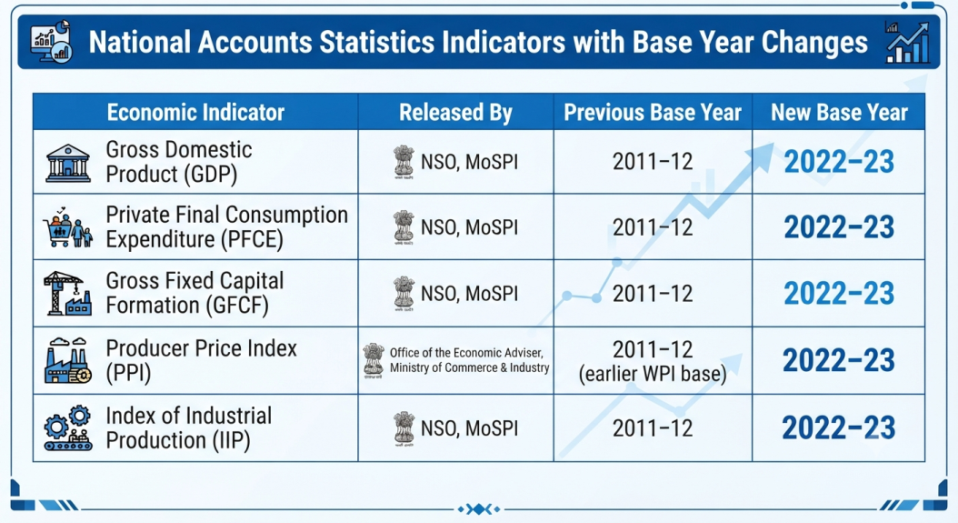
Key Changes Made in Methodologies

  • Double deflation: Factory growth is calculated by separately adjusting input costs and output prices for inflation (replacing the earlier single-index method), using Annual Survey of Industries (ASI) data. 
  • Direct informal sector measurement: Small businesses and informal workers are now estimated via field surveys (Annual Survey of Unincorporated Sector Enterprises & Periodic Labour Force Survey) instead of indirect methods. 
  • Expanded corporate & government coverage: MCA-21 filings track active and multi-industry firms; government pension and housing benefits are included. 
  • Other improvements: Smoother quarterly GDP series and full integration of Supply and Use Tables (SUT) to eliminate statistical discrepancies.

Significance for India

  • Accurate Real Growth Measurement: Double deflation captures actual volume changes, technology improvements, and terms-of-trade shifts without distortions caused by volatile raw material/energy prices.
  • Enhanced Global Credibility: Complete compliance with UN SNA 2008 and IMF standards improves cross-border reliability and sovereign ratings assessment.
  • Data Harmony: The SUT balancing framework removes arbitrary statistical discrepancies between expenditure and output estimates.
  • Better Policy Targeting: Incorporates high-frequency GST data and recent survey baselines, providing policymakers with a truer depiction of the formal and informal sector balances.
Watch Video News Today

Explore Related Content

Discover more articles, videos, and terms related to this topic

RELATED TERMS

3

GST data

Data collected from the Goods and Services Tax (GST) regime, which is a comprehensive indirect tax levied on the supply of goods and services. It is a crucial source for understanding economic activity in sectors like trade and accommodation.

IMF standards

Standards and guidelines set by the International Monetary Fund (IMF) for compiling economic statistics, particularly in areas like balance of payments, government finance, and national accounts, to ensure international comparability and reliability.

UN SNA 2008

The United Nations System of National Accounts 2008 is an internationally recognized framework for the compilation of national accounts, providing guidelines for measuring economic activity.

Title is required. Maximum 500 characters.

Search Notes

Filter Notes

Loading your notes...
Searching your notes...
Loading more notes...
You've reached the end of your notes

No notes yet

Create your first note to get started.

No notes found

Try adjusting your search criteria or clear the search.

Saving...
Saved

Please select a subject.

Referenced Articles

linked

No references added yet
