Introduction
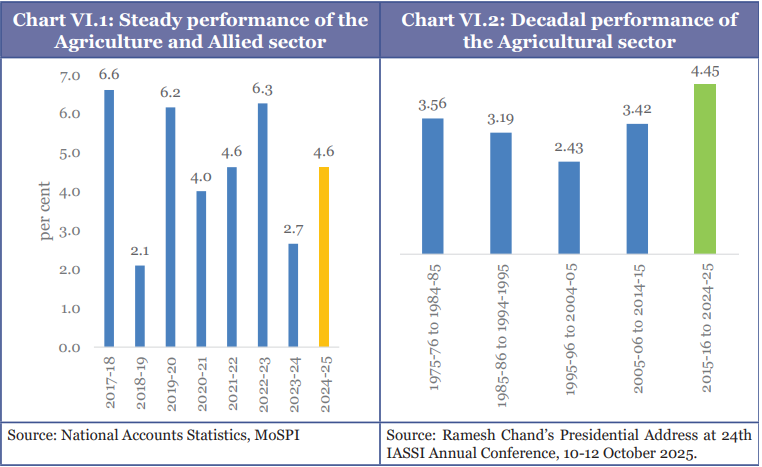
- Contributes nearly one-fifth of India's national income at current prices, but account for 46.1 % of the country's workforce.
- India's agriculture recorded a robust Quinquennial and a highest decadal growth of 4.4 % (more than global average).
- This has primarily resulted from the strong performance in livestock (7.1 %) and fishing and aquaculture (8.8 %), followed by the crop sector at 3.5 % (FY16-FY25).
Chapter Precap
Agricultural and Allied Sector Performance
| Critical Inputs and Technology
|
Food Processing
| |
Overview of Agricultural and Allied Sector Performance
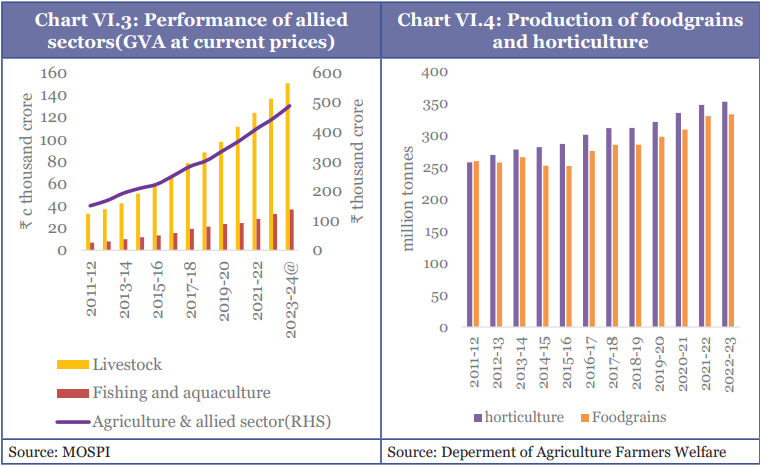
- Food grain production is estimated to have reached 3,577.3 lakh metric tonnes (LMT) in 2024–25.
- This growth has been driven by higher output of rice, wheat, maize and coarse cereals (Shree Anna).
- Yields of major crops like cereals, pulses, rice, maize, soybean has increased while of groundnut has decreased.
- Horticulture sector accounts for approximately 33 % of agricultural GVA
- In 2024-25, horticulture production reached 362.08 MT surpassing food grain production underscoring diversification to high value crops.
- India is world's largest producer of dry onions and ranks second in the production of vegetables, fruits, and potatoes.
- Livestock sector: During FY 15 and FY24, it recorded a strong expansion, with its GVA increasing by nearly 195 %.
- India has consolidated its status as a major global seafood supplier, exporting to over 130 countries.
- Regional disparities in Yield: E.g., Major rice producing states like West Bengal, Uttar Pradesh, Telangana, and Andhra Pradesh record yields lower than the national average.
- Challenges in productivity:
- Climate: E.g. According to NITI Aayog, in 15 of the 27 El Niño years (1951–2024), pulse acreage declined by 2-9 %
- Resource constraints: land and water resources are increasingly being constrained due to rising population
- Input constraints: E.g. limited availability of quality seeds,
State level Innovations in Agricultural Governance leading to improved farm outcomes
|
Drivers of Productivity Improvement: Policy and Institutional Interventions
Re-orienting Fertiliser Use towards Soil Health and Crop Productivity
|
- Targeted Policy Missions: National Food Security Mission (NFSM) enhanced productivity and production of Rice, Wheat, Pulses, Coarse Cereals, Commercial Crops, and Nutri-Cereals (Shree Anna).
- In FY25, the scheme was renamed the National Food Security and Nutrition Mission (NFSNM).
- Oilseeds: National Mission on Edible Oils-Oilseeds (NMEO-OS) and the National Mission on Edible Oils–Oil Palm (NMEO-OP) aiming for nearly 70 million tonnes by 2030-31
- Between 2014–15 and 2024–25, the area under oilseeds increased by over 18 %, production by nearly 55 %, and productivity by about 31 %.
- Oil palm area more than doubled over the same.
- Domestic edible oil availability has risen from 86.30 lakh tonnes in 2015-16 to 121.75 lakh tonnes in 2023-24.
- This has lowered the share of imported edible oil, reducing it from 63.2 % in 2015-16 to 56.25 % in 2023-24.
- Pulses: 'Mission for Atmanirbharta in pulses' to reduce import dependency on pulses by increasing productivity
- Horticulture: Mission for Integrated Development of Horticulture (MIDH), the Horticulture Cluster Development Programme, and the Clean Plant Programme
- These interventions have led to productivity gains, with average horticulture productivity increasing from 2019–20 to 12.56 metric tonnes per hectare in 2024–25.
Improving productivity in the Agriculture and allied sectors: The Role of Critical Inputs and Technology
Quality Seeds
- 6.85 lakh Seed Villages were created under the Sub-Mission on Seeds and Planting Materials (SMSP).
- SMSP aims to ensure farmers have access to high-quality seeds by promoting seed production, processing, storage, and certification nationwide.
- National Mission on High-Yielding Seeds launched to strengthen the research ecosystem, targeting the development and propagation of climate-resilient high-yielding varieties.
Irrigation and Water-Use Efficiency
- Gross irrigated area as a share of the gross cropped area has increased from 41.7 % in 2001-02 to 55.8 % in 2022-23.
- Significant inter-State and inter-crop disparities persist. E.g., with irrigation coverage ranging from less than 15 % in millets and around 26 % in pulses to about 67 % in rice.
- Key Interventions: Installation of Drip and Sprinkler systems under the Per Drop More Crop (PDMC) scheme, component of Pradhan Mantri Krishi Sinchai Yojana (PMKSY).
Soil Health and Balanced Nutrient Management
- Fertilizer use remains inefficient, with the N:P: K ratio deteriorating (10.9:4.1:1) in recent years, largely due to price distortions favouring nitrogenous fertilisers.
- Key Interventions:
- Soil Health Management (SHM) and Soil Health Card (SHC) schemes under the National Project on Management of Soil Health & Fertility, promoting integrated nutrient management by combining chemical fertilisers with organic manures and bio-fertilisers.
- Over 25.55 crore cards have been issued (as of Nov 2025).
- National Soil Mapping Programme (NSMP) and the National One Soil Unified Information System (NOSUIS) to generate detailed village-level soil resource inventories.
- Soil Health Management (SHM) and Soil Health Card (SHC) schemes under the National Project on Management of Soil Health & Fertility, promoting integrated nutrient management by combining chemical fertilisers with organic manures and bio-fertilisers.
Credit
- Ground Level Credit (GLC) disbursement stood at ₹28.69 lakh crore, surpassing the ₹27.5 lakh crore targets in FY 25.
- Share of non-institutional credit declined from 90 % in 1950 to 23.4 % in 2021-22.
- Kisan Credit Card (KCC) scheme had 7.72 crore operative accounts.
- KCC scheme was further strengthened by the Modified Interest Subvention Scheme (MISS).
Mechanisation and Collective Access
- Between 2014-15 and 2025-26, a total of 25,689 Custom Hiring Centres (CHCs) have been established under the Sub-Mission on Agricultural Mechanisation (SMAM).
- Key Constraints: Fragmented landholdings and rising labour shortages continue to hinder the adoption of mechanisation.
- Interventions Required: Strengthen collective ownership models through FPOs, PACS, and SHGs.
Technology and Input Support in Livestock, Fisheries and Aquaculture
- Progress has been made in strengthening animal health systems. E.g., nationwide Foot and Mouth Disease (FMD) control programme
- Artificial Insemination (AI) programme has expanded (annual inseminations increased from 76.23 million in 2017–18 to 88.32 million in 2024–25).
- Government has designated specific Nucleus Breeding Centres (NBCs) to enhance the genetic quality of aquaculture species.
- Critical Input Constraint (Fodder): The Survey highlights a critical challenge regarding inputs: feed and fodder shortages, which constitute over 70 % of milk production costs.
- The area under fodder crops is only about 4.61 % of the gross cropped area.
- There are estimated demand supply gaps of 11–32 % in green fodder and 23 % in dry fodder.
Infrastructure and Marketing support
- Key Interventions:
- Agriculture Marketing Infrastructure (AMI) sub-scheme under the Integrated Scheme for Agricultural Marketing (ISAM).
- Agriculture Infrastructure Fund (AIF) was launched to strengthen farm-gate infrastructure and engage private players.
- National Agriculture Market (eNAM)
Using Procurement Efficiencies to Support Crop Diversification and Farmer Incomes
|
- Livestock sector: Animal Husbandry Infrastructure Development Fund (AHIDF)
- Fishery Sector: Pradhan Mantri Matsya Sampada Yojana (PMMSY), the Fisheries Infrastructure Development Fund (FIDF), and PM Matsya Kisan Samridhi Sah Yojana (PM-MKSSY).
- Interventions Required:
- Value addition and processing capacity need to expand faster to reduce dependence on a narrow export basket.
- Infrastructure gaps persist in post-harvest handling, cold chains, and logistics, particularly in inland and remote regions.
- Strengthening aquatic animal health, biosecurity, and quality standards.
Extension services support
- Extension services are delivered through public agencies, Krishi Vigyan Kendras, agricultural universities, private firms, and digital platforms.
- They continue to face challenges of limited reach, staff shortages, and fragmented delivery.
- Key Interventions: Sub-Mission on Agricultural Extension (SMAE) under the Krishonnati Yojana.
- Through support to State Extension Programmes Agricultural Technology Management Agency (ATMA), the government provides farmers access to the latest technologies.
Price and Income Support
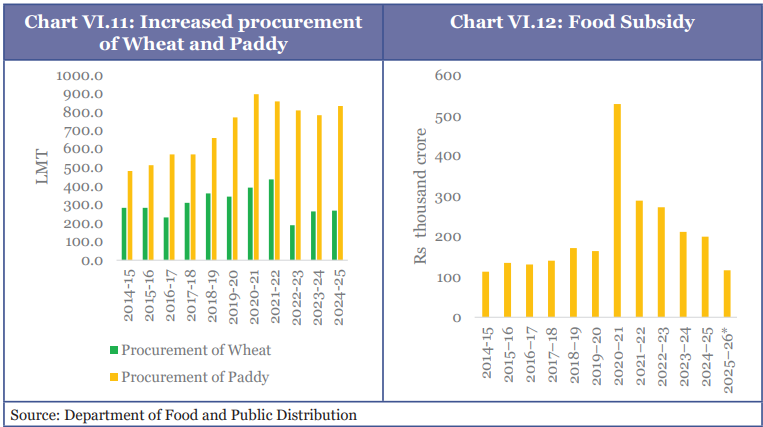
- Government announces Minimum Support Prices (MSP) for 22 mandated crops.
- 24.92 lakh farmers enrolled under the Pradhan Mantri Kisan Maandhan Yojana (PMKMY).
Crop Insurance Support
- Key Interventions:
- Pradhan Mantri Fasal Bima Yojana (PMFBY), in 2024‑25, the scheme insured 4.19 crore farmers, a 32 % increase over 2022‑23.
Ethanol Pricing and Cropping Incentives: Emerging Trade-offs for Food Security
|
- National Crop Insurance Portal serves as a single source of verified information, promoting wider state adoption and increased farmer participation.
- Technological interventions: Yield Estimation System based on Technology (YES-TECH) for yield estimation, Weather Information Network and Data System (WINDS) for automatic weather stations, and automatic rain gauges, have enhanced transparency and objectivity
- Restructured Weather-Based Crop Insurance Scheme has been also launched.
Cooperatives
- Large-scale computerisation and integration with the cooperative banking network are intended to enhance transparency and efficiency.
- Strengthened Primary Agricultural Credit Societies (PACS) by computerizing over 67,000 units and diversifying their activities into storage and input supply.
- Other initiatives: National cooperative university, the inclusion of cooperatives in school curricula, and the introduction of a National Cooperation Policy
Promoting Sustainable Agriculture
- Key Interventions:
- Promoting Crop Diversification Programme (CDP) under the Rashtriya Krishi Vikas Yojana (RKVY)
- Organic and climate resilient farming through targeted schemes such as the Paramparagat Krishi Vikas Yojana (PKVY) for all States/UTs (except the North East) and the Mission Organic Value Chain Development for North Eastern Region (MOVCDNER).
- Promotion of Natural Farming (NF) through the Bhartiya Prakritik Krishi Paddhati (BPKP)
- National Mission on Natural Farming (NMNF)
Transforming Food Subsidy Delivery through Technology, Targeting, and Transparency
|
Food Processing
- It is among the largest employers in India's organised manufacturing sector, accounting for 12.91 % of total organised manufacturing employment.
- In FY25, India's agri-food exports, totalled USD 49.43 billion, accounting for approximately 11.2 % of total exports.
- Share of processed food exports has increased steadily, rising from 14.9 % in FY18 to 20.4 % in FY25.
- Key Interventions: Pradhan Mantri Kisan Sampada Yojana (PMKSY), Production Linked Incentive Scheme for Food Processing (PLISFPI), Pradhan Mantri Formalisation of Micro Food Processing Enterprises (PMFME)
Food Management
- Stabilising prices: E.g., Open Market Sale of staple food grains
- Ensuring food and nutrition security: Distribution of fortified food, enabling greater inclusiveness through Aadhaar-based deduplication and One Nation One Ration Card (ONORC) portability, expanding direct subsidy delivery via Direct Benefit Transfer (DBT).
- ONORC has been rolled out across all 36 States/UTs, covering nearly 80 crore NFSA beneficiaries.
- Increasing post-harvest lending: Credit Guarantee Scheme for Electronic Negotiable Warehouse Receipt (e-NWR) based Pledge Financing (CGS-NPF).
- This scheme covers pledge loans extended on e-NWRs issued against agricultural and horticultural commodities, as well as the losses incurred by the bank due to credit and warehouseman risks.
- National Food Security Act (NFSA), 2013, was introduced to provide a legal guarantee of subsidised foodgrains to nearly 67 per cent of India's population. ( 75% rural and 50% urban)
Conclusion
- Indian agriculture is entering a phase of new opportunity, supported by advances in irrigation, digital extension, climate-resilient agricultural practices, improved storage, and the strengthening of cooperatives and value chains.
What does the Budget say?
- Fisheries & Animal Husbandry:
- Integrated development of 500 reservoirs and Amrit Sarovars and strengthening of fisheries value chains.
- Support for animal husbandry entrepreneurship through credit-linked subsidies, modernisation of livestock enterprises, and formation of Livestock Farmer Producer Organisations (FPOs).
- High-Value Agriculture:
- Promotion of coconut, sandalwood, cocoa, and cashew in coastal regions, and agar trees in the North-East.
- Launch of a Coconut Promotion Scheme for replacement of old plantations to raise productivity.
- A dedicated programme to achieve self-reliance in raw cashew and cocoa and develop them as global brands by 2030.
- Technological Integration:
- Launch of Bharat-VISTAAR (Virtually Integrated System to Access Agricultural Resources), a multilingual AI-based platform integrating agricultural portals.
- Provides customised advisory services to farmers for risk reduction and better decision-making.
Glossary
| Term | Meaning |
| Artificial insemination (AI) | It is a procedure by which one manually deposits a sperm suspension, fresh or frozen-thawed, into the female reproductive tract. |
| Gross Cropped Area | This represents the total area sown once and/or more than once in a particular year, i.e. the area is counted as many times as there are sowings in year. |
| Primary Agricultural Credit Societies (PACS) | Cooperative societies that provide credit facilities to farmers for agricultural activities. |
| Fortification | It is the practice of deliberately increasing the content of one or more micronutrients (i.e., vitamins and minerals) in a food or condiment. |
| Natural farming | No external inputs and use on-farm inputs based on Desi Cow. |
| Organic farming | Involves off-farm purchased organic and biological inputs. |