
Earth’s energy imbalance reached 65-year peak: WMO | Current Affairs | Vision IAS

Upgrade to Premium Today

Start Now
MENU
Home
Quick Links

High-quality MCQs and Mains Answer Writing to sharpen skills and reinforce learning every day.

Watch explainer and thematic concept-building videos under initiatives like Deep Dive, Master Classes, etc., on important UPSC topics.

A short, intensive, and exam-focused programme, insights from the Economic Survey, Union Budget, and UPSC current affairs.

ESC

In Summary

  • The WMO's 'State of the Global Climate 2025' report introduced Earth's Energy Imbalance (EEI) as a key climate indicator.
  • EEI measures the net energy gain or loss by Earth, with a positive EEI indicating warming due to factors like rising GHG concentrations.
  • Key findings include 2025 being the second or third warmest year, 2015-2025 being the hottest decade, record CO2 levels, and record ocean heat content.

In Summary

The findings were part of ‘State of the Global Climate 2025’ report, released by World Meteorological Organization (WMO) on World Meteorological Day (23 March, theme-Observing Today, Protecting Tomorrow).  

It included Earth’s energy imbalance (EEI) as one of the key climate indicators for the first.
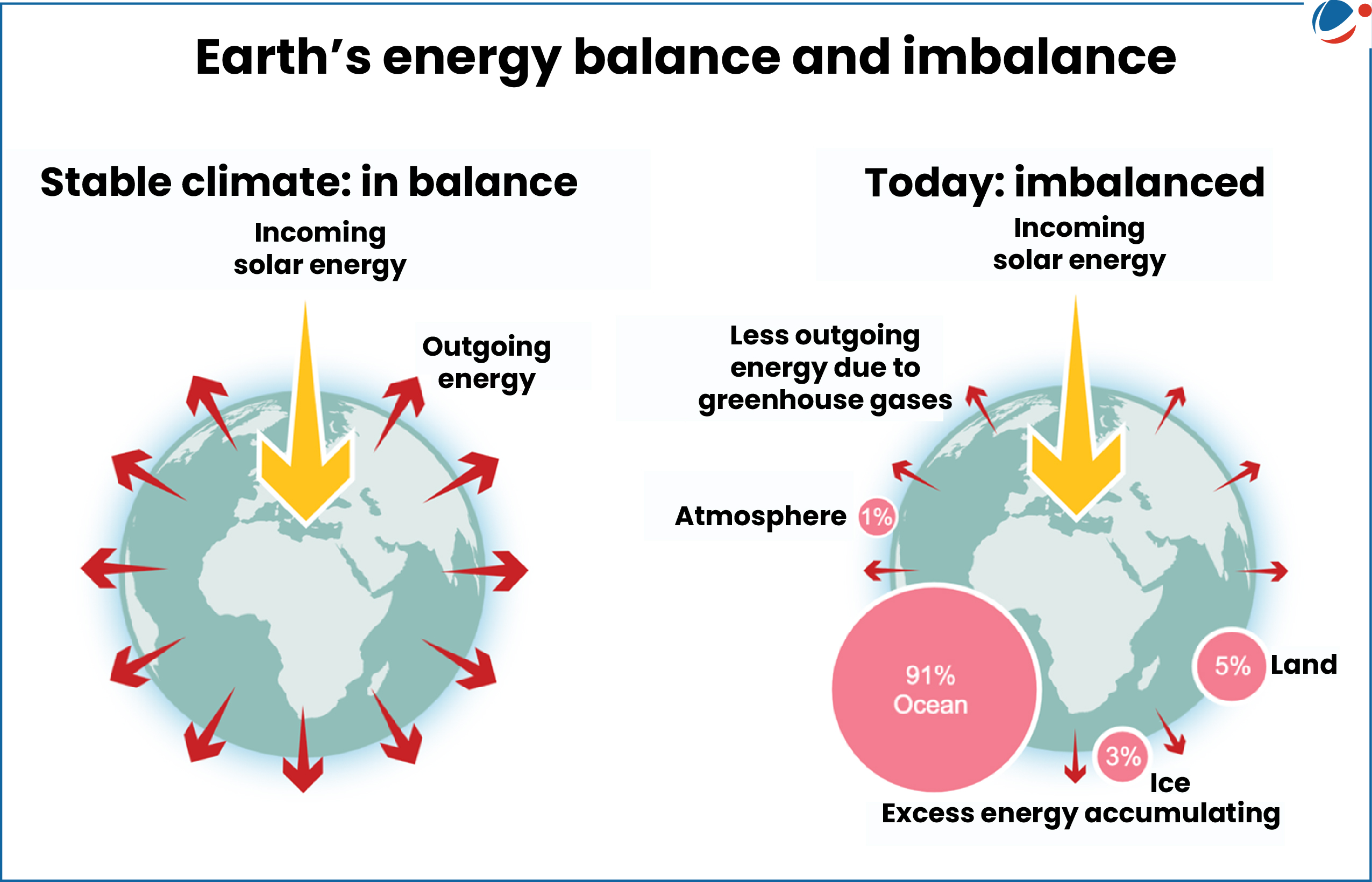
About EEI

  • It is the difference between amount of energy the Earth receives from the Sun (incoming solar radiation minus reflected solar radiation) and amount of energy the Earth radiates back into space (outgoing long-wave radiation). (see infographic)

o "Positive" EEI: Earth is gaining energy and heating "Negative" EEI: Earth is losing energy and cooling

  •  EEI measures rate of the heat accumulation by anthropogenic GHG emissions in climate system and provides a comprehensive picture of warming.
  • Reasons for increase in EEI: Rising concentrations of GHG; reductions in aerosol emissions; increases in trace gases and water vapour (decreases outgoing long-wave radiation); decreased reflection by clouds and sea ice.

Other Key findings of the report

  • 2025 was 2nd or 3rd warmest year on record at about 1.43 °C above the 1850-1900 average.
  • 2015-2025 are the hottest 11-years on record.
  • Highest level of Atmospheric concentration of CO2 recorded in 2024 in the last 2 million years.
  • Ocean heat content reached a new record high in 2025.
Watch Video News Today

Explore Related Content

Discover more articles, videos, and terms related to this topic

RELATED VIDEOS

3
News Today (Sep 17, 2024)

News Today (Sep 17, 2024)

YouTube HD
Carbon Markets

Carbon Markets

YouTube HD
What is Artificial Rain? | Deep Dive With VisionIAS

What is Artificial Rain? | Deep Dive With VisionIAS

YouTube HD

RELATED TERMS

3

Ocean heat content

The amount of heat stored in the ocean. A record high ocean heat content signifies significant warming of the ocean, which has implications for sea-level rise and marine ecosystems.

Aerosol emissions

Tiny solid particles or liquid droplets suspended in the atmosphere. Some aerosols can have a cooling effect by reflecting sunlight, while others can contribute to warming.

Anthropogenic

Originating from human activity. In the context of climate change, it refers to emissions and actions caused by humans that impact the environment.

Title is required. Maximum 500 characters.

Search Notes

Filter Notes

Loading your notes...
Searching your notes...
Loading more notes...
You've reached the end of your notes

No notes yet

Create your first note to get started.

No notes found

Try adjusting your search criteria or clear the search.

Saving...
Saved

Please select a subject.

Referenced Articles

linked

No references added yet
