
Meghalaya Government Signs MOU with Starlink India to Boost Satellite Internet | Current Affairs | Vision IAS

Upgrade to Premium Today

Start Now
MENU
Home
Quick Links

High-quality MCQs and Mains Answer Writing to sharpen skills and reinforce learning every day.

Watch explainer and thematic concept-building videos under initiatives like Deep Dive, Master Classes, etc., on important UPSC topics.

A short, intensive, and exam-focused programme, insights from the Economic Survey, Union Budget, and UPSC current affairs.

ESC

In Summary

  • Meghalaya partners with Starlink, becoming the third state to do so, enhancing satellite internet accessibility.
  • Satellite internet uses satellites in LEO/MEO/GSO orbits, offering global reach, rapid deployment, and disaster resilience over wired services.
  • The regulatory framework involves the Dept. of Telecommunications, TRAI for spectrum, and IN-SPACe for private space activity authorization.

In Summary

Meghalaya becomes the third Indian state after Maharashtra and Gujarat to partner with Starlink formally.

  • Starlink was launched in 2019 by SpaceX and plans to have 42,000 satellites in Low Earth Orbit (LEO).

About Satellite Internet
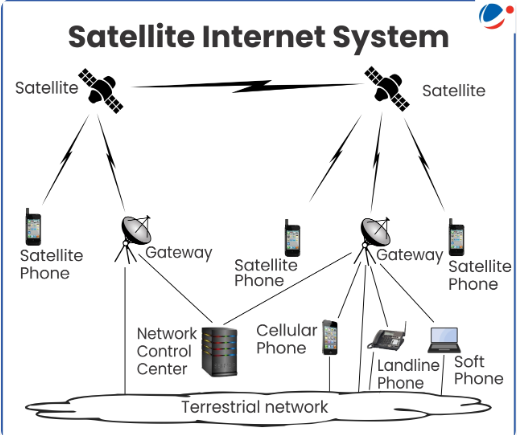
  • Definition: Satellite internet refers to the internet service provided through satellites placed in Geostationary Orbits (GSO) or Non-Geostationary Orbits (NGSO).
    • LEO and MEO (Medium Earth Orbit) are NGSO.
  • Unlike land-based internet services such as fiber, cable, etc., it doesn't rely on wires to transmit data. improving accessibility, deployment speed, and long-distance transmission.
  • Infrastructure: It generally includes three segments:
    • Space Segment: Includes network of several communication satellites.
    • Ground segment: Includes satellite measurement and control networks, gateway stations, etc.
    • User segment: Includes communication terminals used by users.

Advantages over existing land-based internet services: 

  • Global reach: Connects remote and underserved regions lacking fiber or cellular infrastructure.
  • Rapid deployment: Requires only power and clear sky, avoiding costly and time-consuming civil works.
  • Disaster resilience: Restores communication quickly and acts as backup when terrestrial networks fail.

Regulatory Landscape for Satellite Internet Services

  • Department of Telecommunications grants licences and regulates under the Unified Licence Regime.
  • Telecom Regulatory Authority of India recommends spectrum assignment terms for satellite services.
  • Indian National Space Promotion & Authorisation Centre promotes, authorizes, and supervises private space activities.
Watch Video News Today

Explore Related Content

Discover more articles, videos, and terms related to this topic

RELATED TERMS

3

Indian National Space Promotion & Authorisation Centre (IN-SPACe)

An autonomous body under the Department of Space, Government of India, established to promote, authorize, and supervise private sector space activities in the country.

Telecom Regulatory Authority of India (TRAI)

The independent statutory authority that regulates the telecommunications sector in India, responsible for setting policies and recommendations for the growth and development of the sector, including data centres.

Unified Licence Regime

A licensing framework introduced by the Department of Telecommunications in India that consolidates various telecom licenses into a single license, simplifying regulatory processes for service providers.

Title is required. Maximum 500 characters.

Search Notes

Filter Notes

Loading your notes...
Searching your notes...
Loading more notes...
You've reached the end of your notes

No notes yet

Create your first note to get started.

No notes found

Try adjusting your search criteria or clear the search.

Saving...
Saved

Please select a subject.

Referenced Articles

linked

No references added yet
