
Supreme Court expresses concern over the rising drug menace situation in Punjab | Current Affairs | Vision IAS

Upgrade to Premium Today

Start Now
MENU
Home
Quick Links

High-quality MCQs and Mains Answer Writing to sharpen skills and reinforce learning every day.

Watch explainer and thematic concept-building videos under initiatives like Deep Dive, Master Classes, etc., on important UPSC topics.

A short, intensive, and exam-focused programme, insights from the Economic Survey, Union Budget, and UPSC current affairs.

ESC

In Summary

  • Supreme Court recommended specialized NDPS courts to address the huge pendency of cases under the NDPS Act, 1985.
  • India's drug menace is driven by its location between the Golden Crescent and Golden Triangle, porous borders, easy availability of synthetic drugs, socio-economic factors, and online trade.
  • Key measures to combat drug abuse include Nasha Mukt Bharat Abhiyaan, the NDPS Act 1985, National Policy on NDPS 2012, NAPDDR, and adherence to international conventions.

In Summary

The court also highlighted the huge pendency of cases lodged under the Narcotic Drugs and Psychotropic Substances (NDPS) Act, 1985.

  • Supreme Court recommended the creation of specialized NDPS courts across all states to expedite trials.

Reason of Drug Menace in India
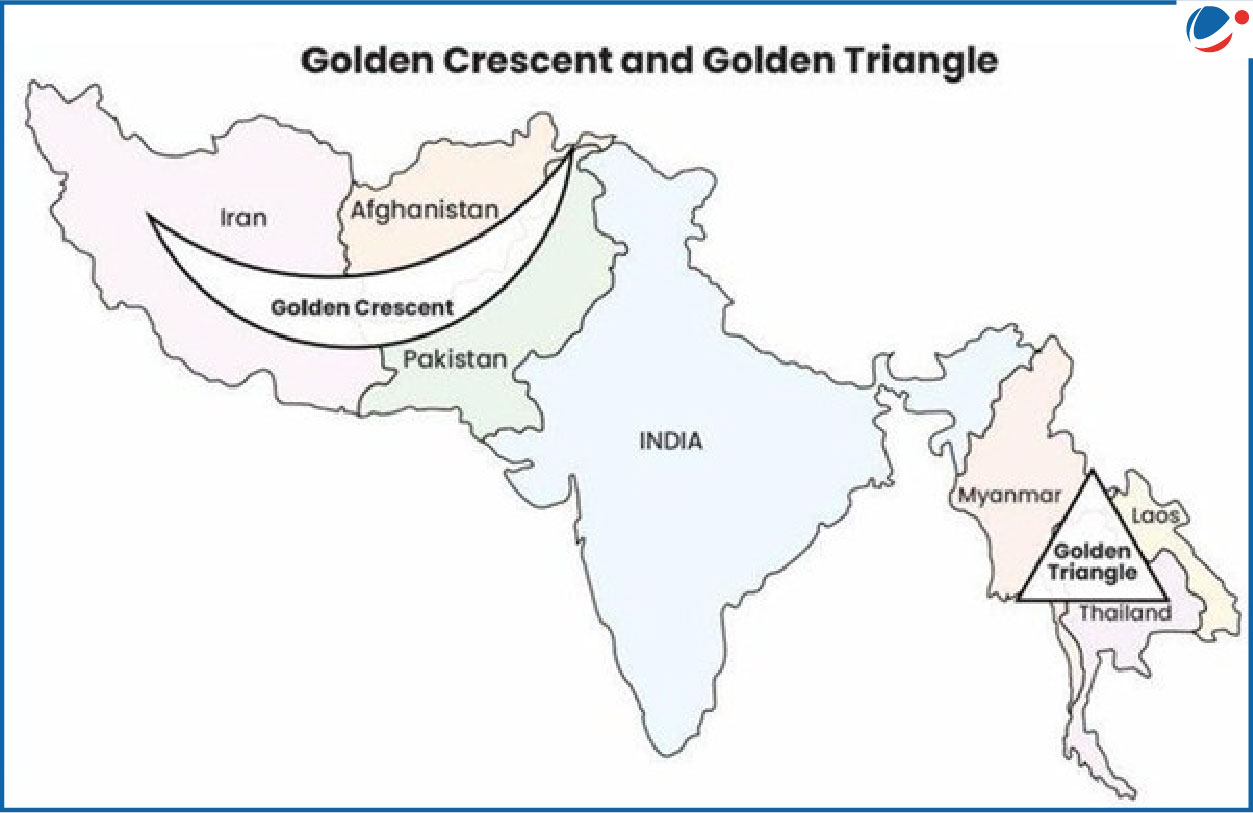
  • Geographical Location: Between two major illicit drug-producing regions - Golden Crescent (Iran, Afghanistan and Pakistan) and the Golden Triangle (Myanmar, Laos, and Thailand).
  • Porous Borders: Peddlers/smugglers are using technologies including drones for smuggling of narcotics across India-Pakistan border in Punjab State.
  • Easy availability of synthetic drugs: Like 3,4-Methylenedioxymethamphetamine (MDMA) or ecstasy, has manifested in the form of increasing drug addiction cases.
  • Economic, Social and Psychological Factors: Unemployment, family breakdown, depression, academic pressure, and urban isolation contribute to drug abuse.
  • Online Drug Trade: Technology such as use of dark web and encrypted platforms have enabled anonymous drug transactions.


Key measures taken to curb drug menace in India

  • Nasha Mukt Bharat Abhiyaan (NMBA): Launched in 2020 to make India drug-sensitised and resilient against substance abuse. 
  • NDPS Act 1985: Make stringent provisions for the control and regulation of operations relating to narcotic drugs and psychotropic substances.
  • National Policy on NDPS 2012: To combat the drug menace in a holistic manner.
  • National Action Plan for Drug Demand Reduction (NAPDDR) (2018–2025): A multi-pronged strategy focusing on education, de-addiction, and rehabilitation of individuals and families.
  • International convention: India is a signatory to Single Convention on Narcotic Drugs, 1961, Convention on Psychotropic Substances, 1971 and Convention against Illicit Traffic in Narcotic Drugs and Psychotropic Substances, 1988. 
Watch Video News Today

Explore Related Content

Discover more articles, videos, and terms related to this topic

RELATED TERMS

3

Convention Against Illicit Traffic in Narcotic Drugs and Psychotropic Substances, 1988

An international treaty that aims to combat illicit drug trafficking by providing for measures against money laundering and the illicit manufacture of drugs. It complements the 1961 and 1971 conventions.

Convention on Psychotropic Substances, 1971

An international treaty that regulates the use of psychotropic substances, requiring parties to control the manufacture, trade, distribution, and use of these drugs, which are known to affect brain activity.

Single Convention on Narcotic Drugs, 1961

An international treaty administered by the UNODC that aims to limit the cultivation of opium poppy, cannabis, and coca plant, as well as the production, trade, and use of narcotic drugs to medical and scientific purposes.

Title is required. Maximum 500 characters.

Search Notes

Filter Notes

Loading your notes...
Searching your notes...
Loading more notes...
You've reached the end of your notes

No notes yet

Create your first note to get started.

No notes found

Try adjusting your search criteria or clear the search.

Saving...
Saved

Please select a subject.

Referenced Articles

linked

No references added yet
