
Global Sovereign Credit Rating Agencies are unfair to India: Commerce and Industry Minister | Current Affairs | Vision IAS

Upgrade to Premium Today

Start Now
MENU
Home
Quick Links

High-quality MCQs and Mains Answer Writing to sharpen skills and reinforce learning every day.

Watch explainer and thematic concept-building videos under initiatives like Deep Dive, Master Classes, etc., on important UPSC topics.

A short, intensive, and exam-focused programme, insights from the Economic Survey, Union Budget, and UPSC current affairs.

ESC

In Summary

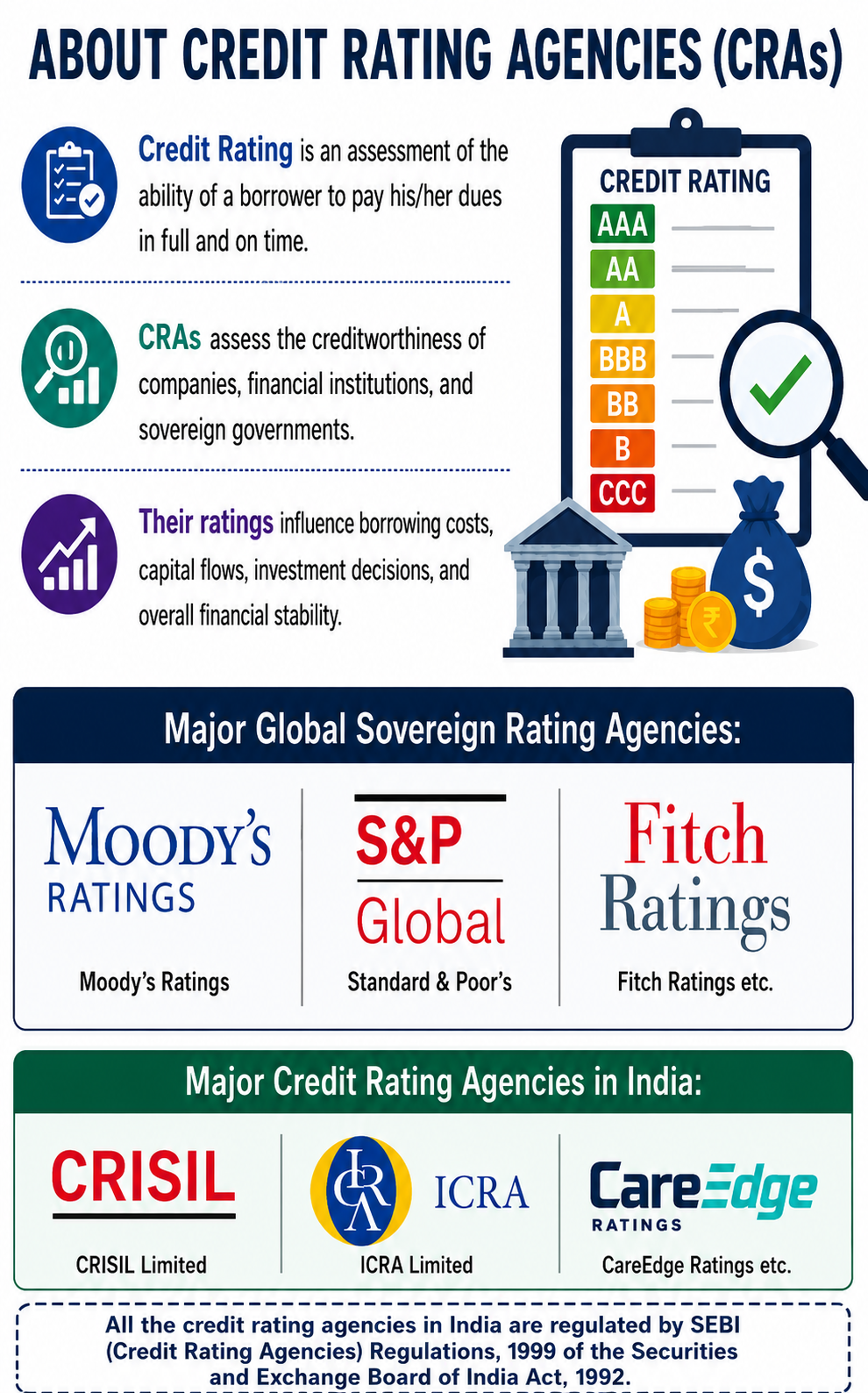
  • Union Minister criticizes global credit rating agencies (CRAs) like Moody's, S&P for low sovereign ratings despite India's strong fundamentals.
  • Issues include conflict of interest, rating shopping, opaque methodologies, weak accountability, and sovereign bias against India.
  • Reforms suggested: neutral fee models, enhanced SEBI supervision, improved corporate governance, and transparent rating methodologies.

In Summary

The Union Minister criticized global sovereign credit rating agencies like Moody's, S&P for assigning India relatively low sovereign ratings despite its strong macroeconomic fundamentals.

Issues with the CRAs 

  • Conflict of Interest: CRAs are paid by issuers they rate, incentivizing inflated ratings.
  • Rating Shopping: Issuers solicit multiple ratings and disclose only the best ones, misleading investors.
  • Opaque Methodologies: Rating models lack transparency, preventing independent scrutiny.
  • Weak Accountability: Limited liability and weak penalties reduce responsibility for inaccurate ratings.
  • Sovereign Bias (against India): Global CRAs over-rely onsubjective factors while undervaluing India’s strong growth, reserves, and default-free record.

Way Ahead

  • Reform the issuer-pays model by introducing neutral fee-allocation mechanisms.
  • Strengthen transparency through disclosure of detailed rating methodologies, assumptions, and risk models.
  • Enhance SEBI's supervisory powers with real-time monitoring, periodic audits, mandatory disclosure and risk-based inspections to eliminate rating shopping.
  • Improve corporate governance by ensuring independent boards, analyst rotation, and robust internal compliance.
Watch Video News Today

Explore Related Content

Discover more articles, videos, and terms related to this topic

RELATED VIDEOS

1
News Today (Mar 17-18, 2024)

News Today (Mar 17-18, 2024)

YouTube HD

RELATED TERMS

3

SEBI (Securities and Exchange Board of India)

भारतीय प्रतिभूति और विनिमय बोर्ड, जो भारत में प्रतिभूति बाजार (शेयर बाजार) के विकास और विनियमन के लिए जिम्मेदार नियामक संस्था है। SEBI भी AI के उपयोग पर नियम बना रहा है।

Rating Shopping

A practice where an issuer seeks ratings from multiple credit rating agencies, choosing the one that provides the most favorable rating, potentially compromising the integrity of the rating process.

Conflict of Interest

A situation in which a person's personal interests (financial, professional, or personal relationships) could compromise their judgment or objectivity in a professional or legal matter.

Title is required. Maximum 500 characters.

Search Notes

Filter Notes

Loading your notes...
Searching your notes...
Loading more notes...
You've reached the end of your notes

No notes yet

Create your first note to get started.

No notes found

Try adjusting your search criteria or clear the search.

Saving...
Saved

Please select a subject.

Referenced Articles

linked

No references added yet