
India-Israel Bilateral Investment Agreement (BIA) comes into force | Current Affairs | Vision IAS

Upgrade to Premium Today

Start Now
MENU
Home
Quick Links

High-quality MCQs and Mains Answer Writing to sharpen skills and reinforce learning every day.

Watch explainer and thematic concept-building videos under initiatives like Deep Dive, Master Classes, etc., on important UPSC topics.

A short, intensive, and exam-focused programme, insights from the Economic Survey, Union Budget, and UPSC current affairs.

ESC

In Summary

  • New India-Israel Agreement replaces 1996 BIT, aiming to balance investment promotion with government's right to regulate.
  • BITs are reciprocal agreements promoting and protecting foreign investments, governed by international law and India's 2015 Model BIT Text.
  • The India-Israel pact covers investment protection, compensation during conflict, right to regulate, and investor-state dispute settlement.

In Summary

The agreement replaces the India–Israel Bilateral Investment Treaty (BIT), 1996 which was terminated in 2017.

  • It aims to promote investment while balancing investor protection with the sovereign right of governments to regulate.
  • Under the Vienna Convention on the Law of Treaties (1969), there is no substantive legal difference between a "Treaty" and an "Agreement”.
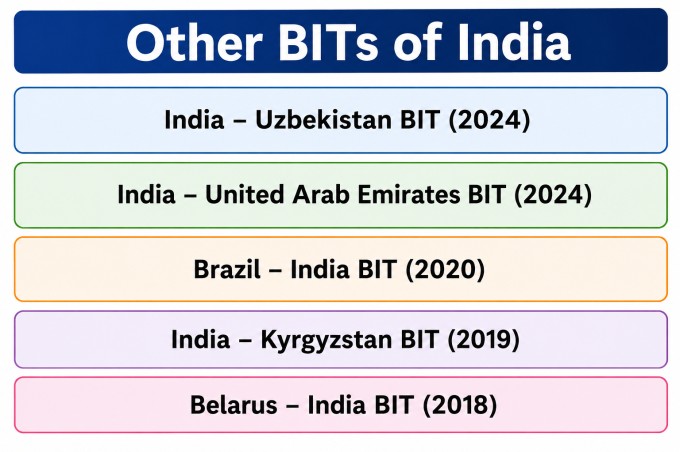
About BIT 

  • Definition: They are reciprocal agreements between two countries that promote and protect foreign investments in each other's territories. 
  • Purpose: They provide a legal framework to ensure fair treatment of investors and create a stable investment environment.
  • International Law: BITs come within Art. 38 (1) (a) Statute of the International Court of Justice as primary sources of obligations under public international law. 
  • Indian framework: India approved new Model BIT Text in 2015, which replaced Indian Model BIT, 1993.
    • Since then, Model text 2015 is used for (re)negotiations of BITs and investment.
      • In Budget 2025-26, the Government announced a review of the BIT framework.

About India–Israel BIT

  • Investment Protection: Protects investments made by investors of both countries.
  • Compensation during Armed Conflict: Investors suffering losses due to War, Armed conflict or Civil unrest will receive non-discriminatory treatment regarding compensation.
  • Right to Regulate: Preserves the government's authority to regulate for public health, environment, security, and public welfare.
  • Investor–State Dispute Settlement: Provides a mechanism to resolve disputes through international arbitration.
Watch Video News Today

Explore Related Content

Discover more articles, videos, and terms related to this topic

RELATED VIDEOS

3
Circularity in Textile Structure

Circularity in Textile Structure

YouTube HD
The Contribution of Indian Cinema to the Creative Economy

The Contribution of Indian Cinema to the Creative Economy

YouTube HD
Impact Investments

Impact Investments

YouTube HD

RELATED TERMS

3

Right to Regulate

The principle that a government retains its sovereign authority to enact and enforce laws and regulations for legitimate public policy objectives, such as public health, environmental protection, security, and public welfare, even when these may affect foreign investments.

Investor–State Dispute Settlement

A mechanism within investment agreements, such as BITs, that allows foreign investors to bring claims directly against a host state in international arbitration proceedings, outside of domestic courts.

Statute of the International Court of Justice

The primary document outlining the structure, jurisdiction, and functions of the International Court of Justice. Article 38 (1) (a) specifies that treaties are a primary source of obligations under public international law.

Title is required. Maximum 500 characters.

Search Notes

Filter Notes

Loading your notes...
Searching your notes...
Loading more notes...
You've reached the end of your notes

No notes yet

Create your first note to get started.

No notes found

Try adjusting your search criteria or clear the search.

Saving...
Saved

Please select a subject.

Referenced Articles

linked

No references added yet