
ISRO conducts first SOLVE ground test important for Gaganyaan missions | Current Affairs | Vision IAS

Upgrade to Premium Today

Start Now
MENU
Home
Quick Links

High-quality MCQs and Mains Answer Writing to sharpen skills and reinforce learning every day.

Watch explainer and thematic concept-building videos under initiatives like Deep Dive, Master Classes, etc., on important UPSC topics.

A short, intensive, and exam-focused programme, insights from the Economic Survey, Union Budget, and UPSC current affairs.

ESC

In Summary

  • ISRO successfully tested the Sub-Orbital Launch Vehicle for Experiments (SOLVE) solid motor, a platform for Gaganyaan's parachute tests.
  • SOLVE will carry the Crew Module to 10-17 km for parachute deployment and sea splashdown.
  • The Gaganyaan Mission aims to send three astronauts to a 400 km LEO for three days, with Vyommitra undertaking the first uncrewed mission.

In Summary

Sub-Orbital Launch Vehicle for Experiments (SOLVE) solid motor was successfully tested at the Static Test Facility, Satish Dhawan Space Centre, Sriharikota.
  • ISRO is developing a solid motor based SOLVE as a test platform to carry out Integrated Parachute Tests. 

About SOLVE

  • Objective: It will serve as a test platform for validating the deceleration (parachute) system of the Gaganyaan Mission Crew Module.
  • Function: Carries Crew Module to 10–17 km, followed by separation and sea splashdown using 10 parachutes.
  • Component: Solid motor is derived from the Polar Satellite Launch Vehicle (PSLV) Strap-on Motor with modifications.

About Gaganyaan Mission

  • India's first human spaceflight mission aims to send 3 astronauts to a 400 km Low Earth Orbit for 3 days, followed by a safe splashdown in Indian waters.
  • Gynoid (female robot) Vyommitra will undertake the first uncrewed mission of Gaganyaan.

Components of the Gaganyaan Mission

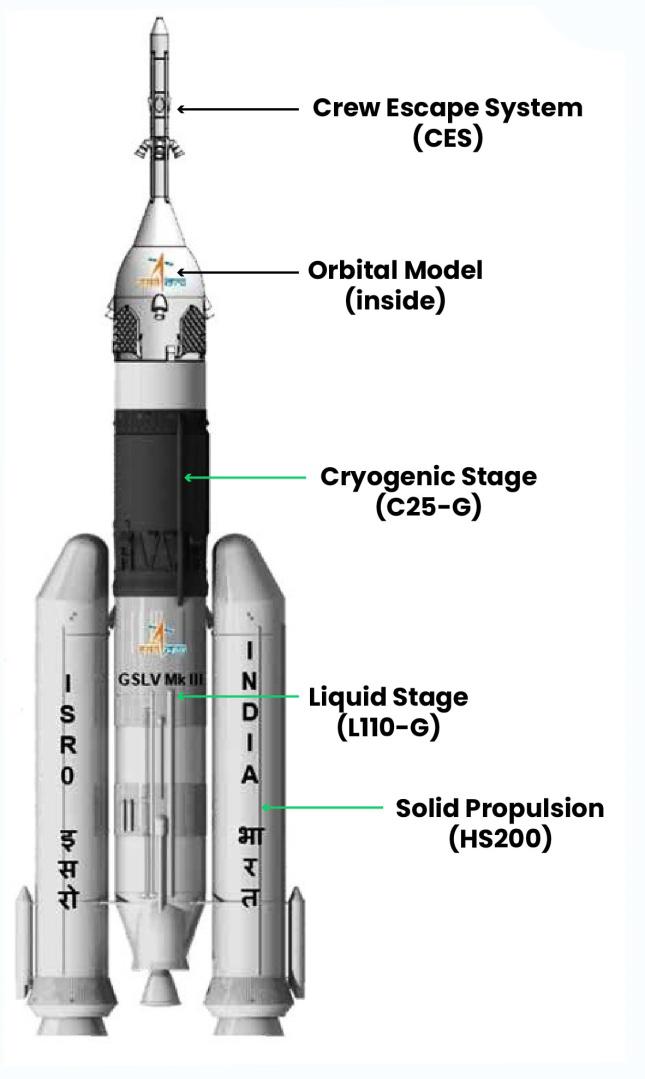
  • Human-Rated LVM3 (HLVM3): Modified LVM3 rocket designed to safely carry astronauts, equipped with a Crew Escape System (CES). It is a three-stage rocket. (Refer Image)
  • Crew Escape System (CES): Emergency escape mechanism that rapidly separates the Crew Module from the launch vehicle.
  • Orbital Module (OM): Spacecraft comprising:
    • Crew Module (CM): Pressurized, habitable module with life support.
    • Service Module (SM): Provides propulsion, power, and thermal control.
  • Life Support System (LSS): Maintains an Earth-like environment inside the Crew Module.
  • Thermal Protection & Recovery Systems: Includes heat shield, parachutes, and sea recovery systems etc.
  • Human-Centric Technologies: Human Factors Engineering, Bioastronautics, etc.
Watch Video News Today

Explore Related Content

Discover more articles, videos, and terms related to this topic

RELATED VIDEOS

3
News Today (Feb 22, 2024)

News Today (Feb 22, 2024)

YouTube HD
News Today (May 07, 2025)

News Today (May 07, 2025)

YouTube HD
News Today (Feb 20, 2026)

News Today (Feb 20, 2026)

YouTube HD

RELATED TERMS

3

Bioastronautics

A field of study that investigates the physiological, psychological, and behavioral responses of humans to spaceflight and the space environment, crucial for ensuring astronaut health and performance.

Life Support System (LSS)

A critical system within the Crew Module that maintains an Earth-like environment, providing breathable air, temperature control, and other essential elements for astronaut survival in space.

Orbital Module (OM)

The spacecraft component of Gaganyaan that comprises the Crew Module (CM) and the Service Module (SM). The CM is the pressurized, habitable section, while the SM provides propulsion, power, and thermal control.

Title is required. Maximum 500 characters.

Search Notes

Filter Notes

Loading your notes...
Searching your notes...
Loading more notes...
You've reached the end of your notes

No notes yet

Create your first note to get started.

No notes found

Try adjusting your search criteria or clear the search.

Saving...
Saved

Please select a subject.

Referenced Articles

linked

No references added yet