
UN Chief warns AI is outpacing safeguards for children | Current Affairs | Vision IAS

Upgrade to Premium Today

Start Now
MENU
Home
Quick Links

High-quality MCQs and Mains Answer Writing to sharpen skills and reinforce learning every day.

Watch explainer and thematic concept-building videos under initiatives like Deep Dive, Master Classes, etc., on important UPSC topics.

A short, intensive, and exam-focused programme, insights from the Economic Survey, Union Budget, and UPSC current affairs.

ESC

In Summary

  • UN Secretary-General urges global AI regulations to protect children from privacy risks, safety threats like deepfakes, and developmental impacts.
  • India's DPDP Act 2023, IT Act 2000, and SPDI Rules 2011 provide legal safeguards against harmful AI effects on children.
  • Way ahead includes a global AI child safety framework, built-in safety measures, ethical AI design, and AI literacy for children.

In Summary

UN Secretary-General urged global regulations to safeguard children amid its growing use.
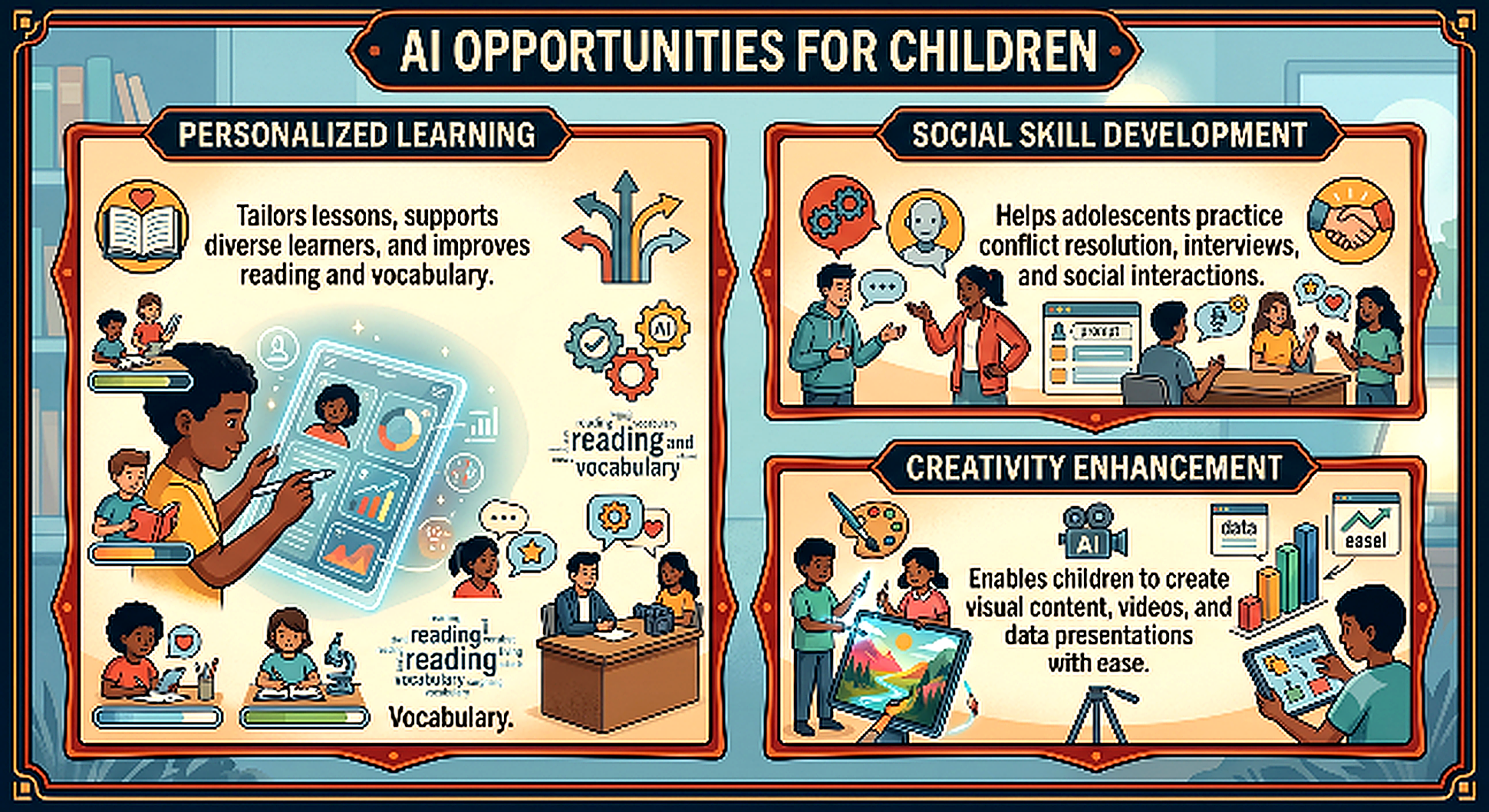
Negative Impact of AI on Children 

  • Privacy Risks: Sharing personal information increases digital footprints and targeted advertising.
  • Safety Threats: Risks include deepfakes, synthetic Child Sexual Abuse Material (CSAM), voice-cloning fraud, and biased AI outputs.
  • Developmental impacts: Weakened critical thinking due to overreliance on AI for instant answers; Emotional dependency on AI companions affecting real-world relationships etc.
  • Behavioural changes: Excessive AI interaction may weaken empathy, patience, resilience, and negotiation skills and may encourage rude or command-based behaviour,

Legal Safeguards Against Harmful Effects of AI on Children

  • Digital Personal Data Protection (DPDP) Act, 2023: Requires verifiable parental consent for processing children's data; prohibits tracking, behavioural monitoring, and targeted advertising.
  •  Information Technology (IT)  Act, 2000 & IT Rules: Mandate removal of harmful child-related content, prompt takedowns, and reporting of offences under POCSO and BNSS.
  • Information Technology (Reasonable Security Practices and Procedures and Sensitive Personal Data or Information) Rules (SPDI Rules), 2011: Require purpose-based data collection, privacy policies, consent, and protection against unauthorized sharing of sensitive data.

Way Ahead

  • Global AI Child Safety Framework: Harmonized global rules requiring AI firms to prove child safety before deployment. E.g., UNICEF’s guidance on AI and children.
  • Built-in Safety Measures: Ban AI-generated child sexual content and enable human intervention for children in distress.
  • Ethical & Transparent AI: Ensure AI clearly identifies itself as non-human and promotes critical evaluation of information.
  • Human-Centric Design: Design AI to complement, not replace, parental, educational, and social interactions.
  • AI Literacy: Integrate AI education to build critical thinking, misinformation awareness, and ethical AI use.
Watch Video News Today

Explore Related Content

Discover more articles, videos, and terms related to this topic

RELATED VIDEOS

3
Simplified | Seeing is not Believing: The DeepFake Dilemma

Simplified | Seeing is not Believing: The DeepFake Dilemma

YouTube HD
Simplified: Virtual influencers revolutionizing creator marketing

Simplified: Virtual influencers revolutionizing creator marketing

YouTube HD
Sovereign AI | Paritosh Parmar Sir

Sovereign AI | Paritosh Parmar Sir

YouTube HD

RELATED TERMS

3

AI Literacy

The ability to understand, critically evaluate, and use Artificial Intelligence technologies ethically and effectively. Integrating AI literacy into education is crucial for building critical thinking and awareness about misinformation and responsible AI use.

Global AI Child Safety Framework

A proposed set of harmonized international regulations aimed at ensuring the safety of children in the context of Artificial Intelligence. It would require AI companies to demonstrate child safety measures before deploying their technologies.

Information Technology (Reasonable Security Practices and Procedures and Sensitive Personal Data or Information) Rules, 2011

These rules, under the IT Act, 2000, outline requirements for data protection and privacy for sensitive personal information. They emphasize purpose-based data collection, privacy policies, consent, and safeguards against unauthorized sharing.

Title is required. Maximum 500 characters.

Search Notes

Filter Notes

Loading your notes...
Searching your notes...
Loading more notes...
You've reached the end of your notes

No notes yet

Create your first note to get started.

No notes found

Try adjusting your search criteria or clear the search.

Saving...
Saved

Please select a subject.

Referenced Articles

linked

No references added yet