
Indian Lab Designs Quantum Computing Algorithm to Beat Classical Computers | Current Affairs | Vision IAS

Upgrade to Premium Today

Start Now
MENU
Home
Quick Links

High-quality MCQs and Mains Answer Writing to sharpen skills and reinforce learning every day.

Watch explainer and thematic concept-building videos under initiatives like Deep Dive, Master Classes, etc., on important UPSC topics.

A short, intensive, and exam-focused programme, insights from the Economic Survey, Union Budget, and UPSC current affairs.

ESC

In Summary

  • BITS Pilani scientists, with IBM Quantum, simulated subatomic particles on 120 qubits, highlighting Quantum Advantage.
  • Quantum computing uses quantum mechanics for complex problems but faces challenges like decoherence, error correction, and hardware dependence.
  • India's National Quantum Mission (NQM) aims to develop quantum computers, secure communication, and quantum materials with a ₹6,003.65 crore budget.

In Summary

BITS Pilani scientists, collaborating with IBM Quantum, have simulated the behaviour of subatomic particles on 120 qubits of an IBM processor highlighting Quantum Advantage.

  • Quantum Advantage occurs when quantum computers execute specific, complex tasks faster, cheaper, or more accurately than the most powerful classical supercomputers

What is Quantum Computing?

Quantum computing is an advanced field of computing that harnesses the unique qualities of quantum mechanics to solve problems beyond the ability of even the most powerful classical computers.
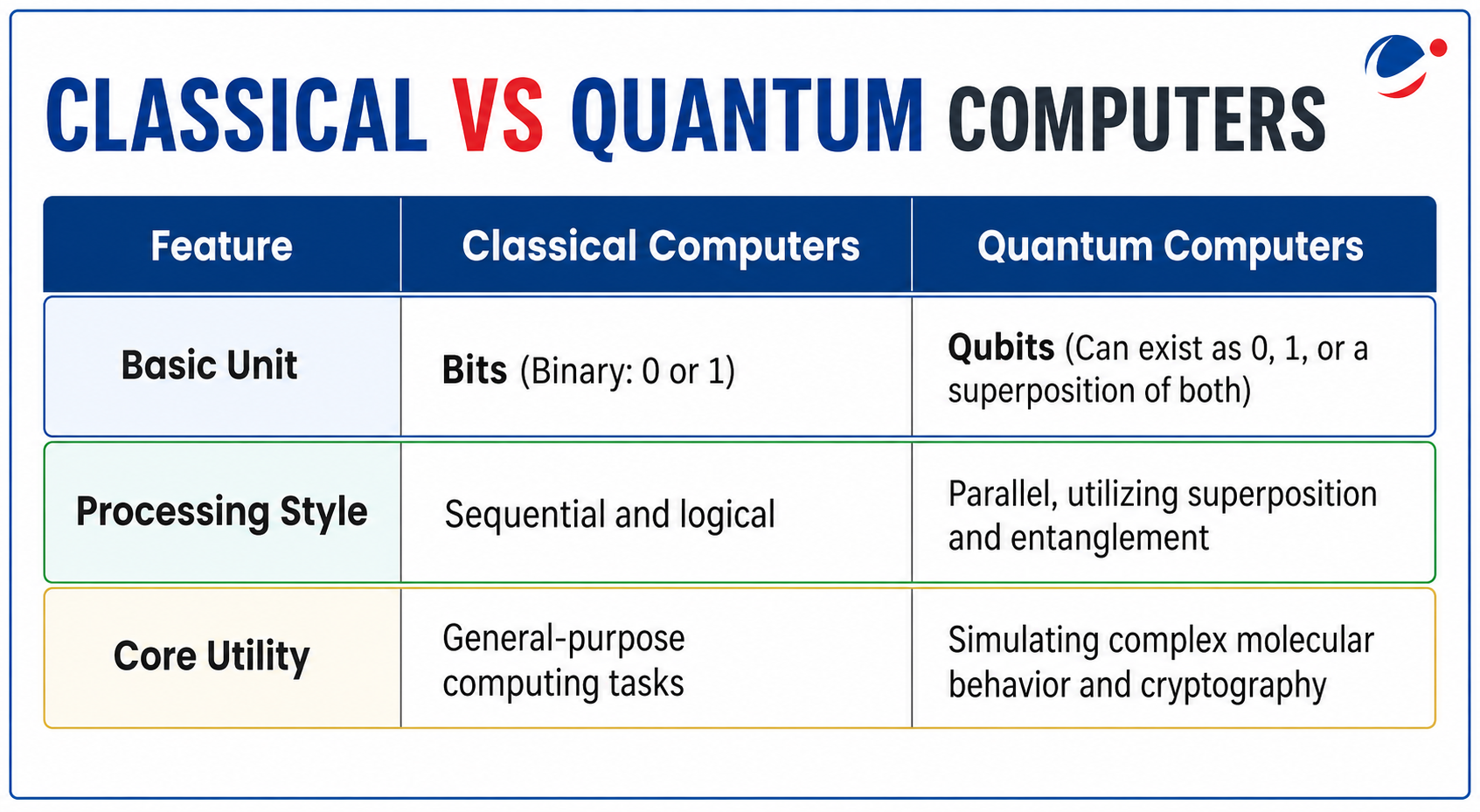
Challenges with Quantum Computing

  • Decoherence and noise: Qubits lose quantum states quickly, degrading accuracy.
  • Error correction: Needs many physical qubits to create one reliable "logical" qubit.
  • Hardware dependence: Indigenous fabrication of qubit-grade materials and cryogenic systems is nascent.

National Quantum Mission (NQM)

  • Implemented by the Department of Science and Technology (DST) with a ₹6,003.65 crore budget for 2023-2031.
  • Objectives: Develop quantum computers (50-1,000 physical qubits).
    • Secure and high-bandwidth communication infrastructure over 2,000 km. 
    • Inter-city quantum key distribution (QKD) over 2000 km.
    • Develop multi-node quantum network, magnetometers, and atomic clocks.
    • Develop Quantum materials for cutting-edge device fabrication.
  • Executed via four Thematic Hubs (T-Hubs):  Quantum Computing, Quantum Communication, Quantum Sensing & Metrology, and Quantum Materials & Devicesfollowing the Hub-Spoke-Spike model, across premier institutes.
Watch Video News Today

Explore Related Content

Discover more articles, videos, and terms related to this topic

RELATED TERMS

3

Hub-Spoke-Spike Model

A model for implementing research missions where specialized 'hubs' at leading institutions focus on specific thematic areas, supported by 'spokes' and connected through 'spikes' for broader impact and collaboration.

Quantum Key Distribution (QKD)

A secure communication method that utilizes quantum mechanical principles like entanglement to generate and distribute cryptographic keys, offering theoretically unhackable data transmission.

National Quantum Mission (NQM)

A government initiative focused on advancing research and development in quantum technology across various fields, promoting its application in strategic sectors like defence and communication.

Title is required. Maximum 500 characters.

Search Notes

Filter Notes

Loading your notes...
Searching your notes...
Loading more notes...
You've reached the end of your notes

No notes yet

Create your first note to get started.

No notes found

Try adjusting your search criteria or clear the search.

Saving...
Saved

Please select a subject.

Referenced Articles

linked

No references added yet
