
India’s Advanced Ocean Research Vessel ‘ORV Sagar Manthan’ Launched | Current Affairs | Vision IAS

Upgrade to Premium Today

Start Now
MENU
Home
Quick Links

High-quality MCQs and Mains Answer Writing to sharpen skills and reinforce learning every day.

Watch explainer and thematic concept-building videos under initiatives like Deep Dive, Master Classes, etc., on important UPSC topics.

A short, intensive, and exam-focused programme, insights from the Economic Survey, Union Budget, and UPSC current affairs.

ESC

In Summary

  • India launched the Advanced Ocean Research Vessel (ORV) Sagar Manthan, signifying self-reliance in oceanographic science and maritime technology.
  • Built by GRSE for NCPOR, it's a multidisciplinary platform for deep ocean research, gradually replacing the 43-year-old ORV Sagar Kanya.
  • Key functions include seafloor mapping, seismic surveys, ROV/AUV operations, and atmospheric/oceanographic observations for resource security and climate understanding.

In Summary

India’s Advanced Ocean Research Vessel ‘ORV Sagar Manthan’ Launched 

It signifies Self-reliance in oceanographic science and maritime technology, Atmanirbharta in shipbuilding, enhanced strategic autonomy in maritime domain and disaster prevention.

About ORV Sagar Manthan

  • It is an all-weather, multidisciplinary platform to drive Indigenous Maritime Research.
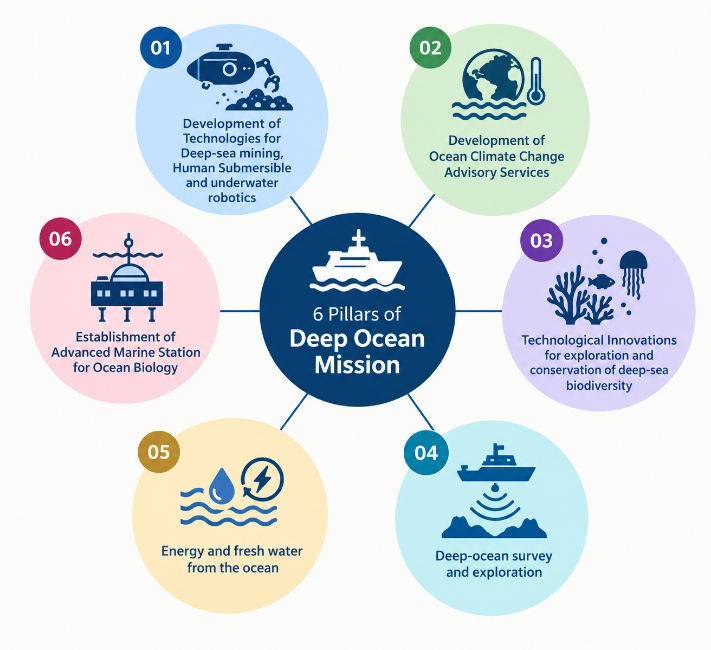
  • Constructed under Vertical-4 (Deep Ocean Survey and Exploration) of the Deep Ocean Mission (DOM).
  • Built by: Garden Reach Shipbuilders & Engineers (GRSE) 
  • For: National Centre for Polar and Ocean Research (NCPOR), Ministry of Earth Sciences 
  • ORV Sagar Manthan will gradually replace the 43-year-old ORV Sagar Kanya (procured from Germany in 1983).
  • Key Features: 
    • Engineered to operate in extreme oceanic environments, including the Southern Ocean.
    • Maximum speed: About 14 knots 
    • Operational depth: Research operations can extend to ~ 6,000 m 
    • Expected commissioning: 2028
    • Projected service life: 30 years
  • Key Functions: Multibeam bathymetric surveys (mapping the seafloor); Multichannel seismic surveys; Operations involving Remotely Operated Vehicles (ROV) and Autonomous Underwater Vehicles (AUV); Atmospheric and oceanographic observations.

Why does deep-sea exploration matter?

  • Mineral resource security: Deep Ocean contains polymetallic nodules and sulphides containing strategically important minerals like manganese, nickel etc.
  • Understanding climate change and Disaster preparedness: Improved projections of sea-level rise, cyclones, storm surges etc.
  • Deep-sea biodiversity: Reveals species distribution, population connectivity, and habitat links, aiding sustainable fisheries and conservation. E.g. DOM surveys of ~25 seamounts (biodiversity hotspots) in the Arabian Sea and Bay of Bengal.
  • Blue Economy: Aid in improving fisheries, offshore energy, ocean tourism, maritime services etc.
Watch Video News Today

Explore Related Content

Discover more articles, videos, and terms related to this topic

RELATED VIDEOS

2
Carbon Markets

Carbon Markets

YouTube HD
What is Artificial Rain? | Deep Dive With VisionIAS

What is Artificial Rain? | Deep Dive With VisionIAS

YouTube HD

RELATED TERMS

3

Blue Economy

An economic development approach that utilizes ocean resources for economic growth, livelihoods, and employment while preserving the ocean's health and resilience. It encompasses sectors like sustainable fisheries, renewable ocean energy, and eco-tourism.

Polymetallic Nodules

Lumps of minerals found on the seabed, rich in metals like manganese, iron, copper, nickel, and cobalt. They form through slow precipitation of dissolved metals from seawater and are of significant interest for deep-sea mining and scientific research, including potential roles in biogeochemical processes.

Autonomous Underwater Vehicles (AUV)

Untethered, unmanned underwater vehicles that can operate independently without direct human control. AUVs are used for tasks such as mapping, data collection, and surveys in various ocean depths.

Title is required. Maximum 500 characters.

Search Notes

Filter Notes

Loading your notes...
Searching your notes...
Loading more notes...
You've reached the end of your notes

No notes yet

Create your first note to get started.

No notes found

Try adjusting your search criteria or clear the search.

Saving...
Saved

Please select a subject.

Referenced Articles

linked

No references added yet