


The Department of Telecommunications (DoT) has introduced a Financial Fraud Risk Indicator (FRI) to combat mobile-based cyber fraud.
The Indicator allows for swift, targeted, and collaborative action against suspected frauds in both telecom and financial domains.
What is Financial Fraud Risk Indicator (FRI)?
- It is a risk-based metric that classifies a mobile number to have been associated with Medium, High, or Very High risk of financial fraud.
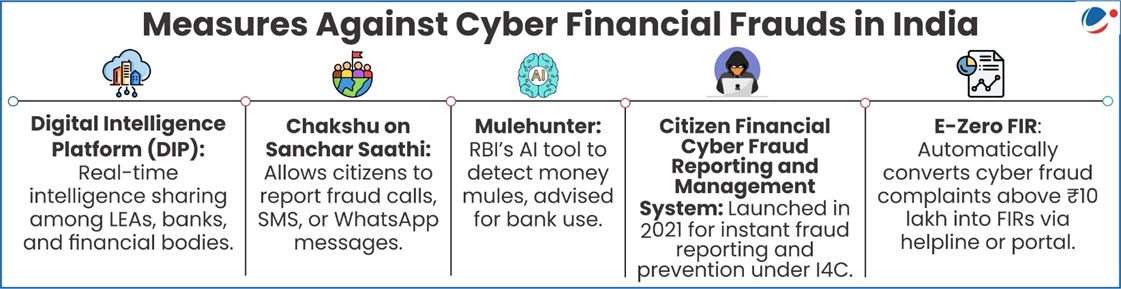
- This classification is an outcome of inputs obtained from: National Cybercrime Reporting Portal (NCRP), DoT’s Chakshu facility and Digital Intelligence Platform (DIP) and Intelligence shared by banks and financial institutions.
- It empowers stakeholders such as banks, NBFCs, and UPI service providers to prioritize enforcement and take additional customer protection measures in case a mobile number have high risk.
Status of Cyber Financial Frauds in India
- Between Financial Year 2020 and 2024, Approx. ₹3,207 crore was lost due to 5,82,000 cases of cyber fraud.
- Some common methods of financial frauds are: KYC Fraud, Customer Care Fraud, UPI Fraud, Card Fraud, Digital Arrest Fraud, Investment Frauds and Get Rich Quick Schemes, etc.
Article Sources
1 sourceThe Government of India has appointed a new chairman along with 7 new members in the National Security Advisory Board (NSAB).
About NSAB
- It was first constituted in December 1998, as an advisory body of eminent persons outside the government, including industry, media and civil society, among others.
- It is assisted by the National Security Council Secretariat (NSCS).
- Functions: To undertake long term analysis and to provide perspectives on the national security issues to the National Security Council (NSC).
- It also recommends measures and policy options on the issues referred to it by the NSC.
The UN Office of Counter-Terrorism (UNOCT) launched VoTAN, a global network to support victims and survivors of terrorism.
About VoTAN
- Background: The Group of Friends of Victims of Terrorism, chaired by Spain and Iraq, was established nearly six years ago to uphold the need to protect victims’ rights.
- Genesis: The network is a key outcome of the 2022 UN Global Congress on Victims of Terrorism.
- Goal: To provide a safe space for victims and survivors to support each other, build resilience and engage as advocates, educators, and peacebuilders.
- Financial Support: Received from Spain
Article Sources
1 sourceIndia has successfully test-fired an indigenously developed anti-drone system, Bhargavastra.
About Bhargavastra
- It is a low-cost, 'hard kill' anti-drone system designed to neutralize threats from drone swarms.
- Developed By: Solar Defence and Aerospace Limited (SDAL),
- Key Features
- Two-layer security system:
- Layer 1: Unguided micro-rockets with a 20m lethal radius for swarm drones
- Layer 2: Guided micro-missiles for precision strikes
- Range: Detects drones from up to 2.5 km. Radar detects aerial threats from 6–10 km
- Terrain adaptability: Above 5000 meters
- Modular design: Allows integration of soft kill options like jamming and spoofing.
- C4I-enabled command centre: Enhances network-centric warfare integration.
- Two-layer security system:
The Indian Navy and DRDO (Defence Research and Development Organisation) successfully tested the indigenously developed MIGM.
About MIGM
- Advanced underwater naval mine designed to enhance the Indian Navy’s capabilities against modern stealth ships and submarines.
- Designed and Developed by: Naval Science and Technological Laboratory (NSTL) under DRDO.
- Features:
- It uses multiple sensors to detect acoustic, magnetic, and pressure signals from marine vessels.
- It has built-in electronics with processors to process data and trigger appropriate actions.
- It is deployable from ships, submarines etc.
Article Sources
1 sourceThe US has recently approved sale of HawkEye 360 technology to India to boost the country’s surveillance capabilities.
About HawkEye 360 technology
- It uses clusters of three satellites in Low Earth Orbit to detect, geolocate, and analyze radio frequency (RF) signals.
Significance for India
- It can detect vessels that turn off their Automatic Identification System (AIS) to avoid tracking in disputed or sensitive areas.
- It will boost India’s maritime domain awareness in the Indo-Pacific.
- Indian forces can now more effectively monitor illegal fishing, smuggling, and conduct surveillance.
Indian Army received new Russian Igla-S missiles to counter drones, choppers, jets.
About Igla-S
- It is a man-portable, shoulder-launched surface-to-air missile (SAM) system designed for mobile ground units operating in high-threat environments
- It is an improved version of Very Short Range Air Defence Systems (VSHORADS).
- Key Features:
- It uses infrared (IR) homing to detect and lock onto the heat signatures of aerial targets.
- Once the missile is launched, it automatically follows the heat coming from the target's engine.
- This makes it very good at hitting fast and small targets like drones and helicopters.
- Range: It can engage targets at ranges up to 6 km and altitudes up to 3.5 km.
CBI launched Operation Hawk to crack down on global cybercrime networks involved in online child sexual exploitation.
- The operation follows Operation CARBON (2021) and Operation Megh Chakra (2022) to track suspects and dismantle such networks with international links.
Article Sources
1 sourceExercise | Details |
IMDEX Asia 2025 | Indian Naval Ship INS Kiltan arrived in Singapore to participate in 14th edition of International Maritime Defence Exhibition (IMDEX) Asia 2025. About IMDEX Asia
|
Nomadic Elephant | 17th edition of India- Mongolia Joint Military Exercise Nomadic Elephant is to be conducted in Ulaanbaatar, Mongolia.
|


