


SHP Development Scheme aims at harnessing unique strengths of small hydropower.
About the Scheme
- Tenure: FY 2026–27 to FY 2030–31.
- Objective: Support Small Hydro Projects (SHPs) (1-25 MW capacity).
- SHPs are administered by Ministry of New and Renewable Energy.
- Large hydropower projects (>25 MW) fall under Ministry of Power.
- SHPs are administered by Ministry of New and Renewable Energy.
- India's SHP Potential: Total of 21,133.61 MW of which 24.5% (5,171 MW) has been harnessed (early 2026).
- Target: Unlock 1,500 MW of new SHP capacity.
- Financial Assistance:
- North Eastern States & International Border Districts: ₹3.6 crore per MW or 30% of project cost (Cap: ₹30 crore per project).
- For other locations: ₹2.4 crore per MW or 20% of project cost (cap:₹20 crore per project).
Article Sources
1 sourceGlobal Network Against Food Crises released 10th edition of Global Report on Food Crises, 2025.
- As per the report, more than 266 million people in 47 countries faced high levels of acute food insecurity in 2025.
- Conflict has overtaken extreme weather as main driver.
About Global Network Against Food Crises
- Genesis: Launched in 2016 by Food and Agriculture Organization (FAO) with European Union (EU) and WFP (World Food Programme) at World Humanitarian Summit.
- Purpose: Multistakeholder initiative of humanitarian and development actors, united by commitment to tackle root causes of food crises and to promote sustainable solutions.
Ministry of Statistics & Programme Implementation (MoSPI) released an approach paper to compilation of ISP.
- Unlike Index of Industrial Production (IIP) which tracks manufacturing, there has been no index to capture short-term movements in services sector, creating a data gap in overall economic performance assessment.
Key Features of Proposed ISP
- Proposed Base Year: 2024-25.
- Data Sources: Goods and Services Tax (GST) data, administrative data from sectoral ministries and the Annual Survey of Incorporated Services Sector Enterprises.
- Coverage: Index is exclusively designed to track formal sector, including sub- sectors like wholesale and retail trade, transport, banking, insurance, real estate, communication, etc.
Article Sources
1 sourceColombia and Netherlands are hosting First Conference on Transitioning Away from Fossil Fuels in Santa Marta, Columbia.
About the Conference
- Officially announced in 2025 during COP30 (UNFCCC) as sustained political platform to deliver implementation-driven action towards an orderly phase-out of fossil fuels.
- It is not an negotiating body nor constitute part of any formal negotiation.
- It does not intend to replace United Nations Framework Convention on Climate Change (UNFCCC).
Key Highlights of the Conference
- Launched the Science Panel for the Global Energy Transition (SPGET).
- Help develop country- and sector-level milestones aligned with returning global warming to 1.5 degrees Celsius (°C) by end of century.
Scientists discovered Gibraltar’s Barbary macaque (Macaca sylvanus), only wild primates found on European continent practicing Geophagy (eating soil).
About Geophagy
- Definition: Geophagy is defined as the voluntary and continuous ingestion of earthy materials, including rocks, soils, and clays, practiced by both humans and animals.
- Reason: Nutrient supplementation, relief from gastrointestinal disorders, and cultural beliefs.
- Prevalence: Commonly seen with Children, pregnant women etc.
Recent measures of inflation control in India, US, and UK highlight economic costs of managing inflation, measured using Sacrifice Ratio.
About Sacrifice Ratio
- It measures the direct economic cost of bringing down inflation.
- It represents the exact percentage of real GDP lost for every 1% decrease in the inflation rate.
- The metric highlights the strict trade-off between ensuring price stability and sustaining economic growth.
- Higher ratios mean fighting inflation causes significant short-term pain, including increased unemployment and reduced industrial production.
Article Sources
1 sourceRecent study highlights high disease burden of Typhoid in India, along with growing presence of multidrug- resistant (MDR) and extensively drug- resistant (XDR) strains.
About Typhoid
- Pathogen: Caused by bacterium Salmonella Typhi (lives only in humans)
- Persons with typhoid fever carry the bacteria in their bloodstream and intestinal tract.
- Transmission (Faecal-Oral Route): Primarily through contaminated food and drinking water.
- Symptoms: Prolonged high fever, fatigue, headache, nausea, abdominal pain, and constipation or diarrhoea.
- Typhoid conjugate vaccines used in immunization.
The ongoing megalithic excavation at Virli Khandar, led by Dr. Prabash Sahu, in Maharashtra's Bhandara district (Vidarbha) reveals distinctive burial architecture and funerary practices.
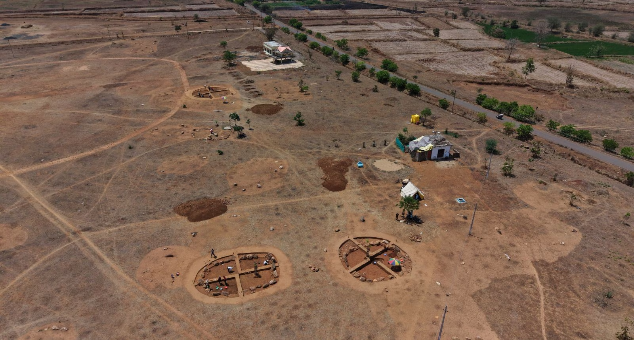
- Preliminary observations suggest the site is at least 2,500 years old, placing it in the Iron Age megalithic period of India.
About Virli Khandar Excavation
- Composite Burials: The site uniquely features stone circles enclosing menhirs (upright standing stones), combining two distinct burial types.
- Inverted Pottery: A rare cluster of ~50 pots, deliberately arranged upside-down.
- Grave Goods: Excavations yielded copper necklaces, iron implements, etched carnelian beads, and fragmentary bone remains.
SIPRI has released the Trends in World Military Expenditure, 2025 Report.
- SIPRI (Stockholm International Peace Research Institute) is an independent international institute dedicated to research into conflict, arms control and disarmament established in 1966 in Stockholm (Sweden).
Key Findings
- The five biggest military spenders in 2025—United States, China, Russia, Germany and India—accounted for 58% of global spending.
- India is the fifth biggest spender (3.2% of total global expenditure) in the world with total expenditure of $92.1 billion.
- India’s spending saw a surge of 8.9% compared to the previous year.


