


Inland Waterways (including rivers, canals, lakes, lagoons, and certain river estuaries) are navigable water channels within a country that are not part of sea.
- They are suitable for navigation due to natural or man-made features and allow vessels carrying at least 50 tonnes under normal operating conditions.
Status in India
- Present Status: National Waterways Act, 2016, declared 111 inland waterways as 'National Waterways’ (NWs) with total length of 20,187 km.
- As of March 2026, 32 NWs are operational.
- Union Budget 2026-27 announced operationalisation of 20 new NW over next five years
- Rising Share: Cargo transportation on NWs reached 145.84 million metric tonnes (FY 2024-25).
- Target: India targets to raise Inland Water Transport (IWT) modal share from 2% to 5% and expand cargo volumes to more than 200 MMT by 2030 (500 MMT by 2047) as per Maritime Amrit Kaal Vision.
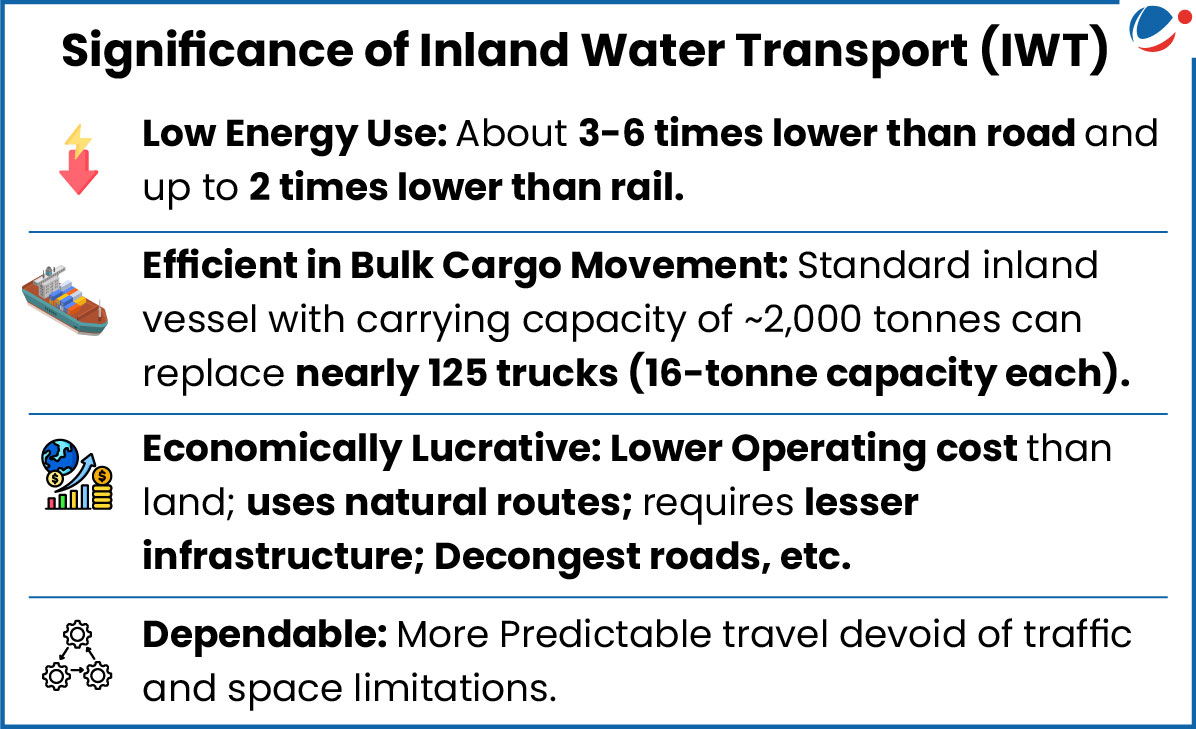
Key Initiatives Towards IWT in India
- Legislative: Inland Waterways Authority of India Act, 1985 provided for establishment of the Inland Waterways Authority of India (IWAI); National Waterways Act, 2016; etc.
- Key Schemes:
- Harit Nauka Inland Vessels Green Transition Guidelines: Targets 30% reduction in carbon intensity of inland waterway-based passenger transport by 2030.
- Coastal Cargo Promotion Scheme: Announced in Union Budget 2026-27 to increase the combined share of inland waterways and coastal shipping from 6 to 12% by 2047.
- Others: Jal Marg Vikas Project along NW-1 (along Varanasi-Haldia stretch); Jalvahak Cargo Promotion Scheme, 2024, etc.




