
Digital Public Infrastructure (DPI) @2047 Report Released by NITI Aayog | Current Affairs | Vision IAS

Upgrade to Premium Today

Start Now
MENU
Home
Quick Links

High-quality MCQs and Mains Answer Writing to sharpen skills and reinforce learning every day.

Watch explainer and thematic concept-building videos under initiatives like Deep Dive, Master Classes, etc., on important UPSC topics.

A short, intensive, and exam-focused programme, insights from the Economic Survey, Union Budget, and UPSC current affairs.

ESC

In Summary

  • DPI 2.0 (2025-2035) and DPI 3.0 (2035-2047) are recommended roadmap phases, with DPI 2.0 focusing on 8 Sectoral Transformations.
  • Key DPI 2.0 drivers include hyper-localized district programs, scaling tech entrepreneurship, leveraging AI, and unlocking data and human capacity.
  • DPI has impacted GDP (0.9% in 2022, projected 4.2% by 2030), unlocked sectors like MSMEs, and accelerated financial inclusion.

In Summary

The report recommends a two-phase approach, namely DPI 2.0 (2025-2035) and DPI 3.0 (2035-2047) as part of the DPI 2047 roadmap with detailed focus on DPI 2.0. 

About DPI 2.0 (Highlights from Report)
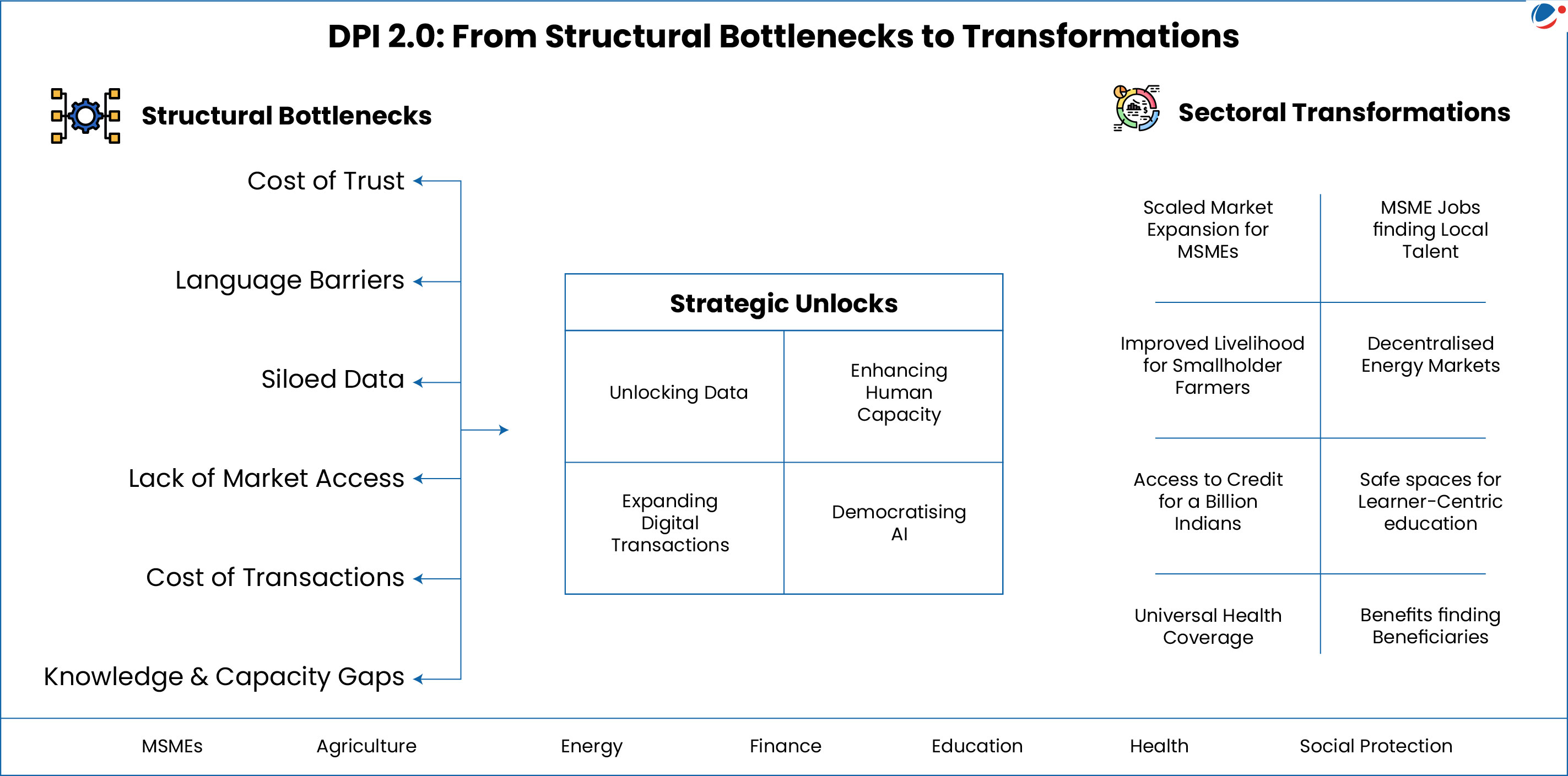
  • Scope: Consists of 8 Sectoral Transformations (See Infographic): 
  • Key Drivers for Execution 
    • Aggregate Demand via District Programs: Hyper-localized solutions by linking DPI to district level development goals. 
    • Scale Tech Entrepreneurship: For delivery of DPI-aligned products and services.
    • Leverage AI Momentum: Making AI accessible to all. 
    • Deploy Cross-Sectoral Strategic Unlocks: Including Unlocking Data, Democratizing AI, Enhancing Human Capacity, Expanding Digital Transactions. 
  • Key Recommendations towards DPI 2.0: Decentralized State-led execution; Focus on MSME and Agriculture in First cycle (2026-2027); neutral ecosystem body for global engagement, etc.

About DPI

  • Meaning: It is a design approach to enable non-linear socio-economic development at scale by leveraging technology and market innovation. 
  • Key Impacts of DPI
    • GDP:  DPI contributed 0.9% to India’s GDP in 2022 (with projections of 4.2% by 2030). 
    • Unlocking New Sectors: MSMEs registered under GST grew to 1.5 crore in December 2024 (from 5 lakh in 2017-18), etc. 
    • Financial Inclusion: India achieved 80% bank account penetration in eight years, a feat Bank for International Settlements (BIS) estimated would have taken 47 years. 
    • Hockey Stick Effect: Explosion of new services previously unimaginable providing rapidly accelerating growth following ‘hockey-stick’ curve. 
Watch Video News Today

Explore Related Content

Discover more articles, videos, and terms related to this topic

RELATED VIDEOS

3
The Contribution of Indian Cinema to the Creative Economy

The Contribution of Indian Cinema to the Creative Economy

YouTube HD
Impact Investments

Impact Investments

YouTube HD
Universal and Meaningful Connectivity

Universal and Meaningful Connectivity

YouTube HD

RELATED TERMS

3

Hockey Stick Effect

A phenomenon describing an explosion of new services and rapidly accelerating growth that follows a 'hockey-stick' curve, indicating exponential development, as observed with DPI's impact.

Bank for International Settlements (BIS)

An international financial institution owned by member central banks, promoting international monetary and financial cooperation and serving as a bank for central banks. Its estimates are used to benchmark India's financial inclusion progress.

Financial Inclusion

Financial inclusion means that individuals and businesses have access to useful and affordable financial products and services that meet their needs. UCBs are identified as key institutions contributing to this goal, particularly in remote and small towns.

Title is required. Maximum 500 characters.

Search Notes

Filter Notes

Loading your notes...
Searching your notes...
Loading more notes...
You've reached the end of your notes

No notes yet

Create your first note to get started.

No notes found

Try adjusting your search criteria or clear the search.

Saving...
Saved

Please select a subject.

Referenced Articles

linked

No references added yet