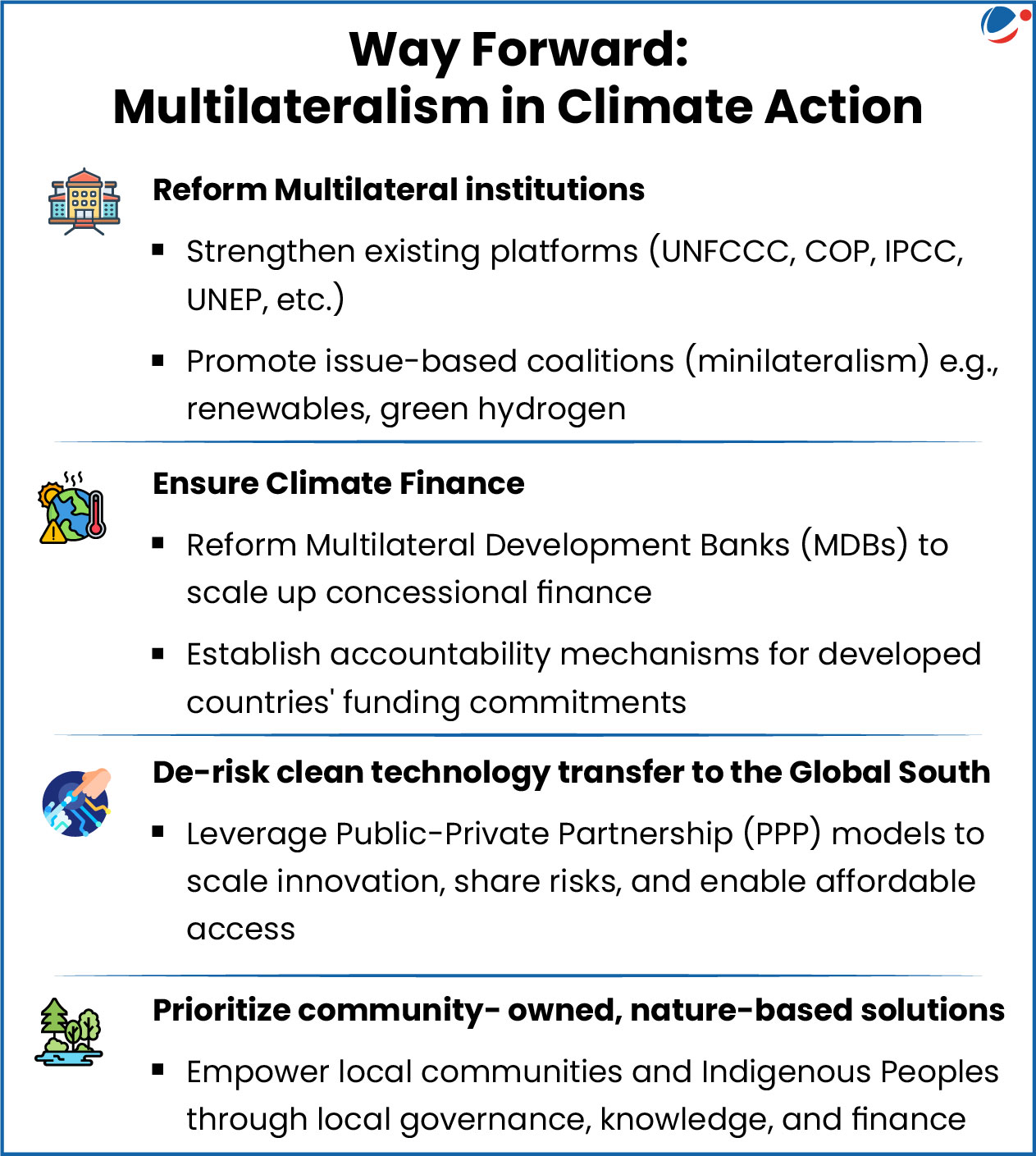
The 17th Petersberg Climate Dialogue (PCD) sought to reaffirm commitment to multilateral climate action amid rising geopolitical tensions.
- The PCD, an informal multilateral annual meeting on climate issues initiated by Germany in 2010, was the first major climate ministerial of 2026 ahead of COP31 of UNFCCC.
Role of Multilateralism in Climate Action
- Climate as a Global Public Good: Multilateralism is a foundational response to climate change, a transboundary threat which transcends national capacities due to its dispersed costs and benefits.
- Collective Governance: Establishes a rule-based order for sharing global responsibilities, preventing unilateralism and ensuring coordinated climate action. E.g. NDCs
- Negotiation Platforms: International frameworks like the UNFCCC, UNCBD, and UNCCD facilitate the development of adaptation and mitigation strategies.
- Upholding Climate Justice: Protects distributive equity by institutionalizing the principle of Common But Differentiated Responsibilities (CBDR), acknowledging varying national capacities and historical emissions.
- Mobilizing Financial Mechanisms: E.g. through institutions like the Global Environment Facility (GEF) and Green Climate Fund (GCF).
Challenges
- Decision-Making Paralysis: E.g. Consensus-based model of UNFCCC
- Financial Constraints: Developed countries have failed to mobilize the promised $100 billion annually.
- Geopolitical Fragmentation: Rising unilateralism undermines the stability and continuity of international climate law. E.g. US withdrawal from key climate bodies.
- Others: Asymmetric Agenda Setting favouring developed nations, Technology Protectionism (restricted tech transfer) etc.