


Developed by NITI Aayog in collaboration with WRI India, the Index evaluates subnational e-mobility policy frameworks and implementation outcomes across Indian States and UTs.
- Overall: The overall performance of the States and UTs has improved compared with 2024.
Key Highlights Across 3 Major Themes
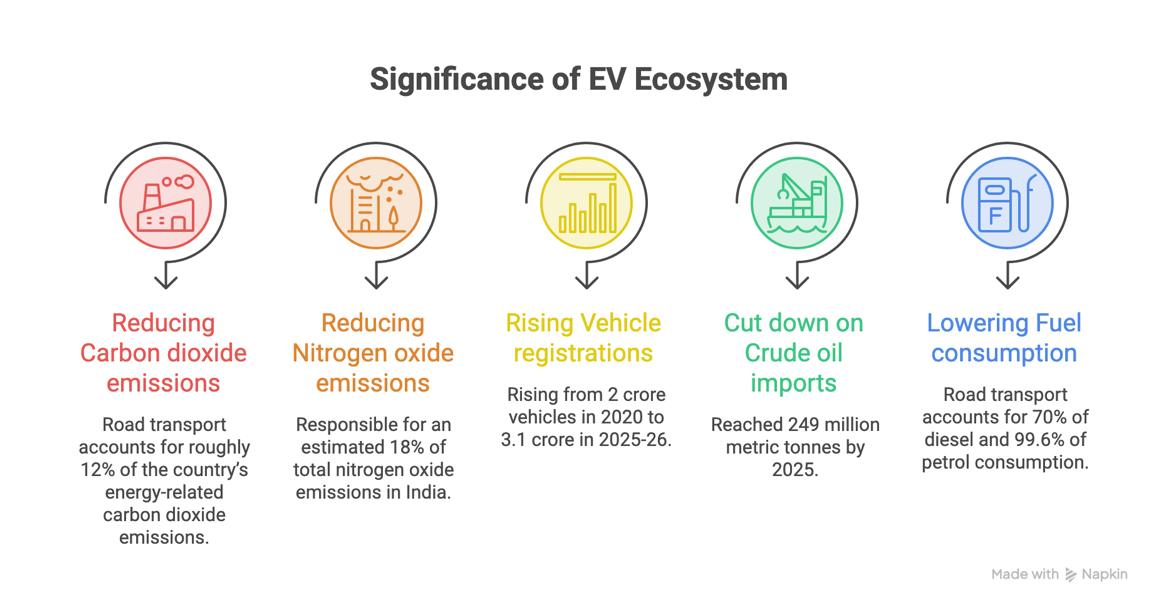
- Transport Electrification Progress (50% Weightage): Represents the largest opportunity for state-level growth, led by Delhi (77), Chandigarh (75), and Maharashtra (68), while 14 regions remain in the aspirant (lowest) category.
- Charging Infrastructure Readiness (30% Weightage): Led by Karnataka (97), Goa (92), and Haryana (91), though network rollout remains early-stage nationwide.
- EV Research & Innovation Status (20% Weightage): Innovation capacity remains heavily concentrated in specific urban and industrial hubs.
- Challenges: Limited charging infrastructure, dispersed settlements and a nascent innovation ecosystem are some of the identified barriers to progress.
India's Steps Towards Electric Mobility
- Central Policy & Investment: Over ₹90,000 crore has been committed toward demand incentives, bus electrification, and battery manufacturing through schemes like PM E-DRIVE, PM-eBus Sewa, and PLIs.
- Ecosystem Expansion: EV sales penetration expanded from 0.5% in 2018 to 8.25% in 2025–26 (over 8.7 million EVs on roads), alongside the growth of public charging stations to over 29,000 by June 2025.




