


WHO/UNICEF Estimates of National Immunization Coverage (WUENIC) 2023 released.
Key findings
Global:
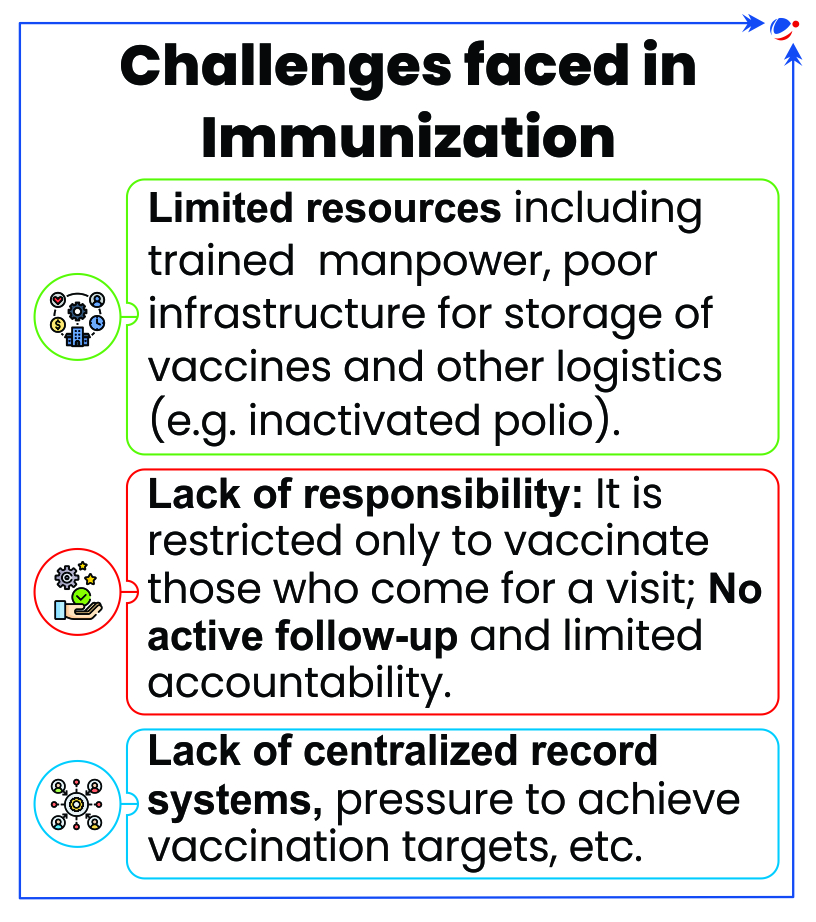
- Childhood immunization coverage stalled in 2023, leaving 2.7 million children either unvaccinated or under-vaccinated.
- Over 50% of unvaccinated children live in the 31 conflict-affected countries.
India:
- In 2023, 1.6 million children missed crucial Diphtheria, pertussis, and tetanus (together called DPT) and measles vaccinations.
- India lacks human papillomavirus (HPV) vaccination in national programs despite cervical cancer being second-highest cancer in women (18% of female cancers).
- India accounted for 2 million zero-dose children.
- Zero-dose children are those that lack access to or are never reached by routine immunization services.
Immunisation in India
- Universal Immunization Programme (UIP) has been operational in India since 1985.
- Mission Indradhanush 2014 was launched as a special drive to vaccinate all unvaccinated and partially vaccinated children, pregnant women under UIP.
- So far 5.46 crore children and 1.32 crore pregnant women have been vaccinated.
- Intensified Mission Indradhanush (IMI) 5.0, 2023 is a catch-up vaccination campaign for children up to 5 years of age and pregnant women, who were left out.
- 12 diseases covered: Diphtheria, whooping cough, tetanus, polio, tuberculosis, measles and hepatitis-B, pertussis, meningitis and pneumonia, Japanese encephalitis (JE) and measles-rubella (MR).
The World Health Organization (WHO) has released its first-ever clinical treatment guideline for tobacco cessation in adults.
- It is expected to help more than 750 million tobacco users who want to quit all forms of tobacco but find it difficult to do so.
- More than 60 per cent of the world’s 1.25 billion tobacco users want to quit, yet 70 per cent lack access to effective cessation services.
- Reasons: inefficient health systems, lack of resources, etc.
- Recommendations combine medication and behavioural interventions.
Tags:
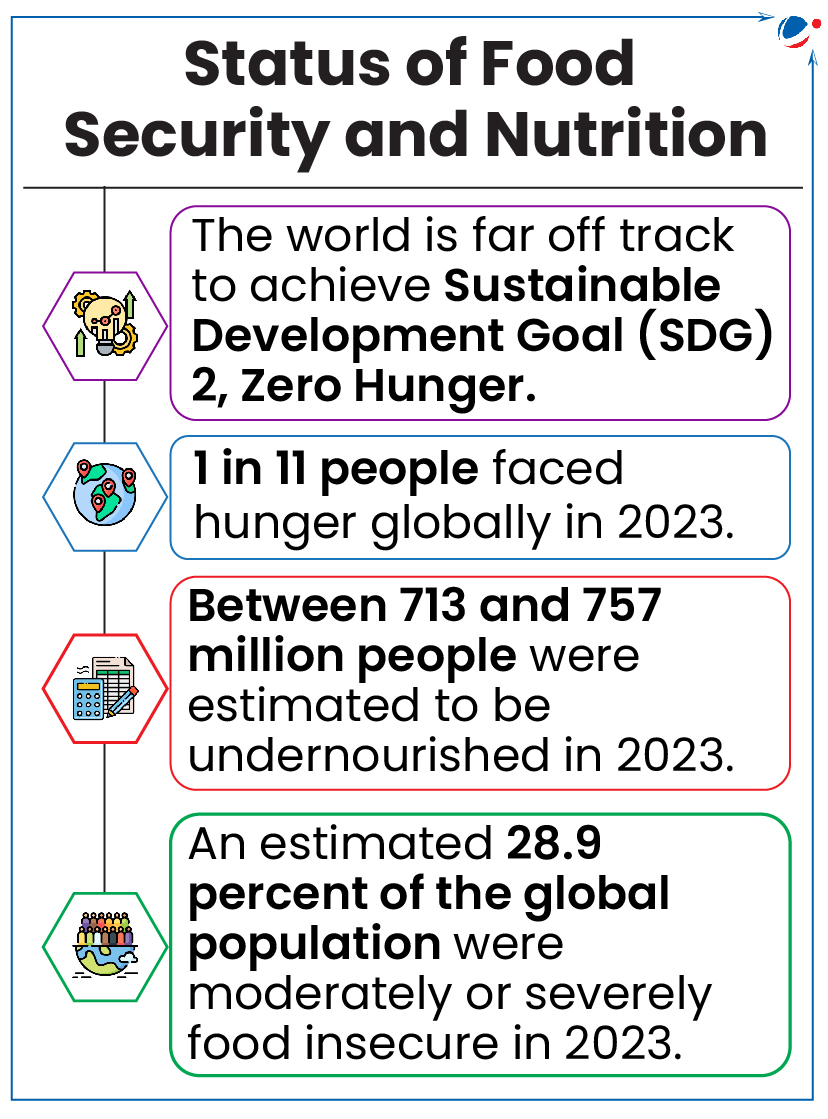
The State of Food Security and Nutrition in the World Report, 2024 released
- The report has been prepared by five specialized agencies of the United Nations-FAO, IFAD, UNICEF, WFP, and WHO.
- The theme of the report focuses on the financing to end hunger, food insecurity and malnutrition in all its forms.
Need for the New Definition
- Absence of a coherent picture of the financial resources spent on food security and nutrition.
- Existence of Multiple definitions creating problems like underfinanced areas, issue accountability of institutions, and tracking of progress.
The report puts forward a new definition of financing for food security and nutrition
- Refers to the public and private financial resources, both domestic and foreign, directed towards eradicating hunger, food insecurity and all forms of malnutrition.
- It aims at availability, access, utilization and stability of nutritious and safe foods, along with strengthening the resilience of agrifood systems.
Current gaps in financing
- Public spending on agriculture per capita is very low and not steadily growing in low-income countries (LICs) and lower-middle-income countries (LMICs)
- Food security and nutrition take less than a quarter of official development assistance and other official flows and seem to have been less of a priority for donors.
84,119 children were rescued by the Railway Protection Force under 'Operation Nanhe Farishtey' in the last 7 years.
About 'Operation Nanhe Farishtey’
- It is a mission dedicated to rescuing children in need of care and protection across various Indian Railway Zones.


