


Why in the News?
Union Budget 2025-26 announced constitution of Makhana Board in Bihar under 'Agriculture as the first engine' for India's development journey.
More on the News
- Board will be established to improve production, processing, value addition, and marketing of makhana.
Board will also provide handholding and training support to makhana farmers and will also work to ensure they receive the benefits of all relevant Government schemes.
- Budget Allocation: Rupee 100 crores.
- To streamline operations and improve collective bargaining power, people engaged in these activities will be organized into Farmer Producer Organizations (FPOs).
About Makhana

- Foxnut, commonly known as Makhana, is an important aquatic flowering crop with botanical name Euryale ferox (prickly water lily).
- It is a plant of tropical and subtropical climate.
- It is also referred to as the 'Black Diamond' due to its dark outer layer.
- It is grown in stagnant perennial water bodies like ponds, land depressions, oxbow lakes, swamps and ditches with water depths of 4-6 feet.
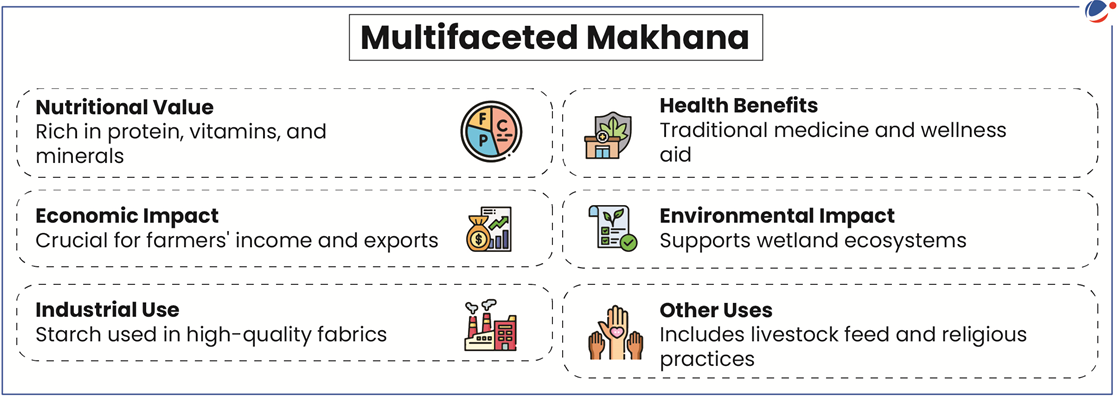
- Makhana is now being recognized as a super food.
- Preferred Climatic conditions
- Temperature: 200C to 350 C
- Relative humidity: 50% to 90%
- Annual rainfall: 100 cm to 250 cm
- Soil: Smooth loamy soil
- Makhana plant is considered as native of South-East Asia and China.
- Major Producing Regions
- Bihar in India is the leading state accounting for ~90% of India's makhana production.
- Other states: West Bengal, Manipur, Tripura, Assam, Jammu & Kashmir, Odisha, Rajasthan, Madhya Pradesh & Uttar Pradesh but commercially produced in few states only.
- Domestic:
- International: Makhana is also grown in Nepal, Bangladesh, China, Japan, Russia and Korea.
Challenges in Makhana Cultivation
Other initiatives taken to promote Makhana Cultivation
|
- Low productivity: Traditional farming methods result in lower yields, with farmers achieving only 1.7–1.9 tonnes per hectare compared to the potential 3–3.5 tonnes per hectare using modern techniques.
- Lack of processing infrastructure: Due to inadequate food processing units, raw makhana is often sold at lower prices to companies outside Bihar, reducing local farmers' earnings.
- Export barriers: Strict global quality standards like food safety and hygiene certifications have limited exports, with only 2 percent of Bihar's makhana meeting international requirements.
- Market inefficiencies: The absence of an organized marketing chain means farmers often receive lower prices due to the dominance of intermediaries.
- Limited awareness among farmers: Many makhana farmers lack awareness about government schemes, financial incentives, and modern agricultural practices.
- Others: Proper weed management in water bodies, better quality equipment and related accessories, better cold storage facilities etc.
Conclusion
The establishment of the Makhana Board marks a significant step towards the organized promotion, research, and commercialization of makhana cultivation in India. By addressing challenges like traditional farming inefficiencies, post-harvest losses, and limited global reach, the board can play a pivotal role in making makhana a globally competitive superfood. Sustainable cultivation practices, coupled with government initiatives, will not only boost rural livelihoods but also position makhana as a key player in India's agri-export sector.



