


UNESCO launched “Imagine A World With More Women In Science’’ campaign.
- The campaign marks the 10th anniversary of International Day of Women and Girls in Science and highlights positive impact of diverse perspectives by using hashtag #EveryVoiceInScience.
- UNGA has in 2015 declared 11th February as International Day of Women and Girls in Science.
Gender Gap in Science
- Global:
- Low Representation: Women make up only one-third of the global scientific community
- Leadership Gap: Just 1 in 10 STEM leadership roles are held by women.
- India:
- Women constitute 43% enrolment in STEMM (Science, Technology, Engineering, Mathematics & Medicine)
- The number of women scientists is 18.6%, R&D projects run by Women are ~25%.
Challenges
- Social & Cultural Norms (restrictive gender roles), Lack of role models (few visible female leaders in science limits aspirations), workplace inequality (biased work cultures) etc.
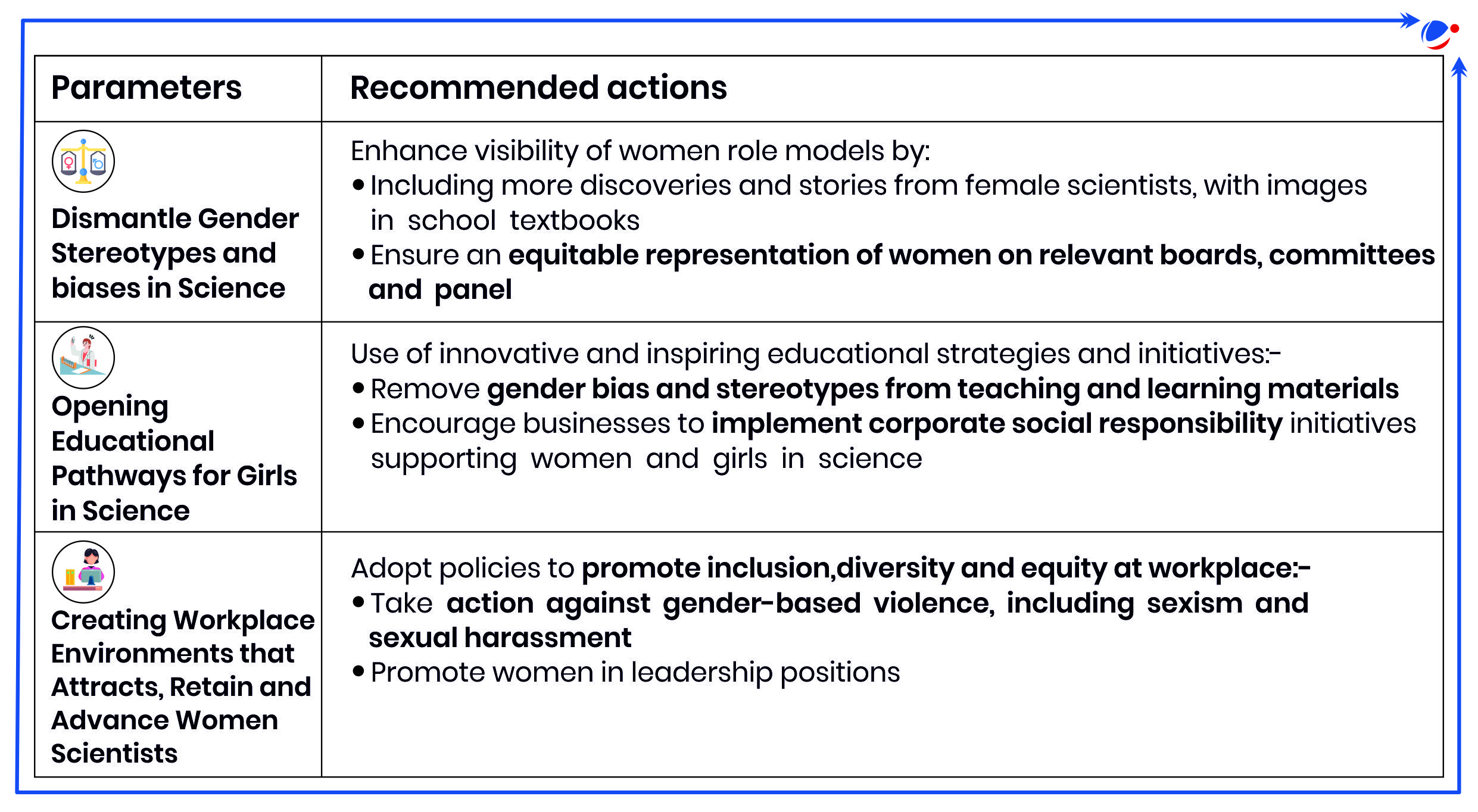
Steps to be Taken
Tags:
The Ministry of Skill Development and Entrepreneurship (MSDE), in collaboration with NITI Aayog launched Swavalambini.
About Swavalambini
- A Women Entrepreneurship Programme, initially introduced across Higher Education Institutions (HEIs) in Eastern regions has been now expanded to other regions of the country.
- Implementation: By National Institute for Entrepreneurship and Small Business Development (NIESBUD) in joint partnership with NITI Ayog.
- Aim: To establish a structured and stage-wise entrepreneurial journey for young women. The programme will take participants through various stages, including awareness-building, skill development, training, mentorship, policy support and funding support.
- It also provides six months of mentorship and handholding support to help participants translate their ideas into sustainable prospects.
The Annual Status of Education Report (ASER) is a nationwide rural household-based survey of children's schooling and learning status.
- It tests the schooling status for children in the age group of 3-16, and the ability to read simple text & do basic arithmetic in the age group of 5-16.
- The ASER survey was conducted annually from 2005 till 2014. Thereafter, an alternate-year cycle was introduced.
Key Findings
- Reversing the Learning Gap: Improvements in basic reading and arithmetic among students of classes 3 and 5 in rural areas reverting back from the post-pandemic damage.
- Improvement in both reading & arithmetic levels for all elementary grades (Std I-VIII) since 2022 with arithmetic levels being highest over the decade.
- Digital Literacy: In 2024, for the first time, it includes a component of ‘Digital Literacy’ among the age group 14-16.
- Access to smartphones is close to universal: Almost 90% of both girls and boys report having a smartphone at home.
- Gender Gap in Smartphone Ownership: 36.2% of boys own a smartphone compared to just 26.9% of girls.
- Smartphone Usage More for Social Media than Education: Only 57% of teenagers use smart devices for educational purposes, while approximately 76% use them for social media.
- School Infrastructure: All Right to Education indicators in ASER show slight improvements, including functional girls' toilets, drinking water facilities etc.
Tags:
WHO marked 20 years of its first global treaty, the WHO FCTC.
About WHO FCTC
- Genesis: Adopted in 2003, enforced in 2005.
- Purpose: Provides a legal framework for tobacco control which includes large pictorial health warnings, smoke-free laws, and higher taxes.
- India’s Role: Ratified in 2004, served as South-East Asia’s regional coordinator.
- Impact: 5.6 billion people covered by at least one policy, contributing to declining global smoking rates.
Tags:



