Union Cabinet approved the Revised National Program for Dairy Development (NPDD) with an enhanced outlay for the period of 15th Finance Commission cycle (2021-22 to 2025-26).
Objectives of Revised NPDD
Establish 10,000 new Dairy Cooperative Societies.
Strengthen milk procurement and processing in the North Eastern Region (NER).
Formation of 2 Milk Producer Companies with dedicated grant support in addition to the ongoing projects of NPDD.
Generate an additional 3.2 lakh direct and indirect employment opportunities, focusing on women, which constitute 70% of dairy workforce.
National Program for Dairy Development (NPDD)
It is a Central Sector Scheme launched in 2014 (Restructured in 2021).
Implementing Agency: Department of Animal Husbandry & Dairying (DAHD), Ministry of Fisheries, Animal Husbandry & Dairying.
Objectives:
To create and strengthen infrastructure for milk and milk products including cold chain infrastructure;
To create training infrastructure for training of dairy farmers;
To increase milk production by providing technical input services like cattle-feed, and mineral mixture;
To assist in rehabilitation of potentially viable milk federations/unions.
The scheme consists of 2 key components:
Component A: Improving essential dairy infrastructure especially in remote and backward areas by supporting formation of Dairy Cooperative Societies (DCS)/Milk Producers Companies (MPC). E.g. milk chilling plants, milk testing laboratories, and certification systems.
Component B: Dairying through Cooperatives (DTC): Japan International Cooperation Agency (JICA)-assisted programme for sustainable development of dairy cooperatives by improving production, processing, and marketing infrastructure in the 9 States.
Role of Cooperatives in Dairy Sector
Collective empowerment (Sahkar Se Shakti): Cooperatives are ideal for the fragmented dairy sector as it provides institutional support, bargaining power and awareness for growth of small farmers.
Economic Empowerment of Farmers (Sahkar Se Samriddhi): Cooperatives provide equitable wealth distribution and democratic decision-making processes. E.g. Amul, Nandini contributed to economic growth of dairy farmers.
Cooperation among Coopertives (Sahkar Se Sahyog): It aids in achieving synergies among cooperatives. E.g. facilitating transactions of Primary Diary Cooperative Societies (PDCS) through Cooperative Banks.
Challenges in Dairy Sector:
Low Productivity: Lower milk production per animal alongsidehighly fragmented nature of the dairy sector in India.
Reasons- Ineffective breeding programmes, limited extension services, low technological adoption, and limited availability and affordability of quality feed and fodder etc.
Informal and unorganized: Cultural preference for informal supply of milk leads to lower demand for packaged milk from organized sector.
Quality issues: Adulteration is a major issue in supply chain of milk and milk products. E.g. dilution of milk, use of urea etc.
Animal health and breeding services: Limited veterinary infrastructure development and lack of awareness about vaccinations leads to health issues in animals. E.g. Foot and Mouth Disease
Administration: Poor governance of cooperatives with interventions of State governments hinders the democratic practices of cooperatives.
Limited processing and storage: Lack of value-addition, processing, storage and marketing infrastructure impacts the profitability of the milk farmers.
Way Forward
Infrastructure development: Infrastructure related to milk production, processing, storage and research needs to be made accessible at village and district levels.
E.g. Cold chain infrastructure, quality testing labs, veterinary services, value-addition mechanization etc.
Technological adoption: Development of a scientific approach to animal husbandry with making technological interventions accessible and affordable.
E.g. study of animal genetics and methods like artificial insemination, embryo transfer etc.
Promoting Cooperatives: Capitalizing on the power of collectivism in remote areas and increasing awareness about the benefits of cooperatives in dairy farmers.
Processing and Marketing: Promote processing of milk to make in-demand milk products like A2 Ghee, paneer etc. Marketing of quality products with a goal of creating a brand and promoting exports of dairy products.
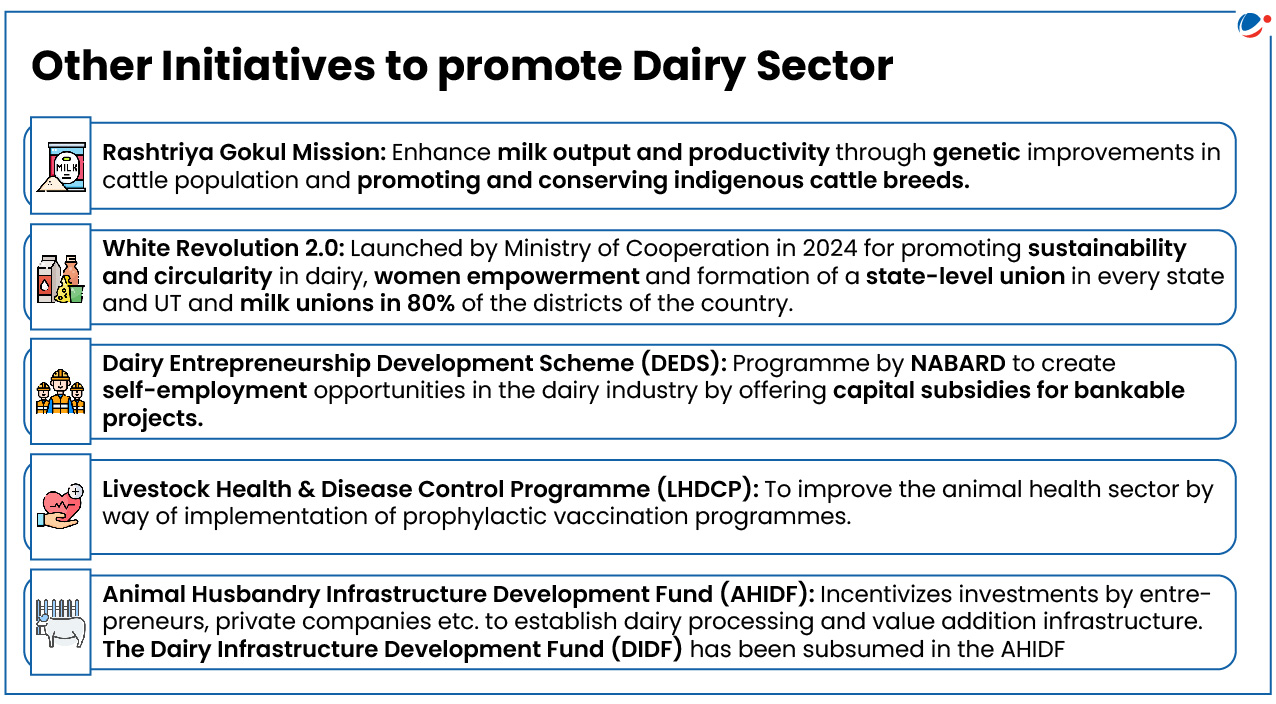
Related News: Revised Rashtriya Gokul Mission (RGM)
Enhanced Outlay: An additional outlay of ₹1,000 crore, bringing the total budget to ₹3,400 crore for the 15th Finance Commission period (2021-22 to 2025-26).
Key Additions:
Heifer (Young Cows) Rearing Centres: One-time assistance of 35% of capital cost for setting up 30 housing facilities for 15,000 heifers.
Support for High Genetic Merit (HGM) Heifers: 3% interest subvention on loans taken by farmers to purchase HGM IVF heifers from milk unions/financial institutions.
Ongoing Activities under RGM:
Nationwide Artificial Insemination Programme (NAIP): Strengthening of semen stations and Artificial Insemination (AI) network.
Bull production and breed improvement using sex-sorted semen.
Skill developmentand farmer awareness programs.
Establishment of Centres of Excellence and strengthening of Central Cattle Breeding Farms.