


REAIM (Responsible AI in the Military Domain) Summit 2024 held in Seoul (South Korea) announced a legally non-binding "Blueprint for Action" to govern responsible use of AI in the military.
- REAIM, with its inaugural summit held in 2023, is a platform for global discussion with all stakeholders on ways to ensure responsible military application of AI.
Key highlights of the ‘Blueprint for Action’
- Impact of AI on international peace and security: AI applications in military domain should be developed, deployed and used in a way that maintains and does not undermine international peace, security and stability.
- Recognize that Al applications can present both foreseeable and unforeseeable risks including risks of an arms race, miscalculation, escalation, and lowering threshold of conflict.
- Stresses the need to maintain human control and involvement for all actions critical to informing and executing sovereign decisions concerning nuclear weapons employment, without prejudice to ultimate goal of a world free of nuclear weapons.
- Implementing responsible AI in the military domain: AI applications should be ethical and human-centric, applied in accordance with applicable national and international law, promote dialogue on rigorous testing and evaluation (T&E) protocols, etc.
- Future governance of AI in military domain: Discussion on Governance should take place in an open and inclusive manner to fully reflect wide- ranging views, strengthen international cooperation on capacity-building to reduce knowledge gap on responsible development and deployment, etc.
Central Bureau of Investigation (CBI) successfully dismantled a virtual asset and bullion-supported cybercrime network through Operation Chakra III (phase 3).
- This operation was executed in close coordination with Federal Bureau of Investigation (FBI) of US.
About Operation Chakra
- Initiated by CBI in 2022 it is an INTERPOL assisted Global Action to combat and dismantle organized cyber enabled financial crime networks.
- Its phase 2 was launched in 2023 and phase 1 in 2022.
With this Addition, Indian navy now have two SSBN (Ship, Submersible, Ballistic, Nuclear) submarines (INS Arihant and INS Arighat).
India’s Nuclear Powered Submarines:
- Arihant-class submarines are being developed and built indigenously under the Advanced Technology Vessel (ATV) Project.
- INS Arihant, India's first indigenous nuclear submarine under ATV project, was commissioned in 2016.
- INS Arihant carried out a successful launch of a Submarine Launched Ballistic Missile (SLBM) in 2022.
- It can carry up to four nuclear-capable K-4 SLBMs (Range exceeding 3,500 km) or twelve K-15 SLBMs (Range of around 750 km).
- INS Arihant, India's first indigenous nuclear submarine under ATV project, was commissioned in 2016.
- In 2019, India signed a $3 billion deal with Russia to lease an Akula-class nuclear-powered attack submarine for 10 years.
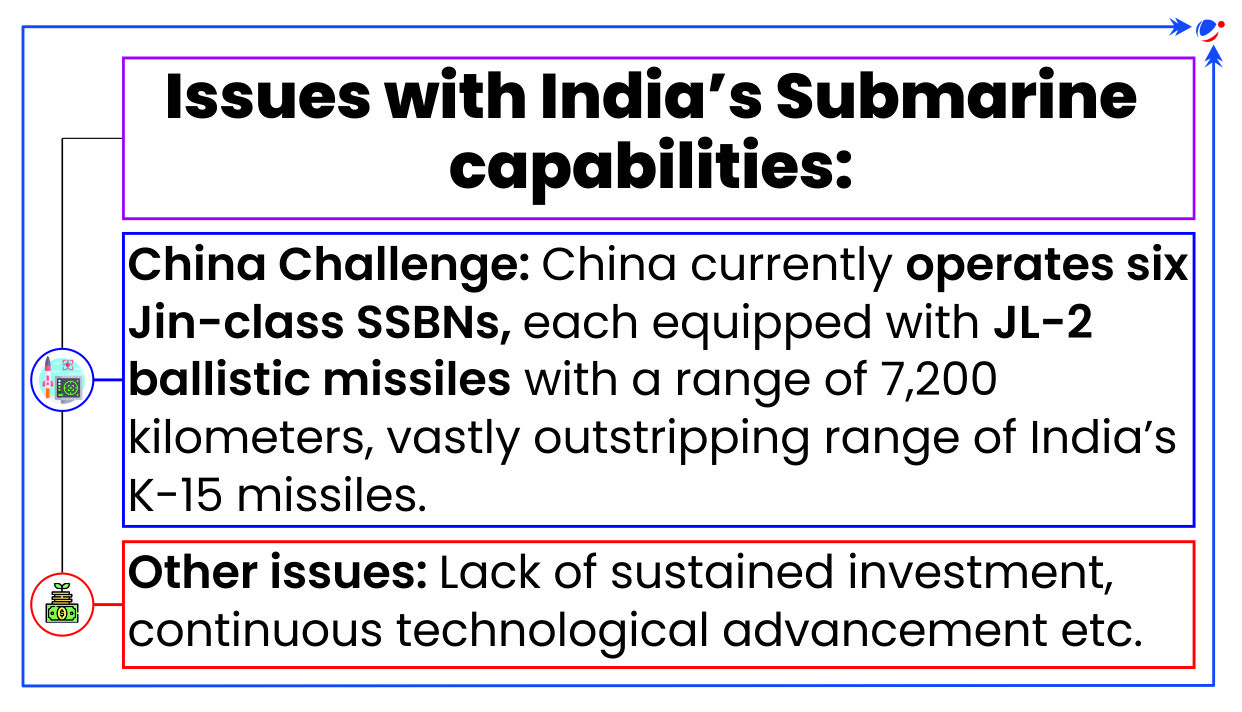
Significance:
- Nuclear Deterrence capability:
- Strengthening nuclear triad (consisting of Land-based intercontinental ballistic missiles, Submarine-launched ballistic missiles, and Strategic bombers).
- Credible second-strike capability: In line with India’s ‘no first-use policy’.
- Strategic Significance: SSBN will help maintain strategic stability in South Asia, particularly in context of India’s nuclear-armed neighbors, China and Pakistan.
- Increased India's naval prowess: By building towards blue water naval capability(Navy that operates into deep oceans).
- Other Significance: Contributing towards Atmanirbhar Bharat, enabling critical defense and attack capabilities etc.
Article Sources
1 sourceRecently, the flight test of VL-SRSAM has been successfully conducted by Defence Research & Development Organisation (DRDO) & Indian Navy from the Integrated Test Range (ITR) in Chandipur, off the coast of Odisha.
- Flight test was carried out from a land-based vertical launcher.
About VL-SRSAM
- It is a vertically launched surface to air missile with all-weather capability for use by Indian Navy.
- It is a ship borne weapon system designed to neutralise various aerial threats at close ranges, including sea-skimming targets.
- Features: Indigenous Radio Frequency (RF) seeker
- Developed by: DRDO


