


Why in the News?
Prime Minister of India recently launched the Mission for Aatmanirbharta in Pulses (Dalhan Aatmanirbharta Mission).
Key Features of Mission for Aatmanirbharta in Pulses
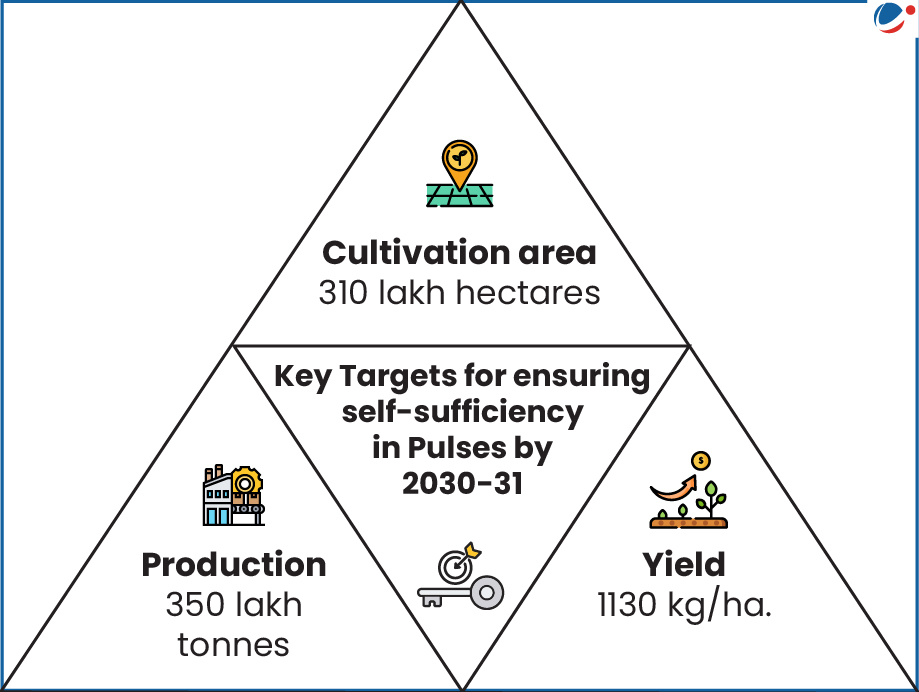
- Aim: Boosting domestic production, reduce import dependence and achieving self-sufficiency (Aatmanirbharta) in pulses by December 2027.
- Duration: 6 Years (2025-26 to 2030-31).
- Financial Outlay: Rs. 11,440 crore.
- Ministry: Ministry of Agriculture & Farmers' Welfare, Government of India
- Focus Crops: Tur/Arhar (pigeon pea); Urad (black gram) & Masoor (red lentil).
- Cluster-based approach: Tailoring interventions to the specific needs of each cluster.
- Benefit: To benefit 2 crore farmers from guaranteed procurement, quality seed distribution, and enhanced value chain support.
- Other intended benefits:
- Promote climate-resilient and soil health-friendly practices.
- Create substantial employment opportunities.
- Promoting intercropping and crop diversification.
- Operational Strategy
- Seed Development and Distribution: Production and distribution of 126 lakh quintals of certified seeds and the free provision of 88 lakh seed kits to farmers.
- Emphasis is placed on developing and disseminating high-yielding, pest-resistant, and climate-resilient pulses varieties.
- Assured Procurement: 100% procurement of Tur, Urad, and Masoor at MSP for four years.
- National Agricultural Cooperative Marketing Federation of India (NAFED) & National Cooperative Consumers' Federation of India Ltd. (NCCF) will procure from farmers in participating states under Price Support Scheme (PSS) of Pradhan Mantri Annadata Aay SanraksHan Abhiyan (PM-AASHA).
- Role of states: To ensure effective implementation, states will prepare rolling five-year seed production plans, with breeder seed production monitored by ICAR and quality assurance maintained through the SATHI portal.
- SATHI (Seed Authentication, Traceability & Holistic Inventory) is a user-oriented centralized portal by the Ministry of Agriculture and Farmers' Welfare, in partnership with National Informatics Centre (NIC).
- Post-harvest value chain: Establishing 1,000 processing and packaging units, supported by subsidies of up to ₹25 lakh per unit.
- Seed Development and Distribution: Production and distribution of 126 lakh quintals of certified seeds and the free provision of 88 lakh seed kits to farmers.
Status of Pulses production in India
|
Need for Aatmanirbharta in Pulses
- Insufficient Domestic Production: Domestic production has not kept pace with demand, leading to a 15–20% increase in pulse imports
- In 2023–24, India imported 47.38 lakh tonnes of pulses, even as it exported 5.94 lakh tonnes.
- Addressing Malnutrition: Pulses contribute nearly 20–25 % of total protein intake in Indian diets, however the per capita consumption of pulses falls short of the recommended 85 grams per day.
- Increasing Demand: Total demand is projected to reach 46.33 MT by 2030 and 50.26 MT by 2047.
- Environmental and Soil Health Benefits: Pulses enhance soil fertility due to their ability to fix atmospheric nitrogen, which helps reduce dependence on synthetic fertilizers,
- Price and Market Stabilization: Price fluctuation due to volatility in global trade and domestic production acts as a challenge in meeting inflation targets.
Other initiatives for promoting pulse production
|
Conclusion
The "Mission for Aatmanirbharta in Pulses" lays the groundwork for a self-reliant, sustainable, and resilient pulses sector. By combining technology, innovation, and farmer empowerment, it will ensure nutritional security, boost rural prosperity, and reduce import dependence — steering India toward true agricultural and economic self-sufficiency.


