


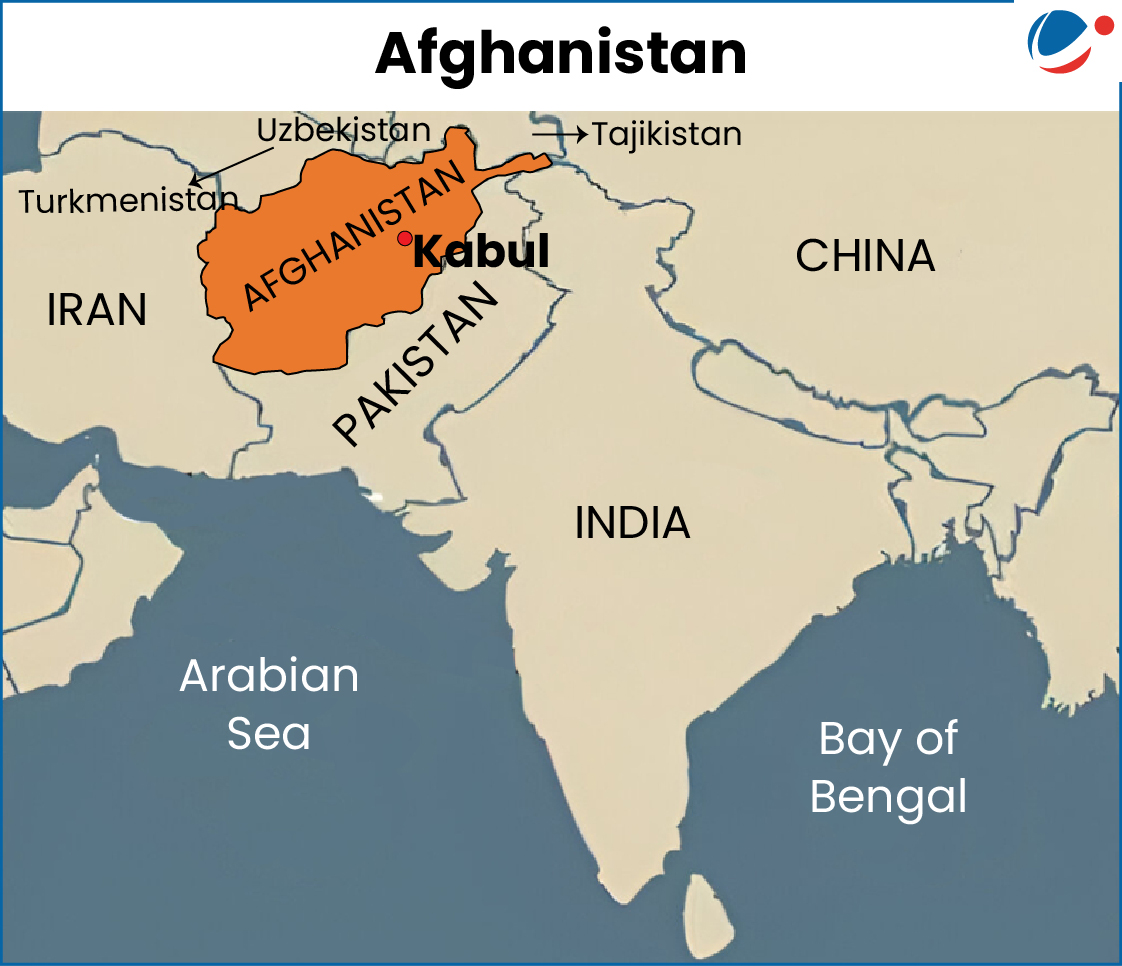
Why in News?
Recently, Afghanistan's Foreign Minister arrived in New Delhi to hold bilateral discussions with India's External Affairs Minister.
More on News
- This visit follows a special travel exemption granted to Afghanistan's Foreign Minister by United Nations Security Council to travel to India.
- It is the first ministerial-level visit to India since the Taliban took control of Afghanistan in August 2021.
Key outcomes of the Visit
- Diplomatic Engagement: India restored status of Technical Mission of India in Kabul to that of Embassy of India in Afghanistan.
- Connectivity: commencement of India-Afghanistan Air Freight Corridor.
- Infrastructure and Energy: Both side appreciated India's support for India-Afghanistan Friendship Dam (Salma Dam) in Herat and India agreed to collaborate on hydroelectric projects in Afghanistan.
Why India is showing renewed interest in Afghanistan?
- Safeguarding Strategic Interests:
- Counterterrorism: India's foremost priority is to prevent Afghanistan from once again becoming a breeding ground for terrorism threatening its security. E.g. Presence of groups such as Al-Qaeda, Islamic State-Khorasan Province (IS-KP), Lashkar-e-Taiba, and Jaish-e-Mohammed remains a serious threat.
- Security Commitments from Kabul: E.g. Afghan Foreign Minister assured that Afghan territory will not be used for activities hostile to India.
- Geopolitical Balancing and Rival Management
- Limiting Pakistan's Influence: India aims to counter Pakistan's influence by leveraging the deteriorating Pakistan–Afghanistan ties, creating space for pragmatic India–Afghanistan cooperation.
- Checking China's Strategic Expansion: India also aims to prevent its strategic rivals, particularly China, from dominating Afghanistan's economic and geopolitical landscape following the Taliban's return to power.
- Protecting Strategic Investments: India has invested USD 3 billion in more than 500 projects across various provinces of Afghanistan, covering power, water, roads, healthcare, education, agriculture, and capacity building.
Global and Regional Perspectives
|
Challenges for India: Navigating a Complex Political Landscape
- Lack of Formal Recognition: India has not formally recognised the Taliban government, limiting the scope of diplomatic and institutional cooperation.
- Diplomatic Dilemmas: Moreover, India risks losing its moral credibility if perceived as aligning with an oppressive regime just to counter Pakistan.
- Balancing Strategic Interests with Humanitarian Concerns: India's secular democracy contrasts with the Taliban's theocratic rule whose restrictions on women and religious freedoms raises concerns about Human Rights violations.
Conclusion
India's renewed engagement with the Taliban reflects a pragmatic shift by prioritising strategic interests over earlier ideological reservations. This renewed approach is vital for securing India's borders against terrorism and countering the influence of strategic rivals. It underscores that engaging with a difficult partner does not signify endorsement and reflects a pragmatic choice of dialogue over disengagement.


