Recently, Tamil Nadu announced $1 Million prize for experts and organizations for deciphering the scripts of the Indus Valley Civilization.
About Indus Valley Scripts
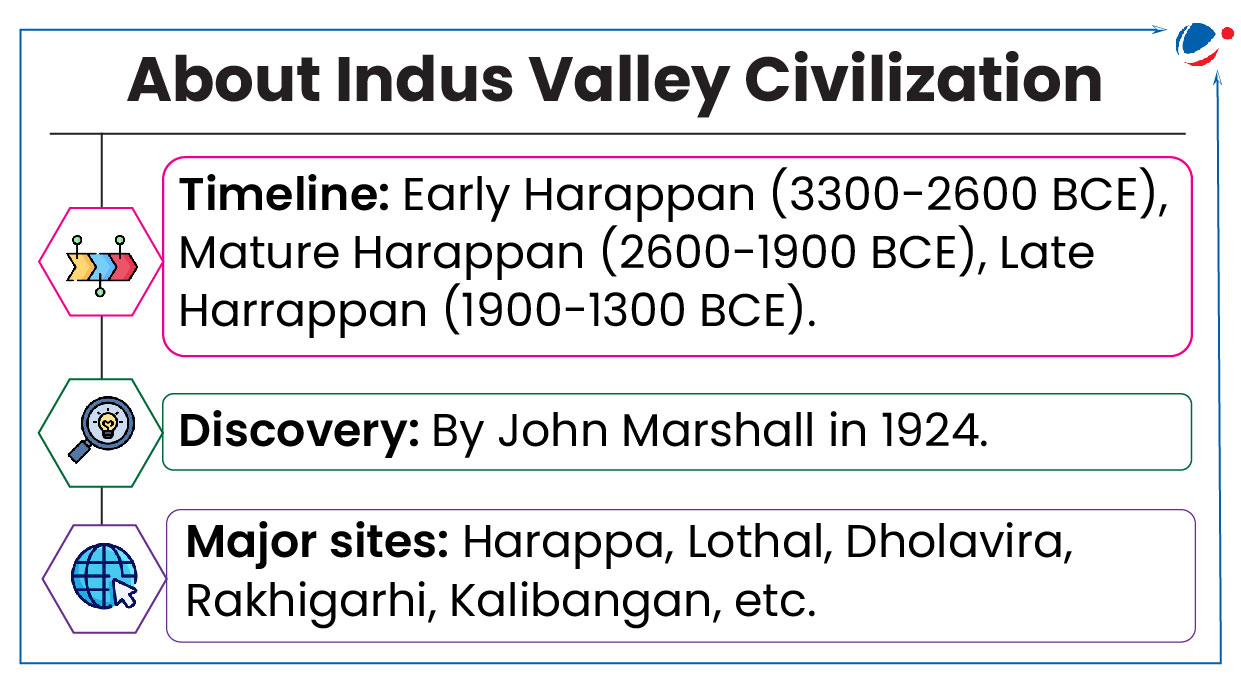
- Distribution and length: Found at approximately 60 excavation sites. Currently, ~3500 specimens of this script survive in stamp seals carved in stone, in moulded terracotta and faience amulets, in fragments of pottery.
- Writing direction and style: Indus script is an unknown writing system, and the inscriptions discovered are very short, comprising no more than five signs on the average.
- Generally written right to left, longer texts sometimes used Boustrophedon Style (alternating directions between lines).
- Composition of the script: Partially pictographic signs, contains human and animal motifs, distinctive 'unicorn' symbol etc.
- Writing media and methods: Use of seals, tablets, and copper tablets, Materials included terracotta, ceramics, shell, bone, ivory, stone, metals, and perishable materials like fabric and wood.
- Applied through carving, incising, chiseling, inlaying, painting, molding,Boustrophedon Style and embossing.
Significance of Deciphering Indus Valley Script
- Historical: Could reveal relationship between Indus Valley Civilization and later Vedic practices and their interaction with other contemporary civilizations.
- Linguistic and Ethnic connections: Could establish connections between the languages of the Indus Valley and contemporary languages from Dravidian and Indo-European families.
5,000-year-old Water Management Techniques unearthed at Harappan site, Rakhigarhi (Haryana).
- The discovery made during an ongoing excavation identified a water storage area between mounds, with an estimated depth of 3.5 to 4 feet depicting their advanced water management techniques.
- A dried riverbed of the Chautang (or Drishavati) River, was also discovered.
Water management practices of the Harappan Civilization
- Elaborate Drainage: Underground drains build with precisely laid bricks, connecting houses to wider public drains were found for sewage disposal in major cities.
- Small Bunds: Built by the local people to store rain water for irrigation and drinking in Lothal, Gujarat.
- Dockyard: At Lothal, near Sabarmati River, is a remarkably lined structure with evidence of channels for inlet and outlet of water.
- Channels and Reservoirs: At Dholavira, Gujarat, built completely of stone for storing fresh water brought by the rains or to store water diverted from the nearby rivulets.
- They were an example of advanced hydraulic engineering for conservation, harvesting and storage of water.
- Tanks and Wells: At Mohenjodaro, where rainwater harvested in tanks was brought to the wells of each house through efficient drainage system.
- The “Great Bath” at Mohenjodaro was a large tank made of brick floor, probably for mass bathing during religious functions, is a remarkable example of ancient large water tanks.
About Rakhigarhi
|
Tags:
Article Sources
1 sourceIdol of Saint Narahari Tirtha has beendiscovered in Simhachalam Temple, Vishakhapatnam.
About Saint Narahari Tirtha
- Narahari Tirtha was a prominent Dvaita Vedanta philosopher, scholar, and saint of the 13th century.
- Believed to be born in Chikakolu town (present Srikakulam, Andhra Pradesh).
- He was a disciple of Madhvacharya, the proponent of Dvaita Vedanta philosophy.
- He introduced Yaksha Gana and Bayalu Aata (open theatre drama) as a part of Vaishnava Bhakti Movement.
- He was consecrated near the rock adjacent to Chakratirtha at Hampi on the banks of river Tungabhadra.
Tags: