


Why in the news?
External Affairs Minister highlighted the crucial role of Non-Resident Indians (NRIs) and Persons of Indian Origin (PIOs) in shaping India's rise as a global power during his speech at the 18th Pravasi Bharatiya Divas.
About Indian Diaspora
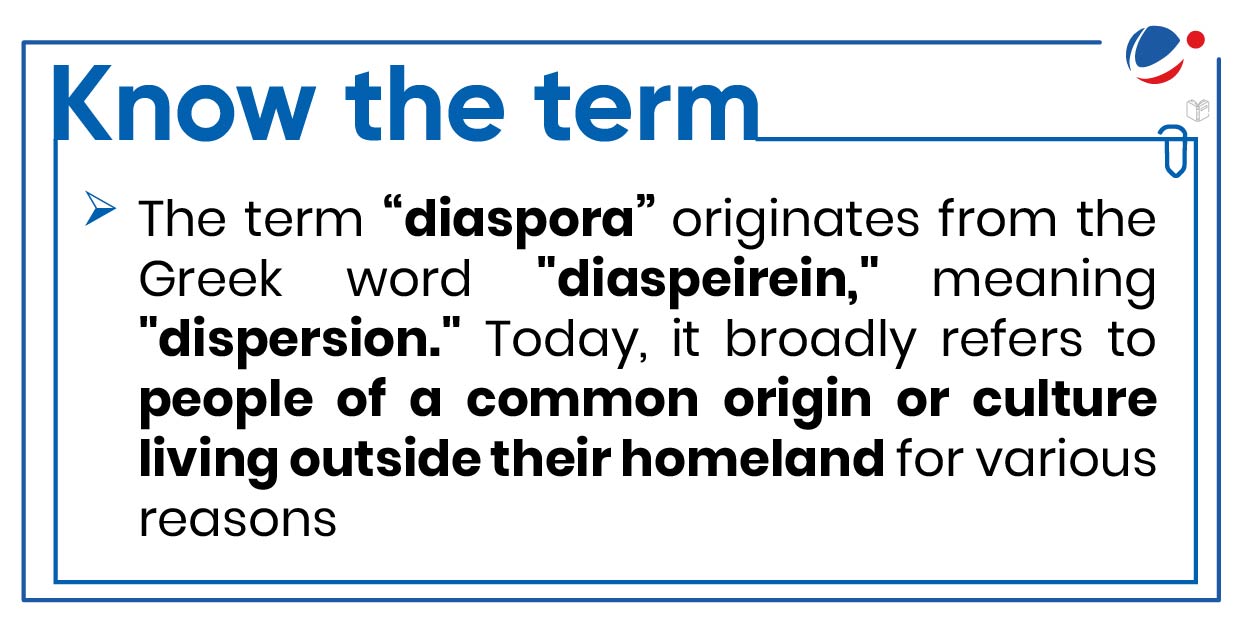
- The Indian government does not have a specific definition for diaspora, but it generally includes Non-Resident Indians (NRIs), and Overseas Citizens of India (OCI).
- In 2015, Persons of Indian Origin (PIOs) and OCI cardholders were merged into one category, OCI.
- According to the World Migration Report 2024, India has the largest international migrant population (~18 million). Major countries with Indian diasporas:
- USA – 4.4M+
- UAE – 3.4M+
- Malaysia – 2.9M+
- The composition of the Indian diaspora is diverse, consisting of labourers/workers, traders, political, leaders, professionals as well as students.
- India's engagement with its diaspora is characterized under the rubric of 4Cs - Care, Connect, Celebrate & Contribute.
Significance of Indian Diaspora
- For IndiaSocio-Cultural Impact: Preserves Indian traditions and promotes cross-cultural understanding through festivals, language schools, and religious practices.
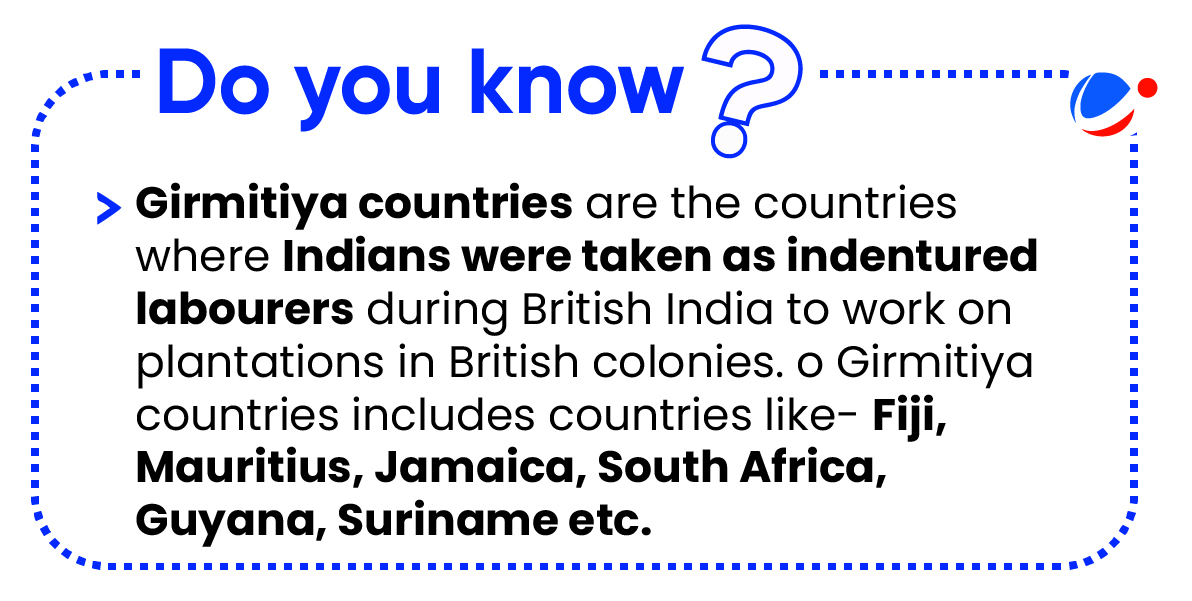
- Example: The Indian diaspora in Girmitiya Countries has kept Indian culture alive.
- Economic Impact
- Remittances: India received $125 billion in 2023, about 3.4% of GDP, boosting economic growth and poverty reduction.
- Investment & Entrepreneurship: Many skilled professionals invest in India, fostering innovation and startups.
- Technological Influence: Indian-origin leaders like Sundar Pichai (Google) and Satya Nadella (Microsoft) shape the global tech industry.
- Political Impact
- Leadership: Various political leaders across the globe has Indian roots including
- Rishi Sunak UK's first Prime Minister of colour
- Kamala Devi Harris, the first woman and the first coloured Vice President of the USA
- Mohamed Irfaan Ali, the ninth executive President of Guyana
- Diplomacy: Influences policies in host nations, strengthening India's global ties.
- Example: The Indian American community played a role in the Indo-US Nuclear Deal.
- Leadership: Various political leaders across the globe has Indian roots including
For Destination Countries
- Diversity & Multiculturalism: Enhances local culture with Indian traditions, languages, and cuisine.
- Labor Supply: Fills workforce gaps, especially in Gulf countries (construction, healthcare, hospitality).
- Example: The Indian community with a strength of approx. 1 million is the largest expatriate community in Kuwait and is regarded as the community of first preference among the expatriate communities.
- Business & Entrepreneurship: Indians drive economic growth by launching businesses and creating jobs.
- Example: In OECD countries, immigrant entrepreneurship is higher than among native-born citizens.
Government Initiatives for Diaspora Engagement
Institutional Measures |
|
Engagement Initiatives |
|
Digital Outreach |
|
Global Agreements |
|
Challenges Faced by the Indian Diaspora
- Challenges in West Asia
- Conflict Zones: Wars (e.g., Yemen, Israel-Palestine) put Indian expatriates at risk, leading to costly evacuations.
- Job Insecurity: Policies like "Saudisation" cause job losses for low-skilled workers, forcing returns to India.
- Data Deficiency: Lack of accurate migrant data (e.g., in Qatar) makes it hard to address their concerns.
- Challenges in Europe, North America & Australia
- Secessionist Movements: Pro-Khalistan protests in the US, UK, Canada, and Australia create diplomatic tensions.
- Racism & Discrimination: Many face racial violence due to their ethnicity and background.
- Immigration Hurdles: Strict visa policies (e.g., H-1B visa in the US) disrupt careers and family stability.
- Example: Children of H-1B holders no longer get automatic US citizenship.
- Other Issues
- Issues in Engagement with India: Since registration by the diaspora is voluntary, the entire diaspora does not register with the Indian Embassies/Posts abroad and the data also varies because of the mobility of the diaspora.
- Insufficient evaluation of programs and schemes for the welfare of diaspora population.
- Challenges in crisis situation: During crises, thousands of Indian students studying in Ukraine (Russia Invasion) and China (Covid-19 induced lockdown) faced uncertainty.
- They were unable to return to these countries, nor could they rejoin their courses physically or complete their internships or training in India.
- Issues in Engagement with India: Since registration by the diaspora is voluntary, the entire diaspora does not register with the Indian Embassies/Posts abroad and the data also varies because of the mobility of the diaspora.
Way Forward for Strengthening Diaspora Engagement
- Legal & Policy Reforms
- Emigration Bill 2023: Finalize and enforce to protect migrant workers' rights.
- Diaspora Database: Encourage registration via embassies for better decision-making.
- Grievance Redressal: Expand MADAD Portal and introduce a unified complaint system like CPGRAMS.
- MADAD enables online logging and tracking of grievances, and submission of course/contact details of students
- Leveraging Knowledge & Skills
- Skilling Programs: Train workers for better jobs abroad.
- Diaspora Networks: Link professionals with Indian businesses to convert brain drain into brain gain.
- Ensuring Safety & Security
- Portability of Benefits: Enable social security transfers through international agreements.
- Mutual Legal Assistance Treaties (MLATs): Strengthen victim protection and fight transnational crimes.
Conclusion
The Indian diaspora serves as a vital link between India and the world, acting as "living root bridges" that strengthen cultural, economic, and diplomatic ties. While challenges like discrimination and labor market uncertainties persist, by fostering stronger connections, India can harness the full potential of its diaspora, transforming brain drain into brain gain.





