


5 countries were elected to serve as non-permanent members of the United Nations Security Council (UNSC).
- These countries are Bahrain, Colombia, the Democratic Republic of Congo, Latvia, and Liberia.
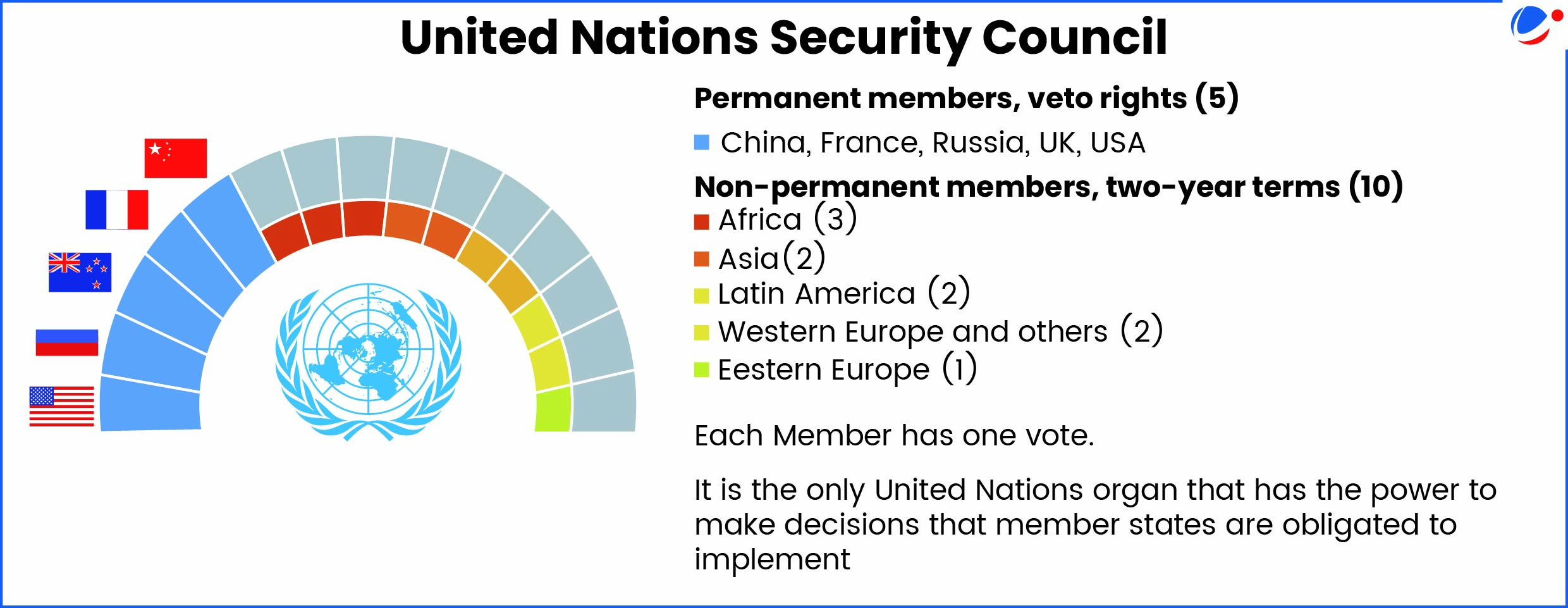
About UNSC
- Genesis: Established in 1945 through the UN Charter as one of the 6 principal organs of the UN.
- Purpose: Maintaining international peace and security.
- Members: 5 permanent members (P5) and 10 non-permanent members (refer to the infographic).
UNSC Reform Proposal (2024)
- Proposed by: G4 Nations (India, Brazil, Germany, Japan)
- Need:
- Misuse of veto power by permanent members
- Poor regional representation
- Does not reflect current global realities
- Key provisions of proposed reforms
- Expanded Membership:11 permanent and 14–15 non-permanent members
- Equitable Regional Representation: 6 new permanent seats to be distributed among Africa, Asia-Pacific, Latin America & Caribbean, and Western Europe/Other States.
- No veto for new permanent members initially: This provision to be reviewed 15 years after reforms are implemented.
Related newsPakistan has been elected as the Chair of the UNSC's Taliban Sanctions Committee and Vice-Chair of the Counter-Terrorism Committee for 2025. Taliban Sanctions Committee (TSC)
Counter-Terrorism Committee (CTC)
|
Article Sources
1 source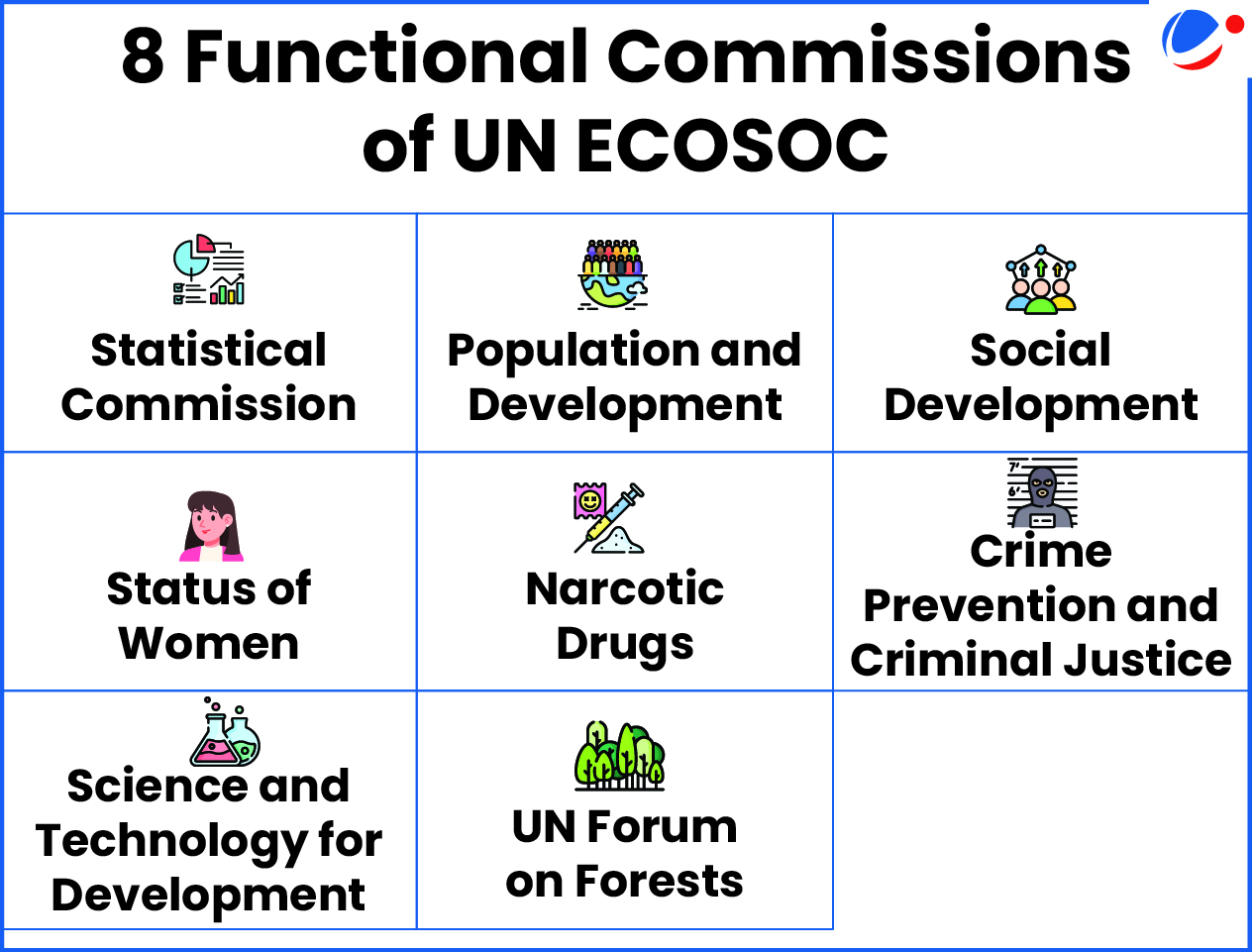
India has been elected to the UN Economic and Social Council (ECOSOC) for the term 2026–2028.
- Membership in ECOSOC is region-based and divided among five geographic groups Africa, Asia-Pacific, Eastern European, Latin American & Caribbean, and Western European and other States.
- India is elected under the Asia-Pacific group, alongside China, Lebanon, and Turkmenistan (4 seats available)
About UN Economic and Social Council (ECOSOC)
- Headquarter: New York (USA)
- Genesis: Established in 1945 as one of the six main organs of the United Nations.
- Members: 54 (elected by the UN General Assembly for a 3-year term; 18 elected each year)
- Key Role:
- Advance the three dimensions of sustainable development: economic, social and environmental
- Coordinates work of UN bodies and specialized agencies
- Issues policy recommendations to the UN system and member states
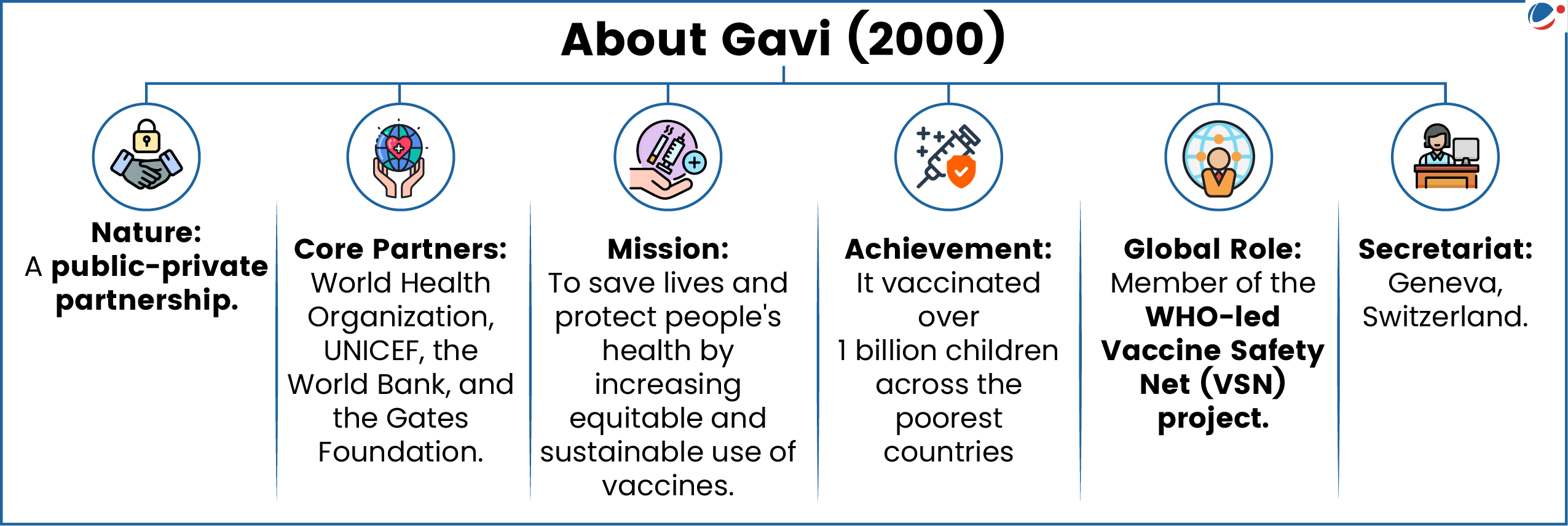
The US has accused Gavi, along with the World Health Organisation (WHO), of silencing dissenting views and legitimate questions about vaccine safety.
- The US has long been one of biggest supporters of Gavi.
Rising trend of US withdrawal from Global Alliance
- In recent years, the United States has exhibited a rising trend of withdrawing from key global alliances and institutions such as the WHO, the Paris Climate Agreement, UN Human Rights Council, UN Relief and Works Agency (UNRWA), etc.
- As a global superpower, the U.S.'s withdrawal carries far greater implications for international governance.
Impact of US Withdrawing from Global Alliances
- Weakening of Multilateralism/Rule-Based Order: E.g. Israel withdraws participation from UN Human Rights Council.
- Undermine Climate Actions: 2024 was recorded as the hottest year and the USA stands as the world's second-largest greenhouse gas emitter behind China.
- Shortage of Funds for Health: US exit could leave institutions with fund crunch. E.g., In 2024, US-funded about 15% of WHO's total funding.
- Other: It creates a leadership vacuum that can be filled up by China (it may reduce India's influence in global organisations' decision-making), etc.
Article Sources
1 sourceChina formally established the IOMed as a global alternative to traditional institutions such as the International Court of Justice (ICJ) and the Permanent Court of Arbitration.
About IOMed
- Purpose: dedicated to resolving international disputes through mediation.
- Members: Over 30 countries joined as founding members including Indonesia, Pakistan, and Belarus.
- Most founding members are from Asia, Africa, and the Caribbean, highlighting its non-Western orientation.
- Scope:
- Disputes between states,
- Disputes Between a state and nationals of another country,
- International commercial disagreements
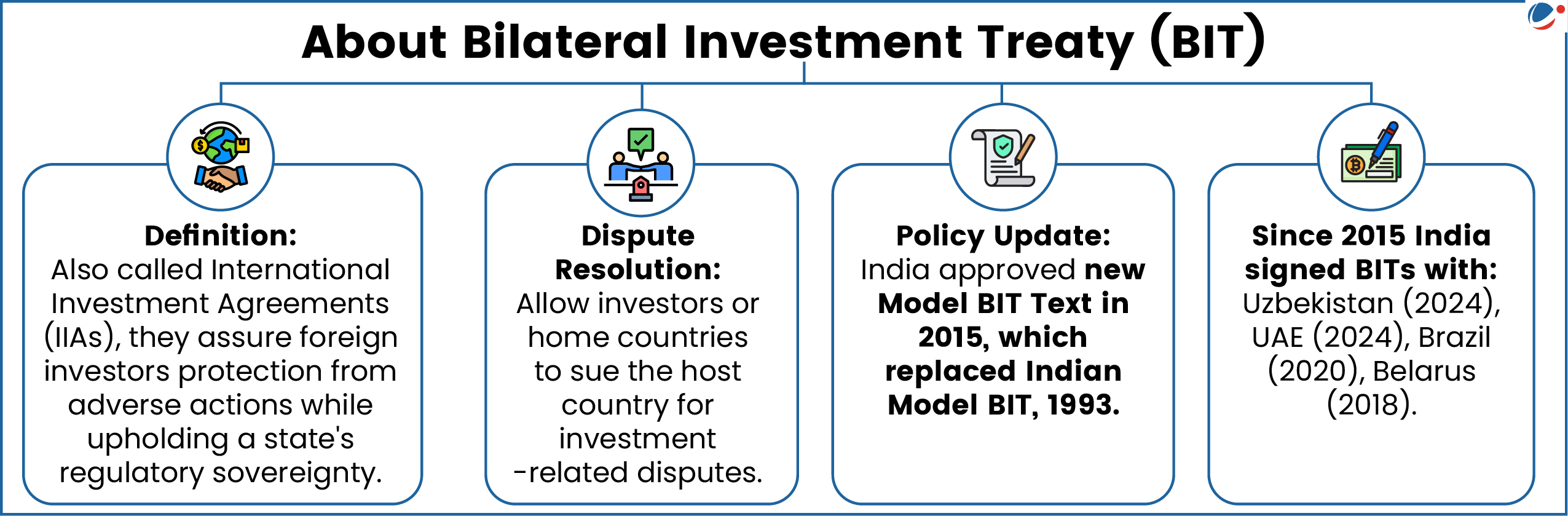
The Bilateral Investment Treaty (BIT) signed in June 2019, entered into force with effect from 5th June 2025.
- This new BIT replaces the earlier agreement enforced in 2000, ensuring continuity in the protection of investments between the two nations.
India-Kyrgyzstan Bilateral Investment Treaty (BIT)
- The BIT balances the investor rights with the sovereign regulatory powers of both countries and reflects a shared commitment to create a resilient and transparent investment climate.
- Key Features of the BIT
- This removal will ensure more consistent treatment.
- General exceptions E.g., Protection of environment, ensuring public health and safety, etc.
- Definition of Assets: Enterprise-based definition with an inclusion and exclusion list & clarifies investment characteristics: capital commitment, profit expectation, risk assumption, etc.
- Exclusions for Policy Space: Excludes local government, government procurement, taxation, compulsory licenses, etc.
- Removes the Most Favored Nation (MFN) clause: Which previously allowed investors to selectively import favorable provisions from other treaties signed by the Host State.
- The BIT contains General and security exceptions: The attempt is to carve out a policy space for the State.
- Revised dispute resolution mechanism: Requires investors to first use local remedies before international arbitration, promoting alternative dispute resolution.
Article Sources
1 source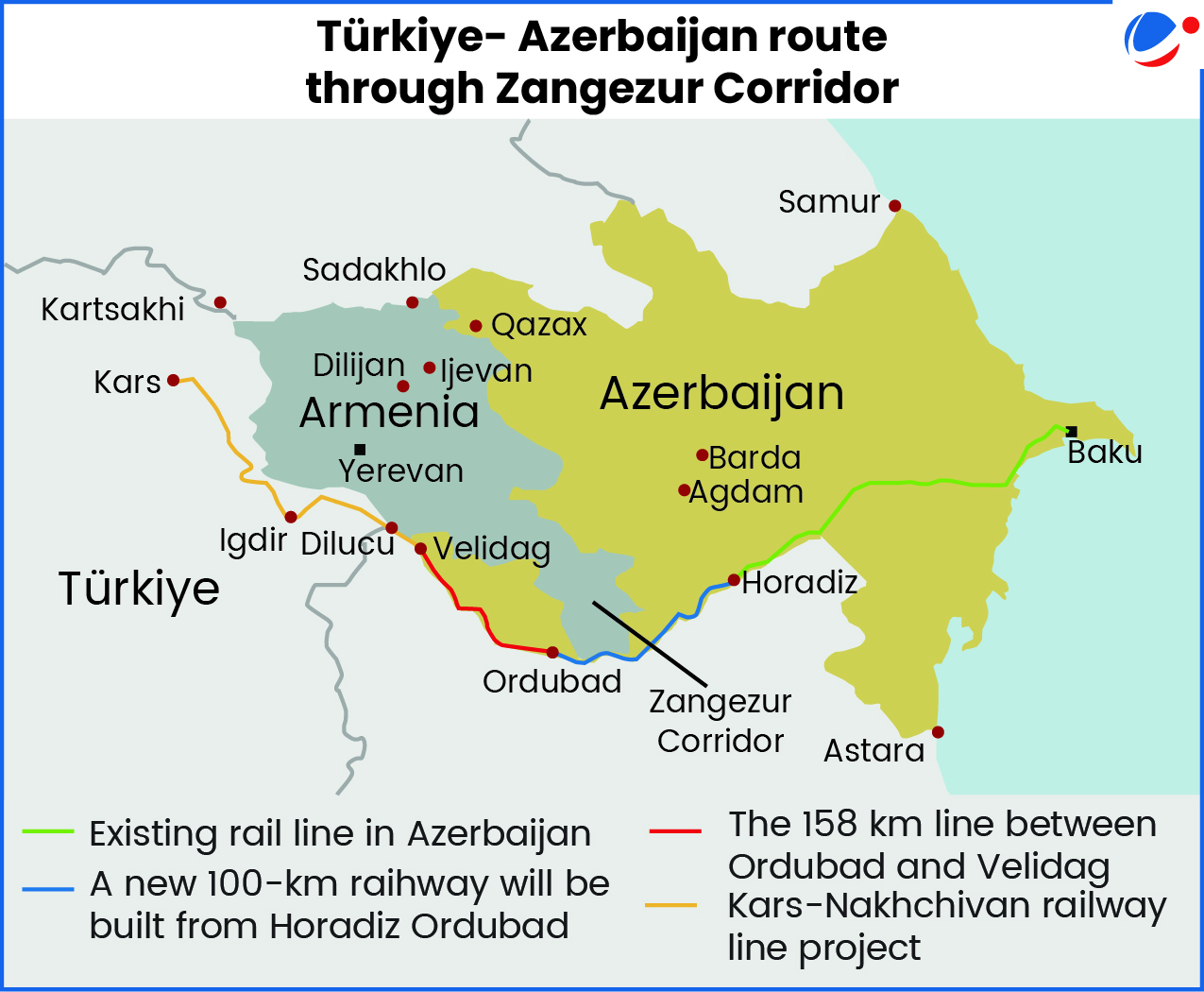
Türkiye urged Armenia and Azerbaijan take steps to open the Zangezur Corridor.
- The two countries have been in conflict over Nagorno-Karabakh (Artsakh) since 1917. The region is internationally part of Azerbaijan, but mainly ethnic Armenians live there.
About Zangezur Corridor
- Location: It is a proposed 43-kilometer transport route through Armenia’s Syunik Province.
- Objective: Connecting Azerbaijan’s Baku Port in Caspian Sea to the Nakhchivan Autonomous Region, a western exclave of Azerbaijan separated by Armenian territory, and further to Turkey.
- India’s concerns: It can undermine India’s investments in Chabahar Port and International North South Corridor (INSTC) by offering a competing pathway, reducing India’s regional leverage.
Ministry of External Affairs rolled out e-Passport and Passport Seva Programme 2.0.
About e‑Passport
- An ePassport is a combined paper and electronic passport with a Radio Frequency Identification (RFID) Chip and an antenna embedded as an inlay of passport that contains the personal particulars and biometric information of the passport holder.
- The underlying technology supporting the security of the ePassport is the Public Key Infrastructure (PKI) solution.
- ePassport safeguards the passport from forgery and potential fraudulent activities like fake passports while confirming the genuineness at border controls.


